
What Alibaba actually said and launched
Start with the keynote. The official transcript, published in Chinese by Qianwen Office's own account, frames the talk around three obstacles companies run into. In our translation: an AI that does not know your business cannot answer a question like last quarter's gross margin for your eastern region, because it does not know which company "our company" is. Productivity gains stay with the individuals who use AI well, because organizations lack a good mechanism for sharing that experience with everyone else. And companies hesitate because of data security.
Chen's answer was that the prerequisite for enterprise agents is data, organized around three ideas: connect, understand, and reuse. He also made a point that is easy to skim past. An agent that does not know something simply does not know it, he said, and a smarter model cannot guess its way to a fact it was never given. Once you tell it, a cost-effective model is often enough.
The product he announced was Enterprise Context. As 36Kr's English report describes it, it is "a product for enterprise context data management." It connects what companies used to call tacit knowledge — documents, meetings and group chats — then "compresses it layer by layer, and extracts it for Agent use on demand." Paired with Qianwen Office's agent hosting, the stated goal is digital employees that understand a company's business.
The transcript is specific about why compression matters. Chen argued that you cannot simply pull all of a company's data into one place, because an agent cannot use it that way: overloading the context window wastes the space the agent needs for the task itself. His description of the approach was layered — organize company knowledge like a file system, with each level compressing the one below it, in the spirit of how skills disclose detail progressively — plus a graph of relationships between people, projects, chats and documents.
Alibaba Cloud's announcement put the same idea at the infrastructure layer. The company's press release describes its agentic cloud as "built around three core scenarios — model, harness and context," with a Context Engine layer "providing real-time data and long-term memory." Within it, "Agent Context is an enterprise-grade context data service that gives AI agents real-time context and long-term memory. By connecting a company's documents, business systems, chat records and multimodal data into a single foundation, it enables agents to remember past tasks, share knowledge across teams, and learn continuously."
Meetings got their own launch. Chen introduced QwenNote A2, a wearable note-taker, and Shu later described hardware as "a very good entry for incremental context collection" — a way to turn conversations into text an agent can use. On privacy, the report notes that "A2 does not retain the original audio, and the transcription content only retains text and meeting minutes."
The report summarized the office meaning of the slogan in four words: "Context is everything."
The claim worth reading twice: context belongs to its owner
The interview is where the idea becomes a principle rather than a product pitch.
Shu Junliang was asked why Alibaba's own apps still did not share a unified context. His answer: "The dimension should not be to interconnect the context between software such as Qwen, Feishu and Qianwen Office, because the context actually follows its subject - whether it is my personal context or the context of this enterprise - this is decoupled from the Agent you finally use."
He then described what Alibaba is trying to provide: "What we provide is the infrastructure of enterprise-level context, which belongs to the enterprise itself." And he explained why a company should want that: "Large enterprises will not only use an AI product, they will also develop some AI products by themselves. Can these AI products not get benefits from my context?"
His closing comparison is the most candid line in the piece. He called enterprise context "the data infrastructure in the new era, which is the same as the database, except that it has not been standardized like the database yet."
Three things follow from those sentences. Context is an asset of the organization, not a feature of whichever agent is in use today. Companies will run several agents, some bought and some built, and all of them should benefit from the same context. And the industry does not yet have a standard way to do this.
Shu was equally direct about the personal side. Personal data, he said, is "currently scattered in various APPs," and whether anyone can gather it "depends on whether these companies open permissions to individuals. At present, we have not seen this opening trend."
What this does and doesn't change
It does make "enterprise context" a named category. When Alibaba Cloud organizes its agent strategy around model, harness and context, and gives context its own product line, the idea of a context layer for AI agents stops being niche. Expect more vendors to describe their products this way.
It does validate an approach many teams arrived at the hard way. Connect the sources, compress them into something an agent can use, and make individual know-how reusable across the group. Chen's three keys — connect, understand, reuse — are a clean summary of what context engineering looks like at company scale.
It does not create a standard. Shu said so himself. Enterprise Context is a product inside Qianwen Office, which is deeply integrated with DingTalk; Chen stressed openness, telling the audience that Qianwen Office serves many customers who use Feishu and WeCom and that "Whether it is Qianwen Office or Enterprise Context, we must adhere to the principle: openness, and more openness." That is a commitment from one vendor, not an interoperable format.
It does not settle personal context. By Shu's own account, the data that describes an individual is scattered across apps that do not open it up.
And it does not tell a team using ChatGPT, Claude, Cursor and an internal agent where their context should live today. That part is left to you.
What people will take from this — and what they shouldn't
"A better model will fix it." The keynote argues the opposite. A model with more intelligence cannot infer your pricing rules or your regional definitions. The same logic is why a larger context window isn't memory: capacity is not knowledge.
"Put everything in one big store and let the agent search." Chen spent a large part of the talk explaining why that fails. Compression and structure are the work.
"Context is a feature of the agent I pick." Shu's point is that it should be decoupled from the agent. If your context lives inside one tool, switching tools means starting over, which is the question behind whether AI memory is a feature or a lock-in.
"This is only for large enterprises." The three obstacles in the keynote — agents that don't know the business, know-how that stays with individuals, and nervousness about data — describe a ten-person team as accurately as a large one. The scale changes; the problem does not.
The Fix: Treat your context as something your team owns
You do not need an enterprise platform to act on Alibaba's argument. You need to decide what your agents should know, keep it compact, and keep it somewhere that outlives any one tool.
Step 1: Write down the context an agent cannot guess
Take the keynote's example literally. What does "our eastern region" mean in your company? How is gross margin calculated here? Which customers are strategic, which products are being retired, which decisions are final? These are facts no model can infer, and they are exactly what gets re-explained in every new chat.
List them. Then add the second category Chen described: the know-how of the people who use AI well. The prompt that works, the review checklist, the way your best salesperson frames a proposal. Today that knowledge sits in one person's chat history.
This is also the tacit knowledge that walks out of the door when someone leaves, which is why keeping AI context when someone leaves starts with the same list.
Step 2: Compress it into layers an agent can navigate
Resist the urge to upload everything. Follow the structure the keynote described, at whatever scale fits your team.
At the top, a short index: what the team does, the main projects, where to look for detail. Below it, one concise entry per project, customer or process, with the current state and the decisions that shaped it. Below that, the source documents themselves, for when detail is genuinely needed.
Connect the pieces. An entry about a project should name the people involved and the documents that matter, so an agent can move from one to the other instead of guessing. Meeting outcomes belong here too, written as decisions rather than transcripts, since a transcript records what was said and an entry records what was agreed. And date things. Shu noted that inside companies there are "many contradictions between the nature of data and the chronological order of data" — the newest decision should visibly replace the old one.
Step 3: Keep it decoupled from any single agent, and test that it is
This is Shu's principle turned into a check. Store your context where more than one agent can reach it, then ask the same question in two different tools. If only one of them knows the answer, your context is living inside that tool.
Put boundaries in at the same time. The keynote spent real attention on security, including requiring confirmation before an agent touches sensitive data. Decide which context is shared with every agent and which is restricted, before you connect anything.
Finally, keep it current. Chen pointed out that business data changes constantly and has to be re-understood as it changes. Make updating the context part of closing a decision, not a separate chore. Setting up shared AI memory for a team covers the day-to-day version of this habit.
Setting this up in MemoryLake
Alibaba's framing describes a layer that belongs to the organization and serves whichever agents it uses. For teams that work across ChatGPT, Claude, coding agents and their own tools, MemoryLake is one place to keep that layer: long-term memory for AI agents that sits outside any single product.
You write the entries yourself, in your own words. Nothing is read out of, written to, or deleted from Qianwen Office, DingTalk, Alibaba Cloud, or any vendor's store.
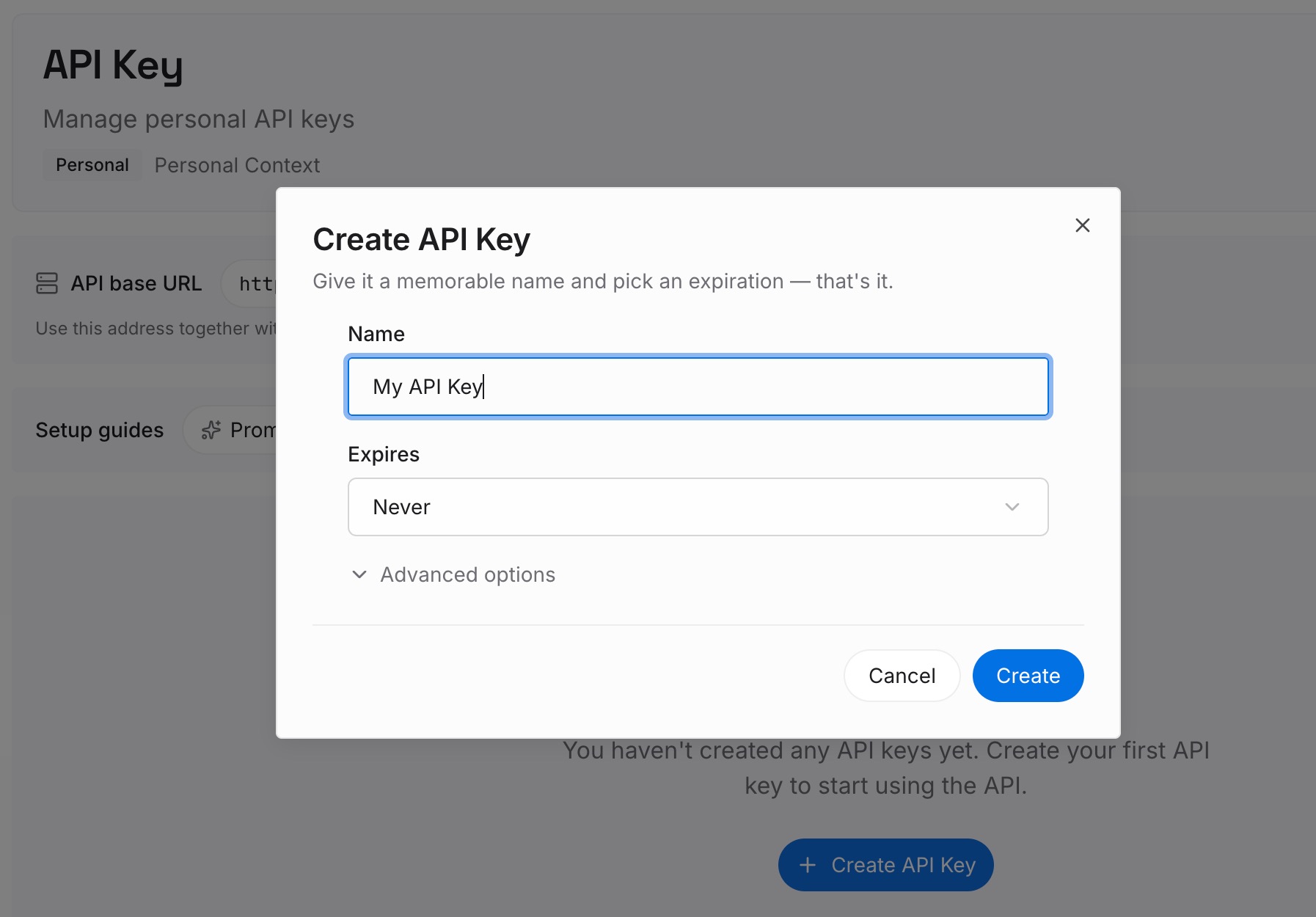
Step 1: Create an API key
Sign in and generate a key from the dashboard. The key belongs to your workspace in the memory layer, so it is independent of which agent your team happens to be using this quarter.
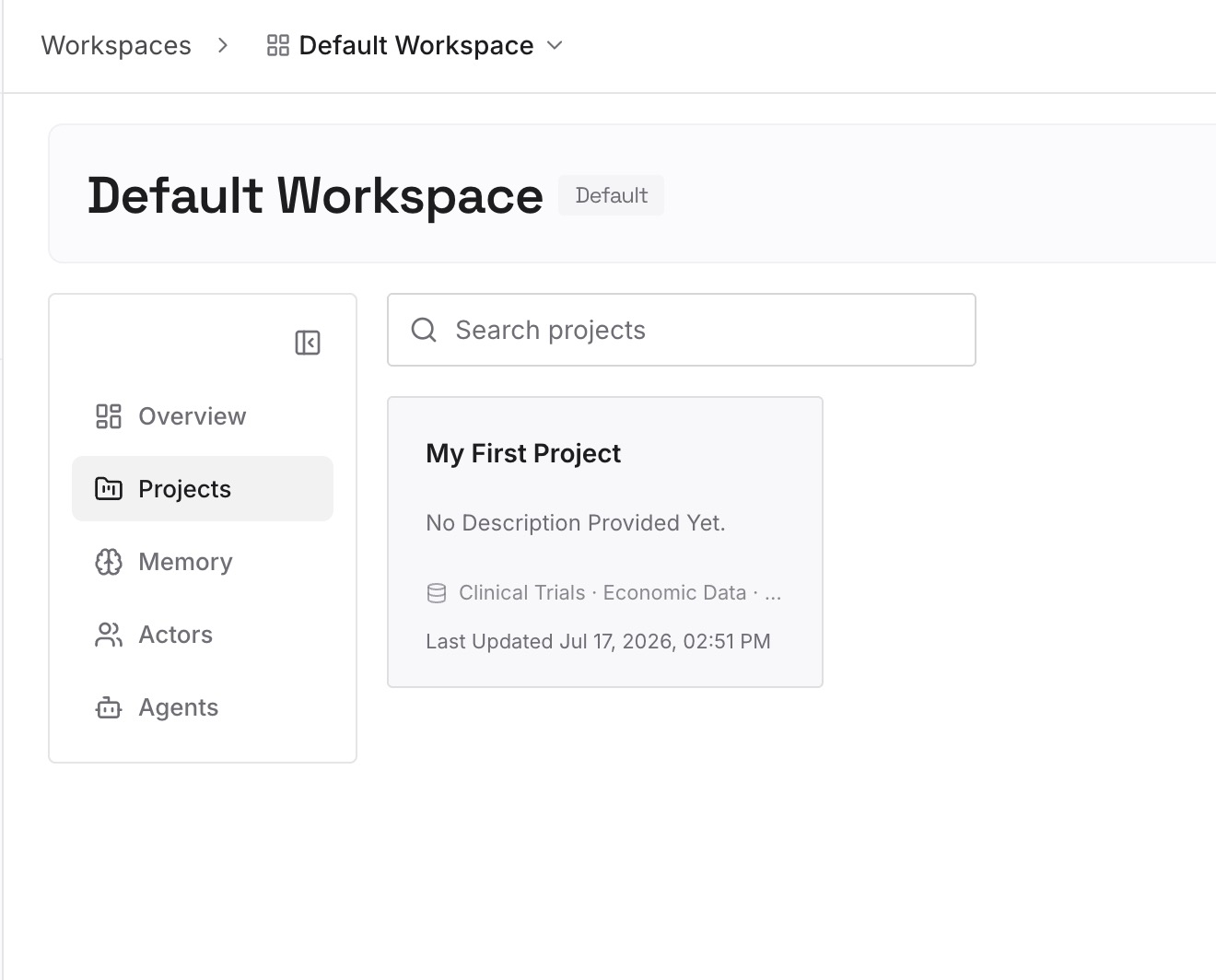
Step 2: Upload your first memories
Start with the Step 1 list from the fix above: the definitions no model can guess, the decisions that are final, and the know-how worth sharing. Keep each entry compact and dated, following the layered structure from Step 2.
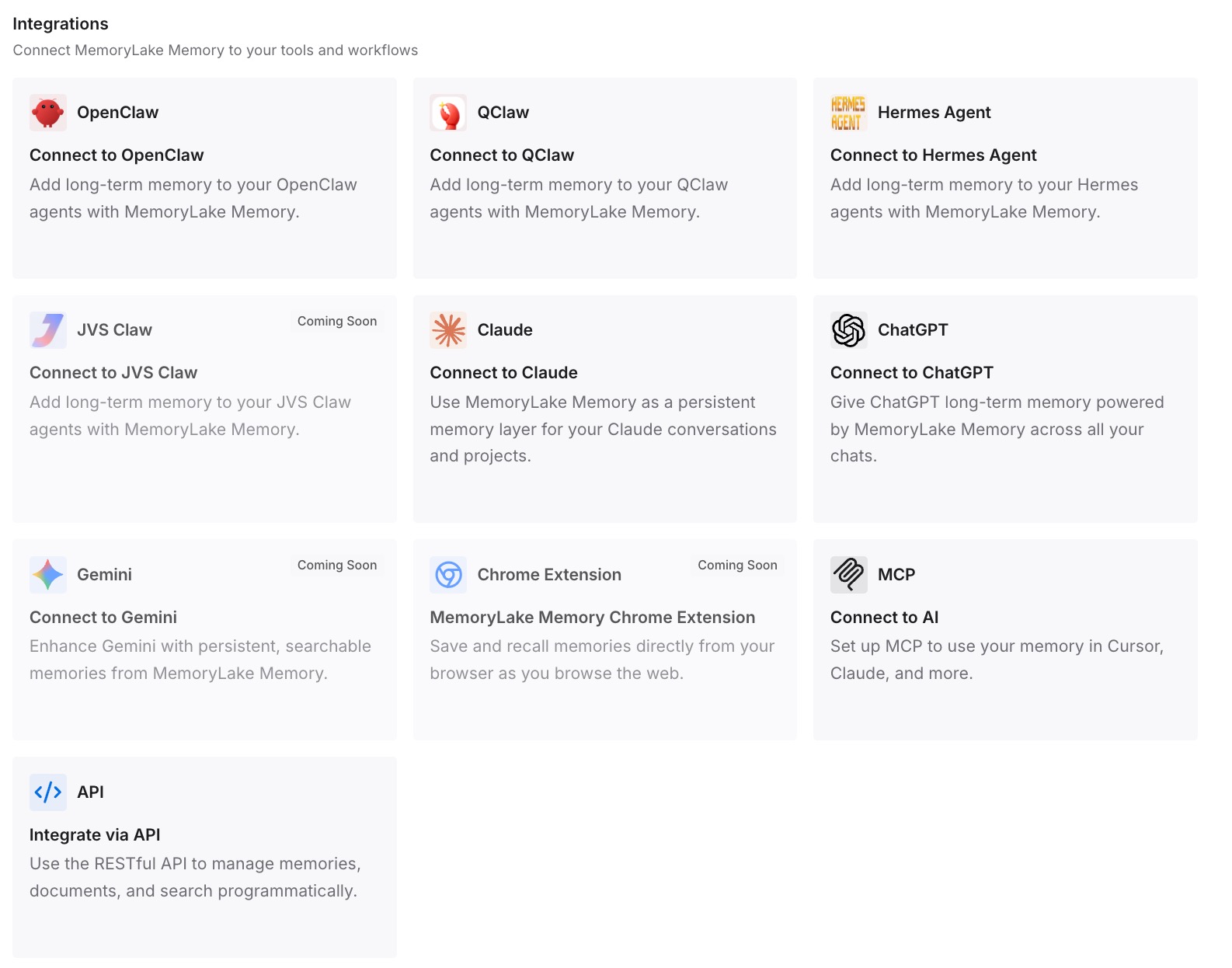
Step 3: Connect your AI & agents
Connect the assistants and agents your team uses. The same entries are then available in each, which is the decoupling test from Step 3 passing by design.
What this changes in practice
The first difference is that onboarding an agent looks like onboarding a person. Instead of re-explaining the business in every chat, each new tool starts with the same brief. Most of what people call AI forgetfulness at work is this gap, as why company AI knowledge disappears every Monday describes.
The second is that individual know-how becomes team knowledge. The keynote's point about unshared experience is solved less by a new feature than by a habit: when someone finds an approach that works, it goes into the shared context, not just their own history.
The third is that switching or adding agents stops being expensive. If context is decoupled, a new coding agent, a new chat assistant or an internal tool built next year starts informed. That is the portability cross-agent memory is about.
The fourth is that security decisions become explicit. Deciding what each agent may see is easier when the context is one layer you control than when it is scattered across tools, each with its own defaults.
Best practices for enterprise context
Start with what can't be inferred. Definitions, decisions and exceptions matter more than bulk documents.
Compress before you connect. A short, layered set of entries beats a large pile an agent has to wade through.
Date every decision. The newest version should visibly supersede the old one.
Keep context independent of any one agent. Test it by asking two tools the same question.
Set access boundaries early. Not every agent needs every fact.
Evaluate platforms on ownership, not only features. When comparing enterprise AI memory platforms, ask whether the context stays yours if you change vendors.
Conclusion
"Context is All You Need" is a slogan, but the argument behind it is sound. Chen Yusen's keynote made the case that agents fail at work mainly because they lack the company's context, and that the job is to connect it, compress it and make it reusable. Alibaba launched Enterprise Context and Agent Context to do that at scale.
The sentence that will outlast the launches is Shu Junliang's: context "is decoupled from the Agent you finally use," and a company's context "must belong to this enterprise." He was candid that the infrastructure for this "has not been standardized like the database yet."
Until it is, the practical answer is the same for any team: write down what agents can't guess, keep it compact and current, and keep it somewhere every agent you use can reach.