
What Is an AI Memory API
An AI Memory API is a specialized middleware or backend service designed to give large language models the ability to store, manage, and recall contextual information over time. Instead of building a complex RAG pipeline from scratch, developers can use these APIs to make their applications stateful.
- Cross-Session Statefulness: It allows the AI to remember user details, preferences, and past conversations across multiple isolated sessions, creating a continuous user experience.
- Dynamic Entity Extraction: These APIs automatically parse conversations to identify and store key entities (like names, dates, or preferences) without requiring developers to write complex regex or extraction logic.
- Automated Context Injection: Rather than forcing the developer to retrieve and append context to a prompt manually, memory APIs often serve the most relevant historical data to the LLM right when it is needed.
- Vector and Graph Storage: They typically combine vector embeddings (for semantic search) with graph structures (for relationship mapping) to understand not just what a user said, but how it relates to previous statements.
How We Evaluated AI Memory APIs in 2026
To determine the best options available for developers, we rigorously tested dozens of solutions on the market. Our evaluation methodology focused on the metrics that matter most to engineers and product builders:
- Data Privacy and Security: We prioritized platforms that offer high-level security, particularly those utilizing end-to-end encryption where the provider cannot access the stored user data.
- Developer Experience (DX) and Integration: We looked at how easily the API integrates with existing workflows, specifically favoring tools that support modern standards like the Model Context Protocol (MCP).
- Versatility of Data Ingestion: The best memory systems should not just accept raw text. We evaluated them on their ability to ingest various file formats (PDFs, Word docs, spreadsheets) and multimodal inputs.
- Version Control and Auditability: Memory can get messy. We gave high scores to APIs that offer transparent, trackable histories of how and when memory was altered.
- Cost Efficiency and Free Tiers: We heavily factored in the generosity of the free tier and the scalability of paid plans for bootstrapped startups and solo developers.
Quick Comparison Table
| Product | Best For | Architecture | Pricing |
|---|---|---|---|
| MemoryLake | Cross-model, user-owned encrypted context | MCP Server / E2E Encrypted | $19/month |
| Redis | Ultra-low latency in-memory vector search | In-Memory Database | Custom |
| Mem0 | Personalized AI agent memory layer | Hybrid Vector / Entity | $19/month |
| Zep | Long-term memory for AI assistants | Temporal Knowledge Graph | $125/month |
| Supermemory | Open-source "second brain" applications | RAG / Vector-based | $19/month |
| Hindsight | User analytics and context tracking | Context Tracking API | Open-source |
| Letta Memory | OS-like tiered memory for agents | Multi-Tiered Memory | Open-source |
| LangMem | Developers deep in the LangChain ecosystem | LangGraph Integration | Open-source |
| Pinecone | Massive-scale enterprise vector search | Serverless Vector DB | $20/month |
| Weaviate | Self-hosted or managed vector search | Vector Database | $45/month |
1. MemoryLake
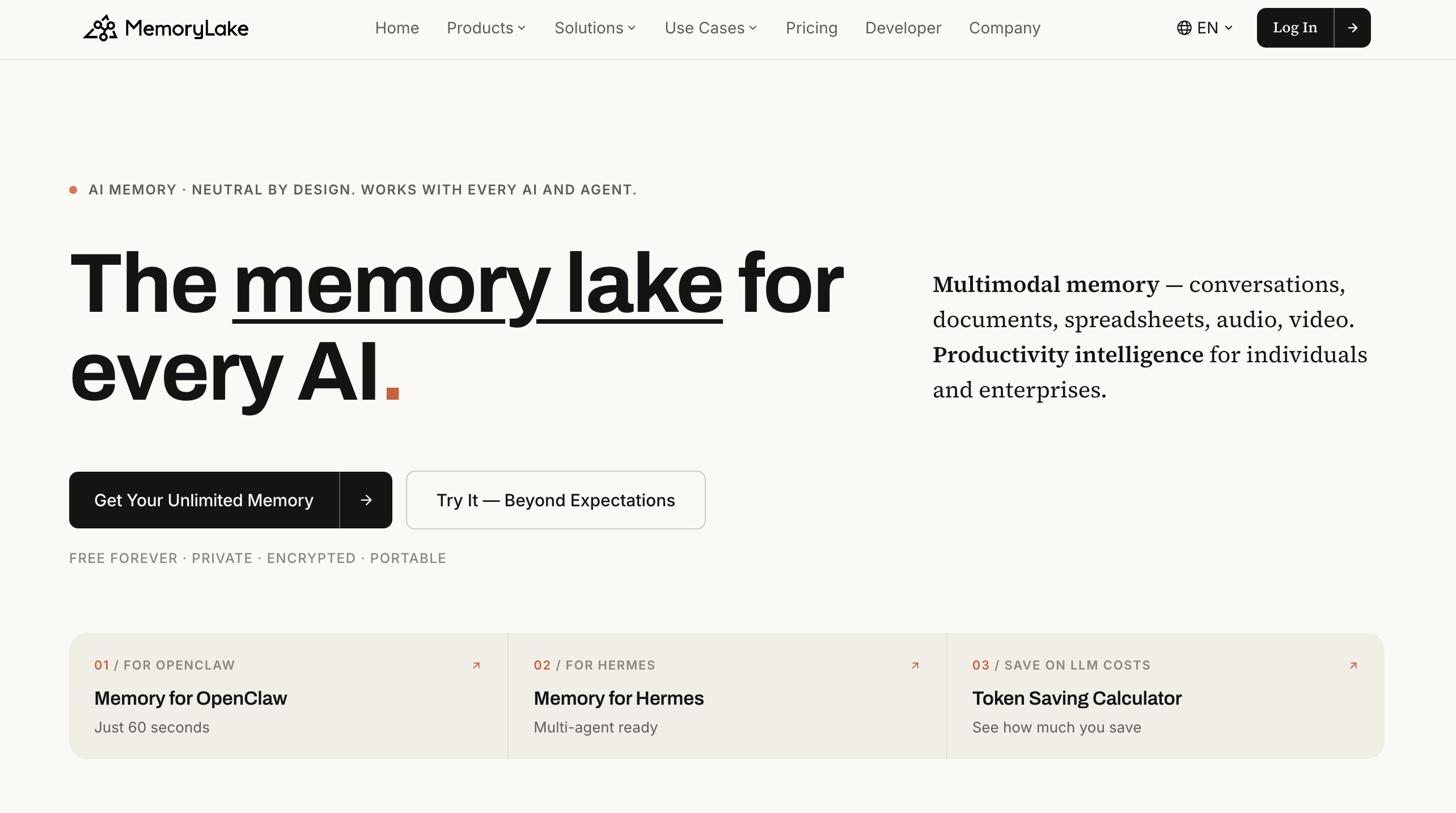
As a pioneering platform in the field, MemoryLake is redefining modern cognitive intelligence as one of the best AI memory APIs for developers creating next-generation autonomous agents. Unlike traditional vector databases that offer only rigid semantic matching, MemoryLake provides an advanced, production-ready infrastructure that gives LLMs human-like long-term recall. By seamlessly combining temporal tracking with multimodal vector search, its developer-friendly API enables seamless context transferability across different foundational models. Developers can leverage its specialized multi-layered memory structures to drastically cut Token overhead by 90%, eradicate hallucination, and unlock stateful, hyper-personalized agentic workflows with strict security compliance.
Key Features
- Universal Document Support: Seamlessly upload and parse a wide variety of formats, including PDFs, Word, Excel, PowerPoint, Markdown, and images.
- Project Organization: Group different contexts and memories logically into dedicated "Projects" to keep different workflows completely isolated.
- MCP Server Integration: Exposes your stored memory directly to any AI application via a Model Context Protocol (MCP) server, allowing absolute cross-model compatibility.
- End-to-End Encryption: True data sovereignty. The system is entirely user-owned, and the provider mathematically cannot read your files or memories.
- Git-Style Versioning: Every change, addition, or deletion to your memory is tracked, providing a complete, auditable history of your context evolution.
Pros
- Complete data privacy ensures sensitive business or personal data is mathematically protected from the vendor.
- Decouples memory from specific LLMs; your context follows you whether you use OpenAI, Anthropic, or local open-source models.
- Native support for a massive array of file types right out of the box, eliminating the need for separate OCR or document parsing APIs.
- Highly auditable; Git-style versioning means you can always roll back to a previous state of your memory.
Cons
- Requires a slight paradigm shift for developers used to storing context directly inside a specific vendor's ecosystem.
- Managing encryption keys means the user bears the responsibility for access recovery.
Pricing
MemoryLake offers a highly generous Free Tier allowing users to create multiple projects and upload standard document sets without a credit card. Pro plans start at $19/month.
2. Redis
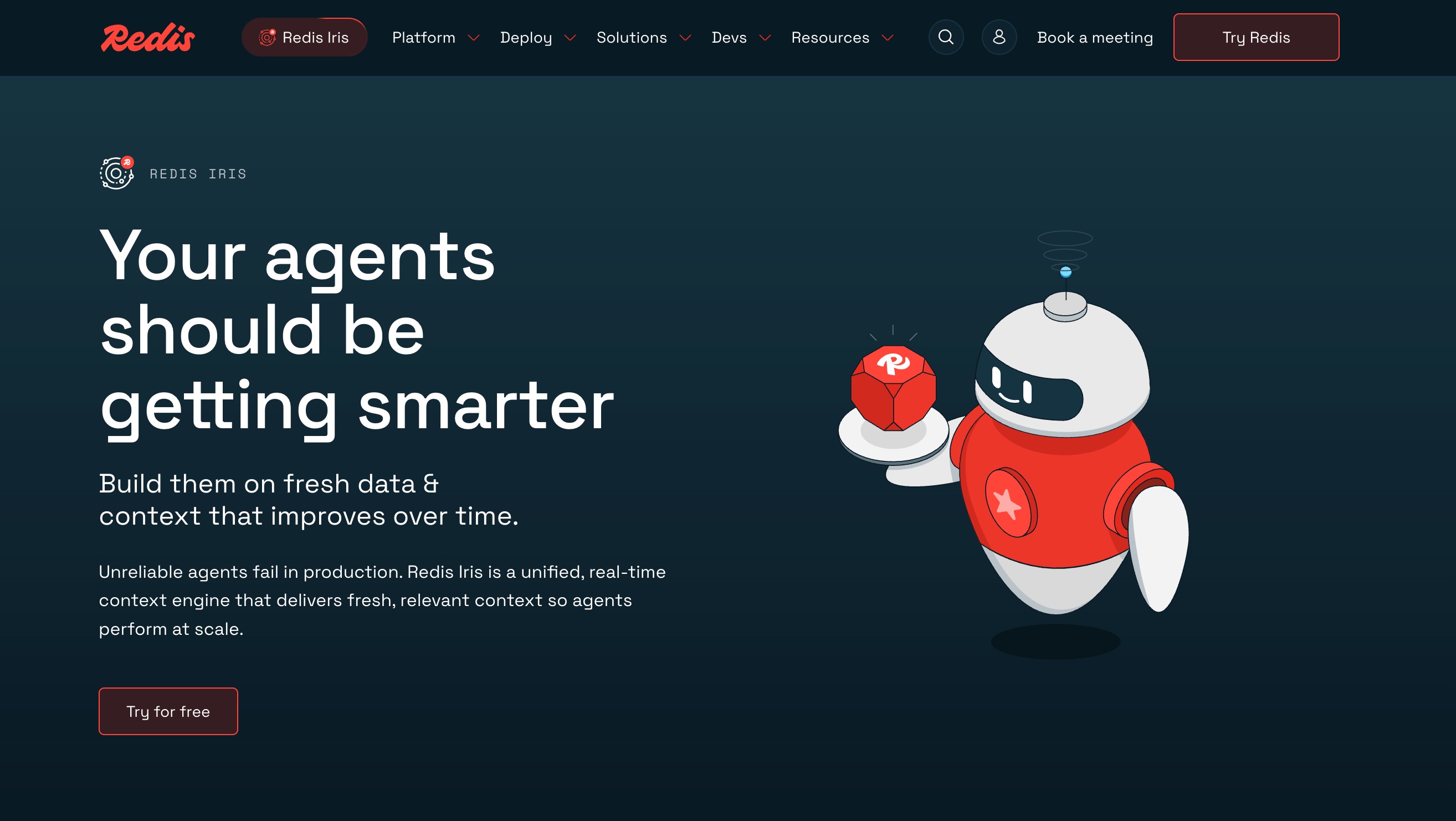
Redis has evolved far beyond a simple caching layer to become a formidable vector database and AI memory store. By leveraging Redis stack and RedisVL (Vector Library), developers can store session histories and embeddings entirely in-memory, resulting in lightning-fast retrieval times that outpace disk-based databases.
Key Features
- In-Memory Architecture: Stores vectors and conversation histories directly in RAM for ultra-low latency semantic search.
- RedisVL Integration: Dedicated Python client designed specifically for building AI applications and handling vector operations.
- Hybrid Search: Combines traditional keyword filtering with semantic vector search in a single query.
Pros
- Unmatched retrieval speed, crucial for real-time voice agents or ultra-responsive chat applications.
- Highly reliable and extensively tested in enterprise environments for over a decade.
- Flexible enough to be used as both an AI memory store and a standard application database.
Cons
- In-memory storage is significantly more expensive than disk-based storage at scale.
- Requires manual configuration to handle complex entity extraction and long-term memory updates.
Pricing
Paid tiers follow a consumption-based model depending on throughput and RAM requirements.
3. Mem0
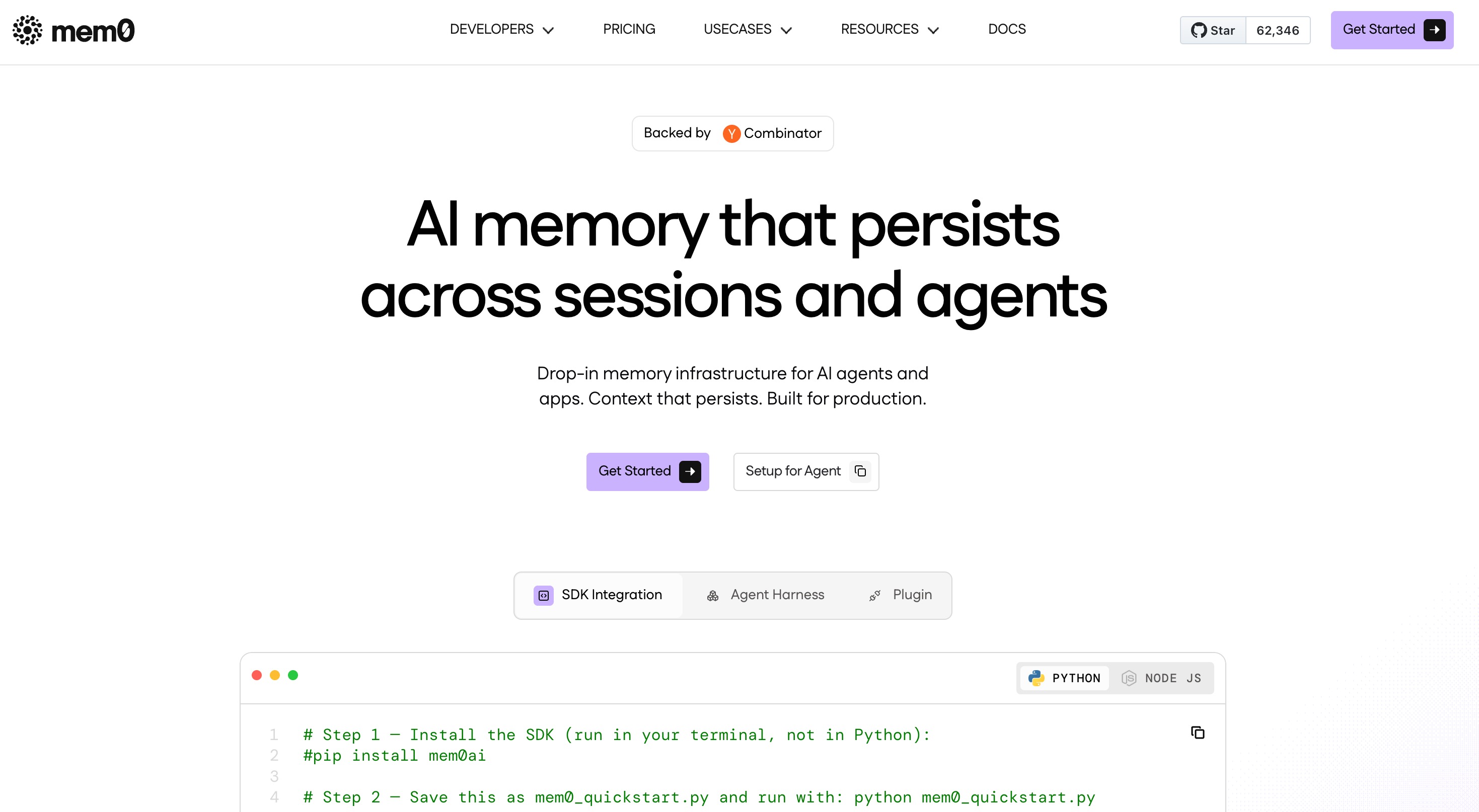
Mem0 (formerly Embedchain) positions itself as a personalized memory layer for AI agents and assistants. It focuses on abstracting the complexities of vector databases by providing a simple API that automatically manages user entities, relationships, and context lifecycle across different sessions.
Key Features
- Entity Extraction: Automatically identifies and stores important user details (e.g., names, allergies, preferences) from unstructured chat logs.
- Multi-Level Memory: Separates memory into user, session, and agent levels for granular context management.
- Adaptive Learning: Automatically updates or deletes outdated facts as the user provides new information.
Pros
- Incredibly simple SDK that gets developers up and running with stateful memory in just a few lines of code.
- Excellent automated handling of contradictory information (e.g., updating a user's location if they move).
- Great dashboard for manually reviewing and editing stored user memories.
Cons
- Abstracts away a lot of underlying architecture, which might frustrate advanced engineers wanting granular control over embeddings.
- Relies on underlying LLM calls to process and extract memory, which can add hidden latency and costs.
Pricing
Mem0 provides a Limited Free Tier for testing and hobbyist projects. The Developer tier starts at $19/month with volume-based pricing for API calls.
4. Zep
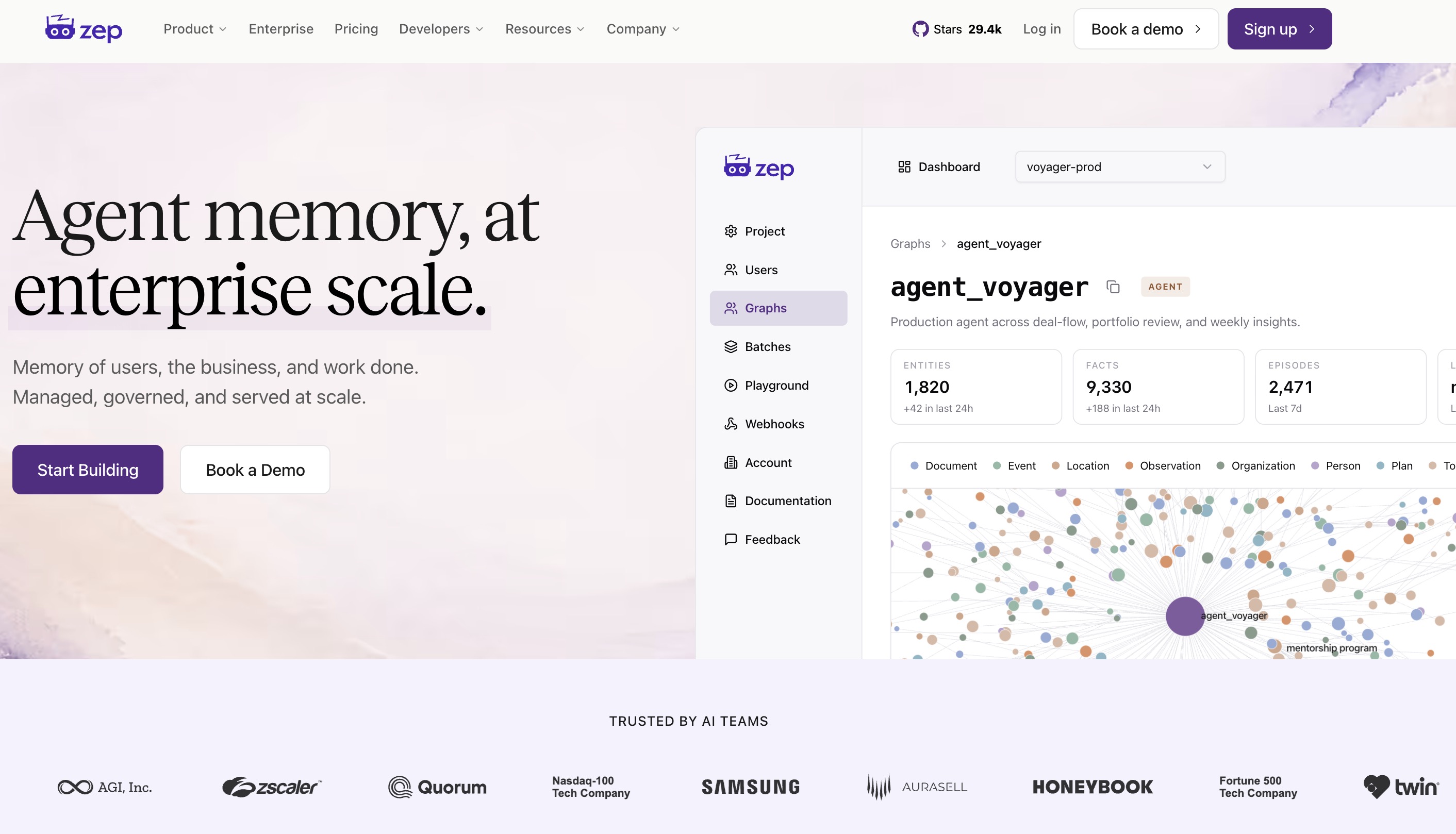
Zep is an open-source, long-term memory service explicitly designed for AI assistant applications. Rather than just relying on standard vector search, Zep utilizes temporal knowledge graphs to understand the relationship between different facts over time, giving agents a more human-like recall ability.
Key Features
- Temporal Knowledge Graphs: Maps relationships between entities and facts, attaching timestamps to understand how information evolves.
- Dialog Summarization: Automatically summarizes older conversation windows to save token context limits.
- Edge Deployment: Can be deployed close to your application infrastructure to reduce data latency.
Pros
- Graph-based approach provides far more accurate context retrieval than purely vector-based systems.
- Automated summarization dramatically reduces the token costs of passing historical context to an LLM.
- Strong open-source community and comprehensive self-hosting documentation.
Cons
- The setup process for the knowledge graph architecture is more complex than simple plug-and-play APIs.
- Self-hosting requires maintaining several separate microservices.
Pricing
Zep is free and Open Source for self-hosting. Zep Cloud starts at $125/month.
5. Supermemory
Supermemory is an open-source platform originally conceptualized as an AI "second brain." It allows developers to build applications where users can save bookmarks, notes, and web snippets, which the AI can then perfectly recall and chat with. It’s highly favored for productivity and knowledge-management AI tools.
Key Features
- Web Scraping Integration: Native capabilities to ingest data directly from URLs and web clippings.
- Canvas Interface: Includes a visual canvas for users to interact with their stored memories and knowledge.
- Local First Support: Strong support for running entirely on local infrastructure for privacy-conscious developers.
Pros
- Completely open-source, allowing for deep customization and forking.
- Excellent for building RAG applications that rely heavily on web-based research and article saving.
- Provides ready-to-use UI components for building knowledge-base applications.
Cons
- Geared more toward "second brain" use cases rather than automated background memory for autonomous agents.
- Requires significant engineering effort to deploy and scale in production environments.
Pricing
Pro plans start at $19/month.
6. Hindsight
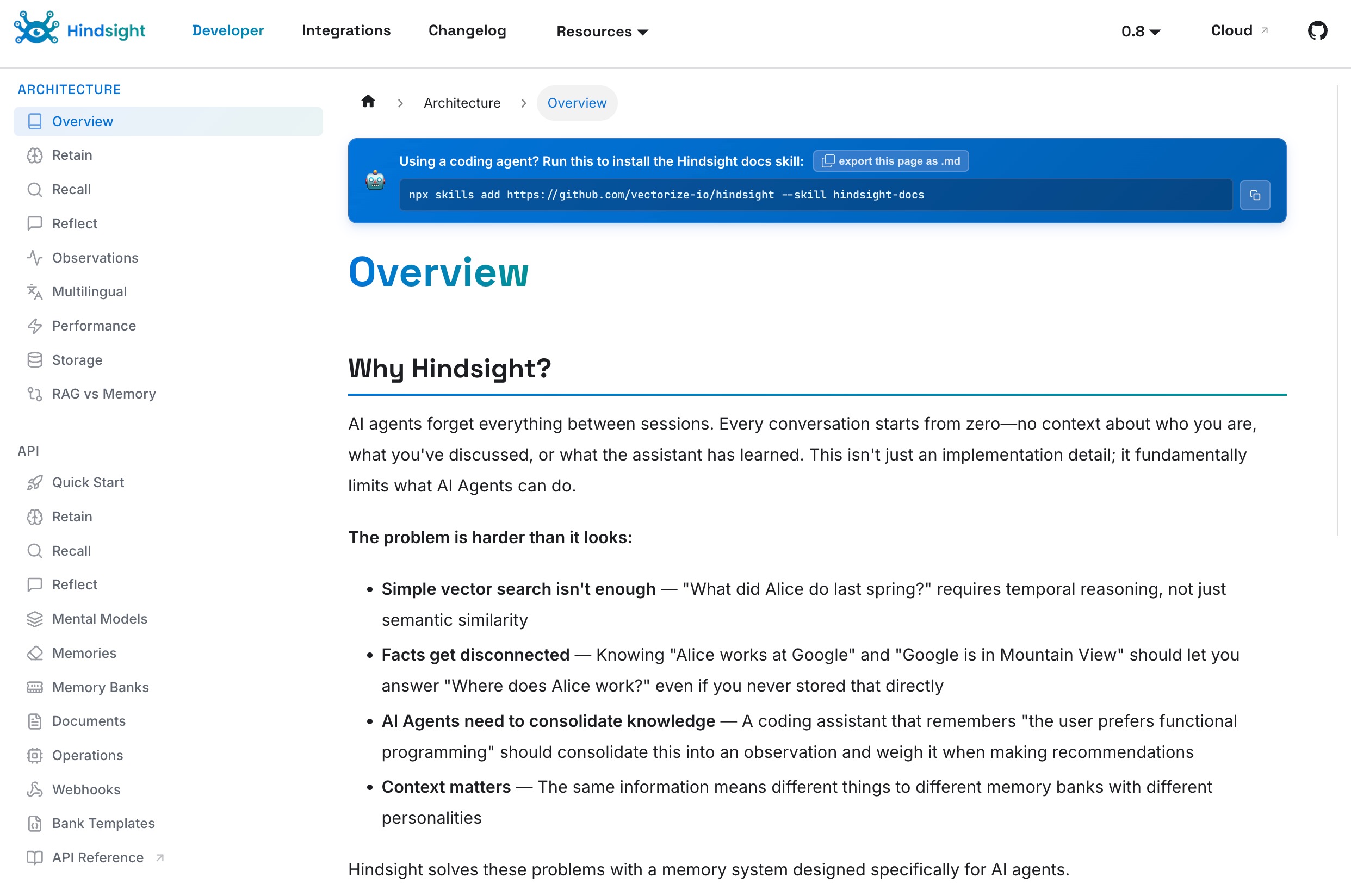
Hindsight takes a slightly different approach by blending AI memory with user analytics. It tracks exactly what context was served to an LLM and how the user interacted with the resulting output, allowing developers to continuously optimize their memory retrieval algorithms based on actual usage data.
Key Features
- Context Tracing: Logs every piece of memory injected into a prompt and traces its impact on the AI's response.
- User Feedback Loops: Integrates thumbs-up/down metrics directly into the memory weighting system.
- A/B Testing: Allows developers to test different retrieval strategies and embedding models simultaneously.
Pros
- Brings much-needed observability and product analytics to AI memory management.
- Helps developers mathematically prove which memory retrieval strategies result in better user satisfaction.
- Highly visual dashboard for tracking API usage and context relevance.
Cons
- More of a monitoring and analytics wrapper; still requires integrating alongside a robust vector or database layer.
- Can be overkill for simple applications that do not require enterprise-level analytics.
Pricing
Open Source.
7. Letta Memory
Originating from the groundbreaking MemGPT research paper, Letta Memory provides an operating-system-like architecture for AI agents. It introduces the concept of tiered memory (main context vs. external storage) and allows the LLM itself to decide when to page information in and out of its active context window.
Key Features
- Tiered Memory Architecture: Divides memory into active context (RAM) and archival storage (Disk).
- LLM-Driven Paging: The AI is trained to autonomously fetch historical data or push current data to storage via function calling.
- Infinite Context Illusion: Creates the perception of an infinite context window without exceeding token limits.
Pros
- The most scientifically advanced approach to managing context limits for autonomous agents.
- Allows for truly endless, multi-year conversations without performance degradation.
- Backed by strong academic research and an active open-source contributor base.
Cons
- Requires models highly capable of complex function calling (like GPT-4 or Claude 3.5 Sonnet) to operate effectively.
- The conceptual overhead of managing memory OS tiers is steep for beginner developers.
Pricing
The core Letta framework is Open Source. Managed Letta Cloud services offer an exploratory free tier with custom enterprise pricing.
8. LangMem
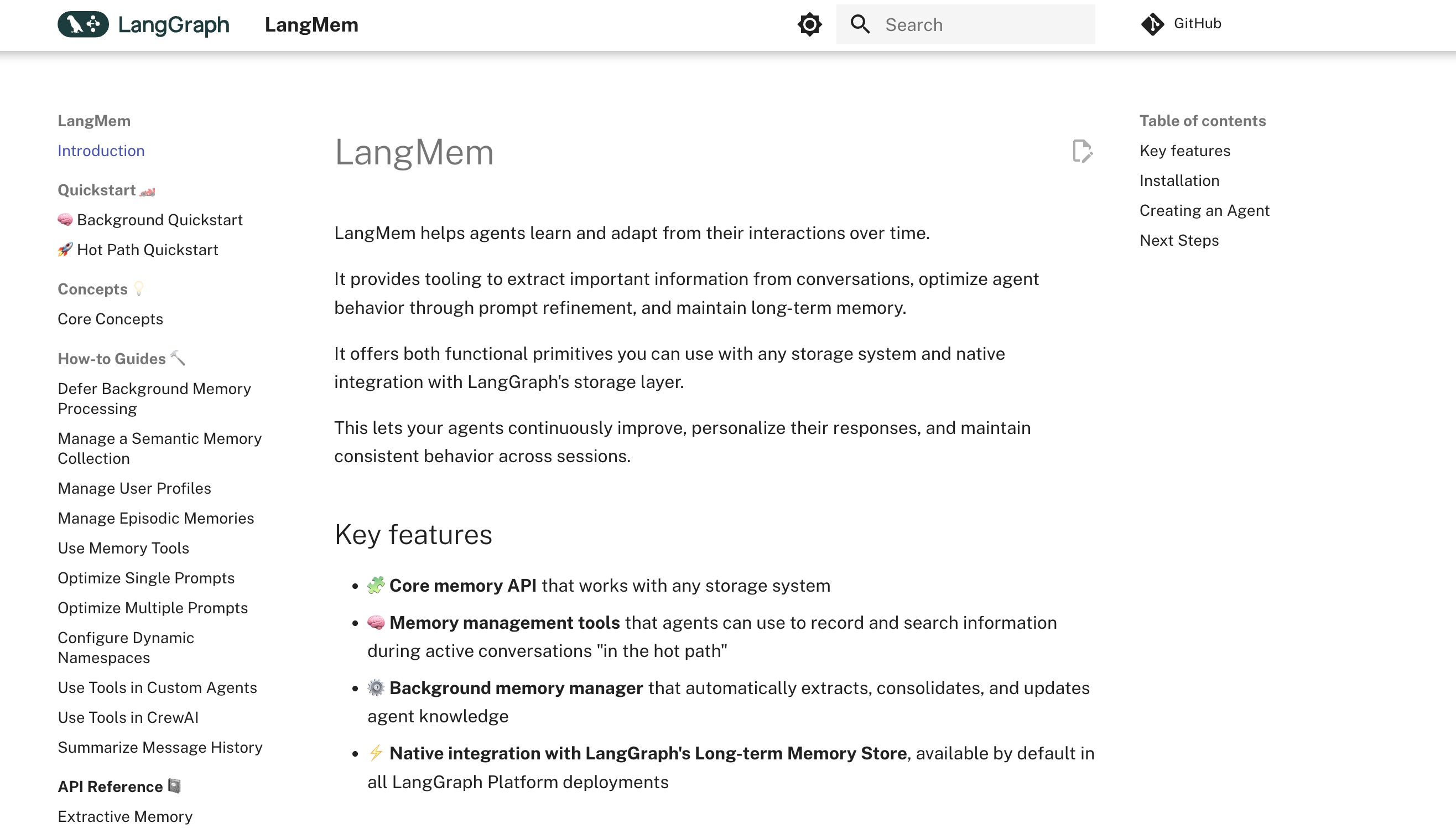
Built by the creators of LangChain, LangMem is specifically designed to add long-term memory to agents built within the LangGraph ecosystem. It focuses on extracting insights from agent trajectories and updating the agent's core instructions and memory banks over time.
Key Features
- LangGraph Native: Seamlessly integrates with LangGraph, acting as a direct extension of its state management.
- Background Processing: Updates memories asynchronously in the background so it doesn't slow down the main user chat response.
- Procedural Memory: Updates not just factual knowledge, but the agent's operational instructions based on past failures or successes.
Pros
- The absolute best choice for teams already deeply entrenched in the LangChain and LangGraph ecosystems.
- Asynchronous updates ensure the user experience remains fast and fluid.
- Procedural memory allows agents to actually "learn" how to do their tasks better over time.
Cons
- Highly coupled with LangChain; difficult to extract and use with raw API calls or competing frameworks.
- Heavily reliant on LangSmith for observability, which adds another tool to your stack.
Pricing
Open Source.
9. Pinecone
While traditionally known as a pure vector database, Pinecone's serverless architecture and advanced metadata filtering make it a powerhouse for building custom AI memory solutions. It is built for massive scale, handling billions of embeddings for enterprise-grade applications.
Key Features
- Serverless Architecture: You don't have to provision or manage compute resources; the database scales instantly from zero.
- Advanced Metadata Filtering: Allows developers to tag vectors with user IDs, session IDs, and timestamps for highly specific context retrieval.
- Real-Time Index Updates: Embeddings are immediately searchable the second they are uploaded to the index.
Pros
- Incredibly robust and capable of scaling to massive enterprise workloads without breaking a sweat.
- Serverless billing means you only pay for exactly what you use, saving money during downtime.
- Massive ecosystem support with tutorials for almost every AI framework in existence.
Cons
- It is a pure infrastructure layer; developers must manually build the entity extraction and context-injection logic.
- Costs can escalate quickly if vector dimensions and read/write operations aren't optimized.
Pricing
Paid plans start at $20/month.
10. Weaviate
Weaviate is an open-source, AI-native vector database that natively integrates machine learning models to streamline the memory creation process. Unlike standard databases, Weaviate can handle the embedding generation directly within its own pipeline, simplifying the developer's architecture.
Key Features
- Built-in Vectorization: Can automatically vectorize text, images, and audio natively upon ingestion using attached ML models.
- Hybrid Search Engine: Combines BM25 keyword search with dense vector search for optimal retrieval accuracy.
- Multi-Tenant Architecture: Built from the ground up to securely separate different users' memories within the same database instance.
Pros
- Reduces architectural complexity by handling embedding generation natively.
- Open-source nature provides deployment flexibility (cloud, on-premise, local).
- Multi-tenancy features make it ideal for B2B applications managing distinct corporate clients.
Cons
- Running hybrid search at scale requires significant compute resources.
- The learning curve for configuring its specialized GraphQL API can be intimidating.
Pricing
Paid plans start at $45/month.
How to Choose the Right AI Memory API in 2026
Selecting the proper memory infrastructure depends heavily on your specific application requirements. When evaluating these options, consider the following:
- Evaluate Your Infrastructure Layer: If you simply need a raw storage layer for embeddings and have the engineering bandwidth to build retrieval logic, tools like Pinecone or Weaviate are fantastic.
- Assess the Need for Agentic Behavior: If you are building autonomous agents that need to manage their own context windows intelligently, Letta Memory provides the most advanced paradigm.
- Consider Ecosystem Lock-in: Using LangMem is great, but only if you intend to stay permanently tethered to the LangChain ecosystem.
- Prioritize Security and Ownership: For modern developers, locking user data inside a specific LLM provider is a massive liability. You need cross-model compatibility and ironclad encryption.
Why MemoryLake Stands Out: When viewed objectively, MemoryLake provides the most complete, future-proof solution. While other platforms force you to choose between ease-of-use and data sovereignty, MemoryLake offers both. Its integration via an MCP Server ensures your memory is instantly compatible with any AI app or model you choose to use tomorrow. More importantly, its end-to-end encryption and Git-style versioning offer an unprecedented level of security and auditability. It fundamentally shifts the paradigm: instead of the AI owning the user’s memory, the user owns their memory, and the AI simply taps into it securely.
Final Thoughts
Solving AI amnesia is the definitive step toward building production-ready, highly personalized applications. Passing massive stateless prompts is an outdated, expensive approach. Whether you choose a high-speed in-memory cache like Redis or a deeply integrated agent framework like Letta, adding persistent state to your AI will dramatically improve user retention and satisfaction. However, if you want a seamless, cross-model memory layer that prioritizes absolute data ownership, end-to-end encryption, and versatile document handling, your first choice should be MemoryLake. Get started with MemoryLake today and build AI applications that finally remember.