
What Should Research Teams Look for in an AI Memory Tool
When evaluating memory infrastructure for academic, scientific, or corporate research, teams should consider several core pillars:
- Context Retention and Continuity: The tool must seamlessly maintain long-term context across multiple sessions, ensuring that insights discovered weeks ago are not forgotten during final reporting.
- Structured vs. Unstructured Retrieval: Research involves both dense text (papers, PDFs) and discrete facts (data points, citations). The tool should efficiently handle hybrid retrieval models combining vector search with graph or relational structures.
- Integration Flexibility: It should easily plug into existing research stacks, frameworks (like LangChain or LlamaIndex), and custom-built agentic workflows without requiring a complete system rewrite.
- Data Security and Privacy: Research data often contains proprietary findings, sensitive intellectual property, or confidential participant data. Robust privacy controls, encryption, and deployment flexibility are non-negotiable.
- Scalability and Performance: As datasets expand into millions of tokens and documents, the memory layer must deliver low-latency retrieval without degrading accuracy or context relevance.
Comparison Table: 10 Best AI Memory Tools
| Tool | Primary Focus | Best For | Core Architecture | Pricing Tier |
|---|---|---|---|---|
| MemoryLake | Persistent Memory Infrastructure | Cross-session agent continuity & deep research context | Structured Persistent Layer | $19/month |
| Hindsight | Retrospective Context Analysis | Historical data tracking & audit trails | Time-series Vector Engine | Open Source |
| Cognee | Knowledge Graph Memory | Connecting disparate research concepts | Graph-augmented Vector DB | $2.50/1M Tokens |
| Pieces | Developer & Researcher Workflow | Local context capture across IDEs and browsers | Local-first Client App | $18.99/month |
| LangMem | Agentic Memory Management | LangChain-integrated stateful research agents | Framework-native Module | Open Source |
| Pinecone | Managed Vector Search | High-scale semantic similarity searches | Managed Vector Database | $20/month |
| Redis | In-Memory Data Store | Ultra-low latency caching and fast state recall | In-Memory Key-Value & Vector | Custom |
| Weaviate | Open-Source Vector DB | Hybrid search combining keywords and vectors | Vector Database with Modules | $45/month |
| Hyperspell | Dynamic Context Injection | Real-time literature cross-referencing | Dynamic Retrieval Engine | Custom |
| Supermemory | Personal & Team Knowledge Hub | Aggregating web clippings, docs, and notes | All-in-one Knowledge Store | $19/month |
1. MemoryLake
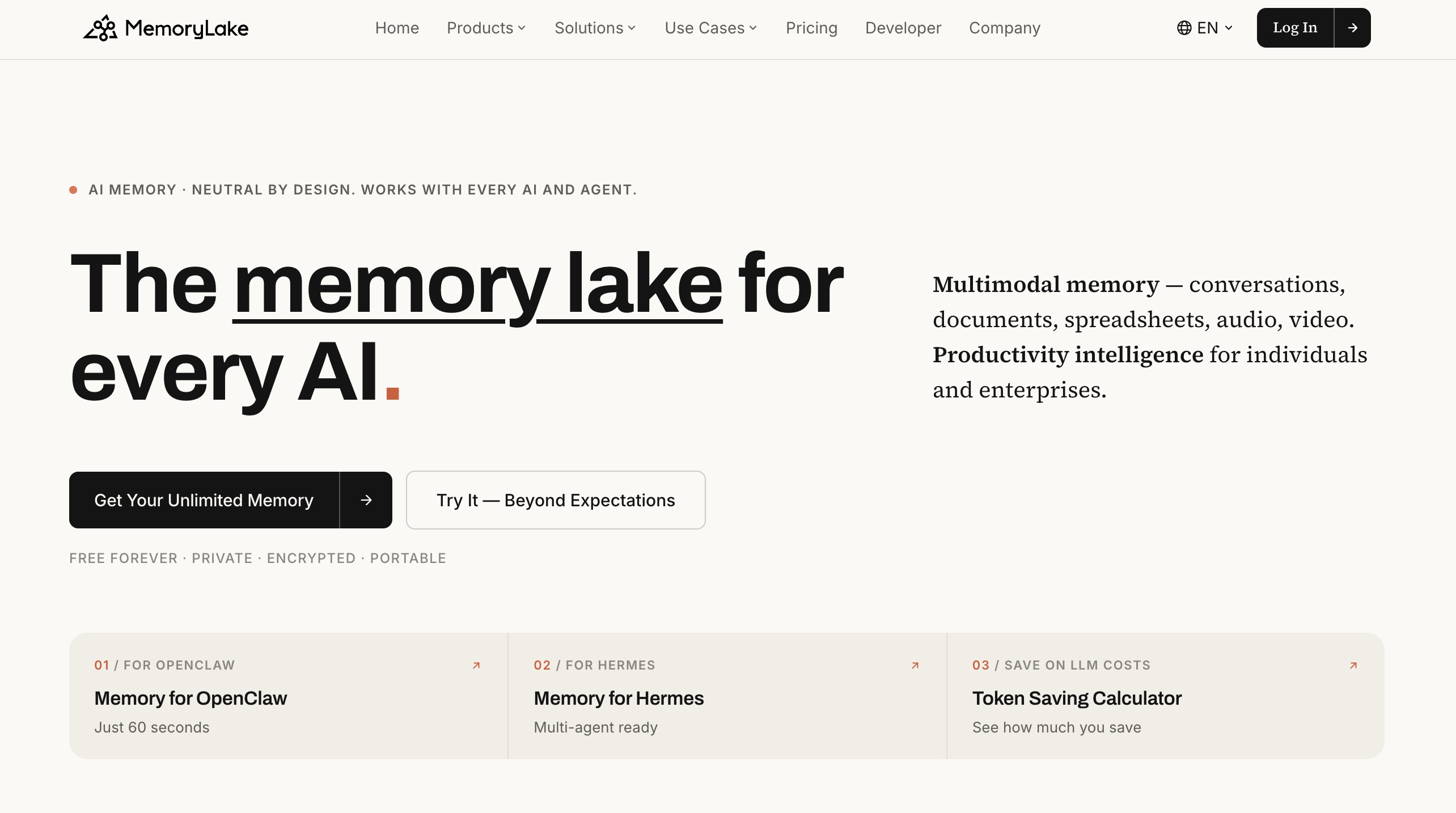
MemoryLake is a persistent memory infrastructure designed to help AI agents and applications maintain context across conversations, tasks, and sessions. Instead of treating every interaction as a fresh start, it enables AI systems to store, organize, retrieve, and reuse relevant information over time. This can include user preferences, historical interactions, important facts, task context, and other long-term knowledge.
MemoryLake is suitable for a wide range of AI applications, from personal assistants and customer support agents to AI-powered workflows, multi-agent systems, and interactive virtual characters. Its focus on persistent, structured memory makes it easier for developers to build AI experiences that feel more consistent, personalized, and context-aware. For teams building agents that need to remember users and previous interactions, MemoryLake provides a dedicated memory layer that can complement existing AI models, agent frameworks, and application infrastructure. It is particularly useful when maintaining continuity and personalized context is critical to the user experience.
Key Features
- Maintains deep contextual continuity across multi-session research projects.
- Intelligently stores, organizes, and reuses historical interactions and facts.
- Acts as a dedicated, drop-in memory layer complementing existing AI models and agent frameworks.
- Handles complex agentic workflows, multi-agent collaborations, and long-term task tracking.
Pros
- Eliminates context loss between separate research sessions.
- Reduces token overhead by fetching only relevant historical data.
- Seamlessly integrates with existing agent infrastructure.
- Delivers highly personalized and consistent AI responses.
Cons
- Requires initial setup to map out team-specific memory schemas.
- Advanced features have a slight learning curve.
Pricing
Free trial, paid plans start at $19/month.
2. Hindsight
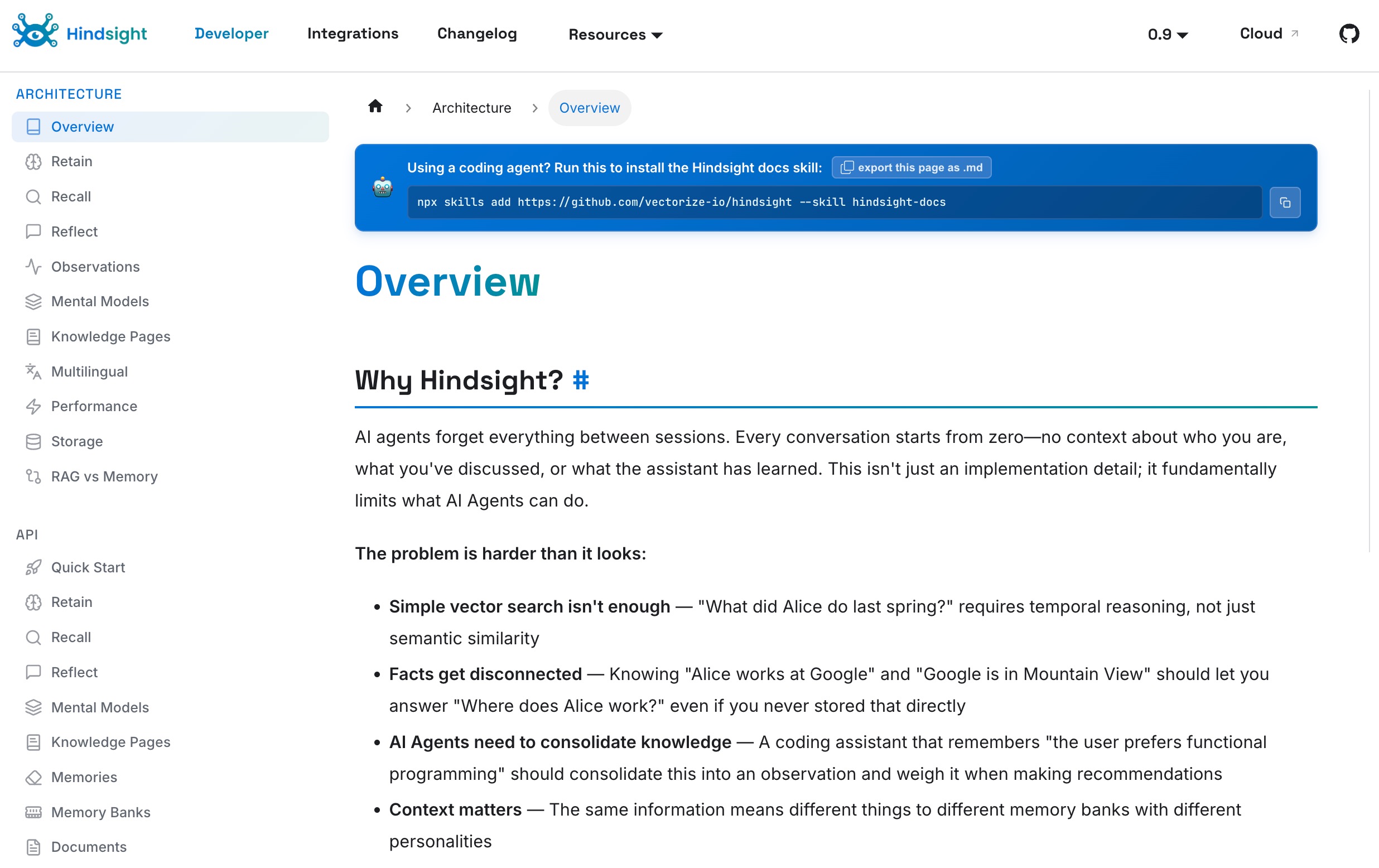
Hindsight is an advanced retrospective context analysis tool engineered specifically to help AI systems look backward, review historical choices, and learn from past operational steps. Research teams often struggle to trace how an AI assistant reached a specific conclusion over weeks of investigation. Hindsight solves this by introducing time-series event logging, retrospective context synthesis, and rigorous audit trails that map out the entire trajectory of an analytical workflow. By turning past data points into transparent historical lessons, it empowers research platforms to continuously refine their reasoning paths, ensure strict experimental reproducibility, and maintain deep accountability across long-term investigative projects.
Key Features
- Time-series event logging for research steps.
- Retrospective context synthesis.
- Audit trail generation for experimental processes.
Pros
- Excellent for tracking the evolution of a research hypothesis over time.
- Helps debug why an AI agent reached a specific conclusion.
Cons
- Less focused on real-time conversational memory.
- Can introduce storage bloat if logs are not pruned.
Pricing
Open-source.
3. Cognee
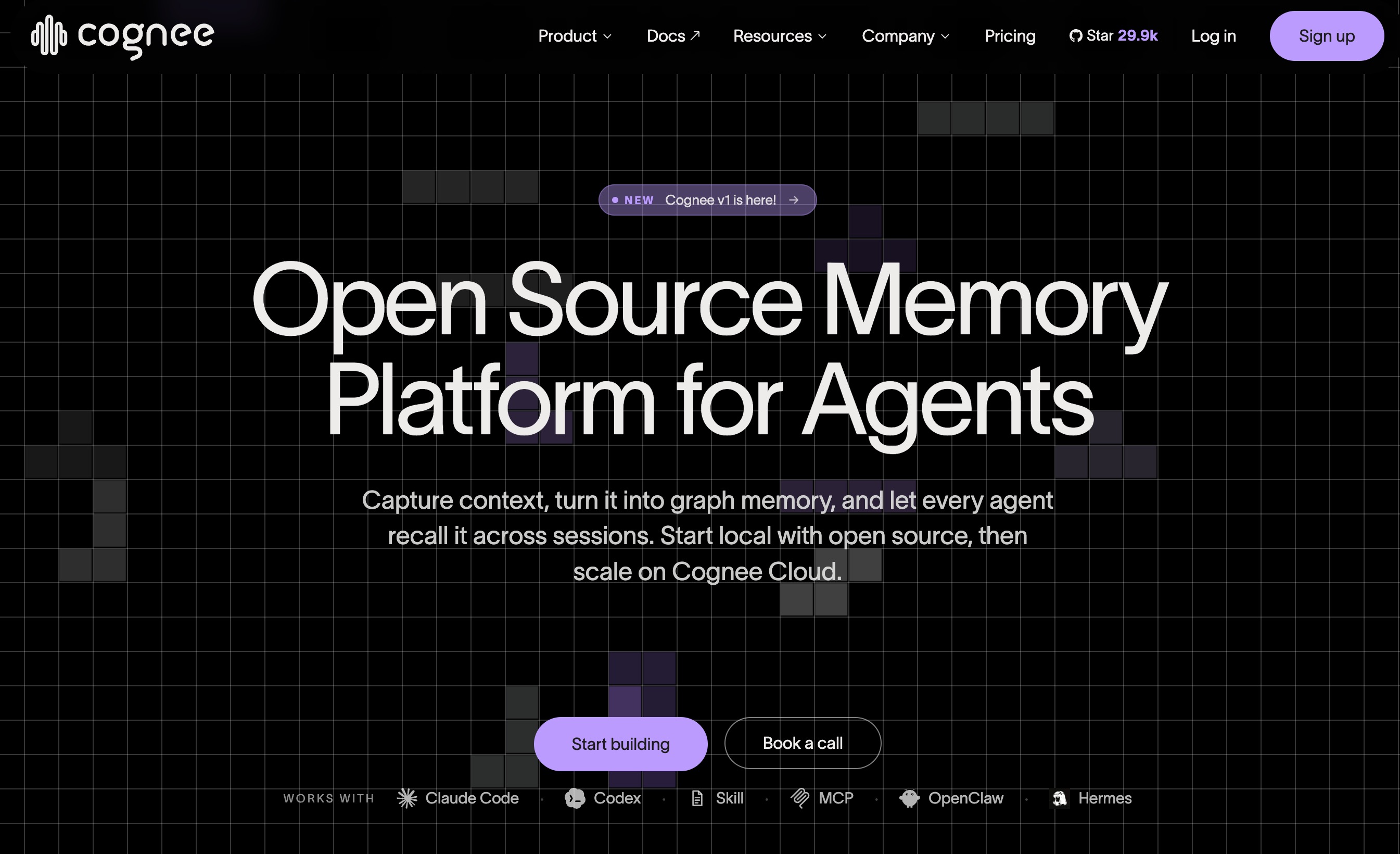
Cognee operates as a sophisticated knowledge graph-driven memory tool that bridges the gap between raw unstructured data and logical relational structures. In academic and scientific research, teams constantly ingest vast webs of disparate papers, notes, and datasets that traditional vector tools struggle to connect. Cognee automatically parses these inputs to build dynamic knowledge graphs, mapping complex domain-specific entities and relationships together. This graph-augmented approach allows research teams to query not just semantic similarities, but explicit logical connections, making it an invaluable asset for uncovering hidden links, cross-referencing multi-disciplinary studies, and visualizing overarching thematic networks.
Key Features
- Automated knowledge graph generation from text documents.
- Relational entity mapping for complex scientific domains.
- Graph-augmented vector retrieval.
Pros
- Brilliant for discovering hidden connections across disparate research papers.
- Provides logical transparency into how the AI retrieves facts.
Cons
- Graph construction can be computationally expensive.
- Requires careful tuning to avoid over-complex relationship webs.
Pricing
Free open-source tier; managed cloud options available ($2.50/1M Tokens) for teams.
4. Pieces
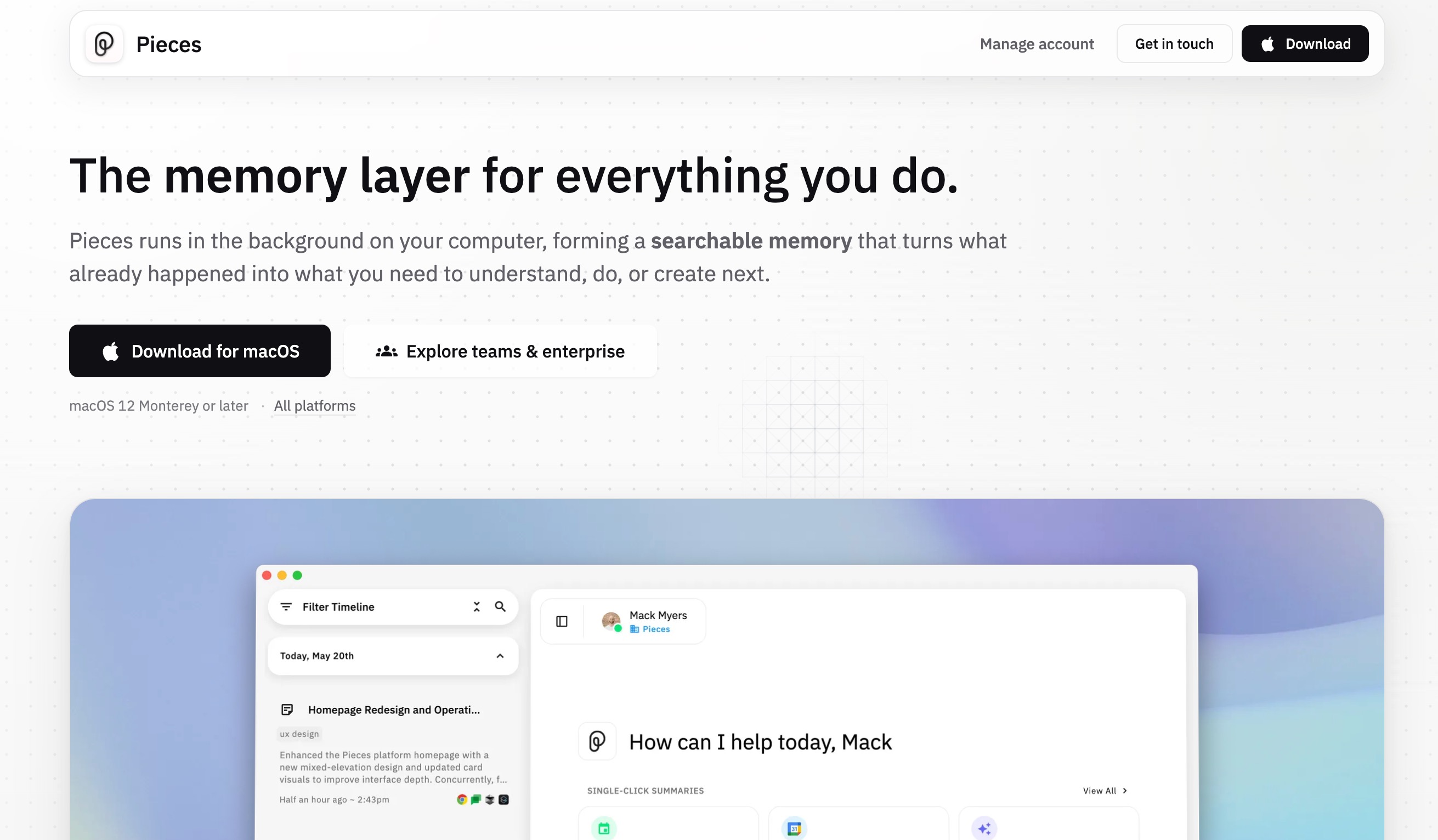
Pieces is a specialized, productivity-driven memory tool built explicitly to capture, enrich, and organize technical snippets, research code, and documentation across a researcher's daily workflow. Designed with a local-first philosophy, it integrates seamlessly into popular integrated development environments (IDEs), web browsers, and collaboration platforms to capture context dynamically as you work. For technical research teams dealing with scattered codebases, algorithmic prototypes, and multi-format files, Pieces provides a centralized repository that cleans up workflow friction, auto-tags valuable insights, and leverages local machine learning models to keep sensitive information completely secure and instantly accessible.
Key Features
- Local-first capture across IDEs, browsers, and collaboration apps.
- Automatic enrichment and tagging of saved research snippets.
- Local LLM support for privacy-first operations.
Pros
- Keeps data locally stored, enhancing institutional security.
- Extremely fast for daily technical note-taking and coding research.
Cons
- Primarily built for individual or small-group desktop workflows.
- Less suited for heavy, cloud-based multi-agent orchestration.
Pricing
Free basic version with advanced enterprise team plans that start at $18.99/month.
5. LangMem
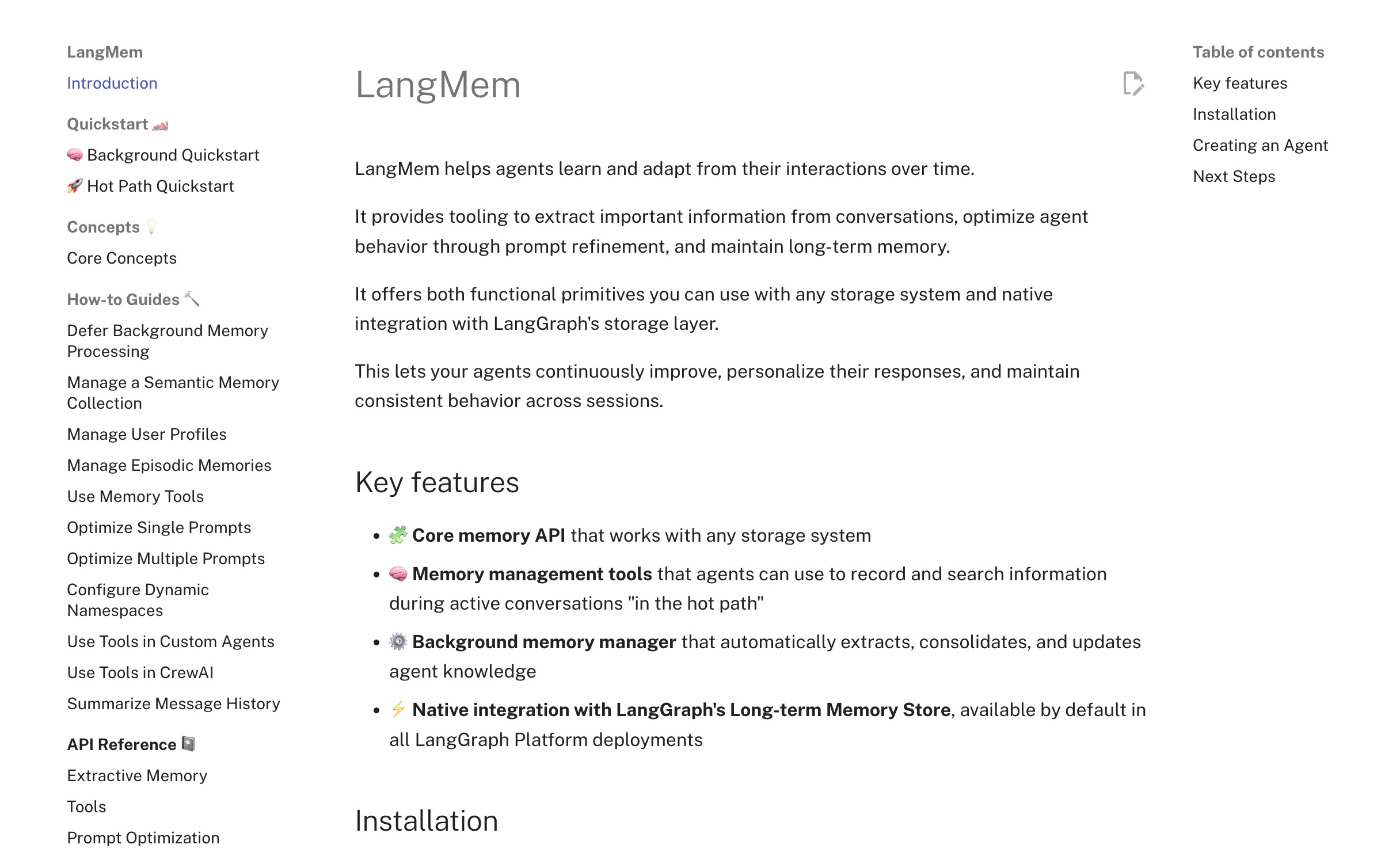
LangMem is a purpose-built memory management module engineered natively for development ecosystems leveraging the LangChain and broader agentic frameworks. As research teams increasingly deploy autonomous multi-agent systems to run simulations or literature reviews, managing state across execution loops becomes exceedingly difficult. LangMem addresses this by providing dynamic memory updating capabilities, letting agents write, read, and refine their own memory stores on the fly. With configurable memory scopes spanning thread-level interactions, user-specific profiles, and global project parameters, it gives developers granular, framework-native control over how stateful research agents evolve and behave over time.
Key Features
- Native integration with popular agentic frameworks.
- Dynamic memory updating during active agent execution.
- Configurable memory scopes (thread-level, user-level, global).
Pros
- Plug-and-play for teams already developing with LangChain.
- Granular control over what information gets saved or discarded.
Cons
- Tied closely to specific framework ecosystems.
- Documentation can be technical and fast-changing.
Pricing
Open-source framework components with managed cloud hosting options.
6. Pinecone
Pinecone is an industry-leading, fully managed vector database designed from the ground up for high-scale semantic similarity searches and heavy enterprise workloads. For large-scale research teams processing millions of document embeddings, scientific abstracts, and massive textual archives, Pinecone offers an infrastructure backbone capable of ultra-low latency searches. Its serverless architecture scales dynamically alongside expanding project volumes, removing the operational headaches of infrastructure management. While it functions primarily as a high-performance vector store rather than a built-in agent memory framework, it provides the raw indexing horsepower required to power deep semantic discovery in modern research engines.
Key Features
- High-throughput vector indexing and similarity search.
- Serverless architecture scaling dynamically with workload.
- Metadata filtering for precise document subset queries.
Pros
- Handles massive volumes of research documentation effortlessly.
- Virtually zero maintenance overhead due to managed serverless scaling.
Cons
- Purely a vector database, lacking built-in agent memory logic or graph structuring.
- Costs can scale steeply with massive vector dimensions.
Pricing
Usage-based pricing starts at $20/month.
7. Redis
Redis is a world-renowned, ultra-fast in-memory data store frequently adapted by engineering teams to act as a high-performance cache and real-time state manager for AI applications. In high-speed research environments where microsecond response times are required to process live data streams or rapid interactive prompting, traditional disk-bound databases often fall short. Redis solves this by keeping active states and vector indices directly in memory, delivering sub-millisecond retrieval speeds. While heavily optimized for caching and fast operational state recall rather than deep long-term narrative memory, it remains a critical component for accelerating real-time research pipelines.
Key Features
- Sub-millisecond data retrieval speeds.
- Built-in vector search capabilities alongside key-value storage.
- Robust replication and persistence options.
Pros
- Unmatched speed for real-time application responsiveness.
- Versatile handling of both cache states and vector embeddings.
Cons
- In-memory storage can become expensive for massive literature libraries.
- Requires careful RAM management and provisioning.
Pricing
Free open-source software, paid Redis Enterprise tiers starting around custom enterprise quotes.
8. Weaviate
Weaviate is a powerful, open-source vector database that distinguishes itself through advanced hybrid search capabilities, seamlessly fusing traditional keyword matching (BM25) with dense vector embeddings. Research teams often face challenges where strict keyword lookups (like specific gene sequences or chemical formulas) must be combined with broad conceptual queries. Weaviate bridges this gap with a modular architecture that supports custom machine learning models and robust multi-tenancy controls. This ensures that enterprise research groups can safely segment proprietary data while enjoying exceptionally high search relevance across massive multi-format literature repositories.
Key Features
- Native hybrid search blending BM25 and vector embeddings.
- Modular architecture supporting custom machine learning models.
- Multi-tenancy support for secure team data segmentation.
Pros
- Exceptional search relevance for academic papers and technical text.
- Flexible deployment options (cloud or self-hosted).
Cons
- Steeper configuration curve compared to fully serverless DBs.
- Resource-intensive during heavy indexing tasks.
Pricing
Open-source free tier; paid plans start at $45/month.
9. Hyperspell
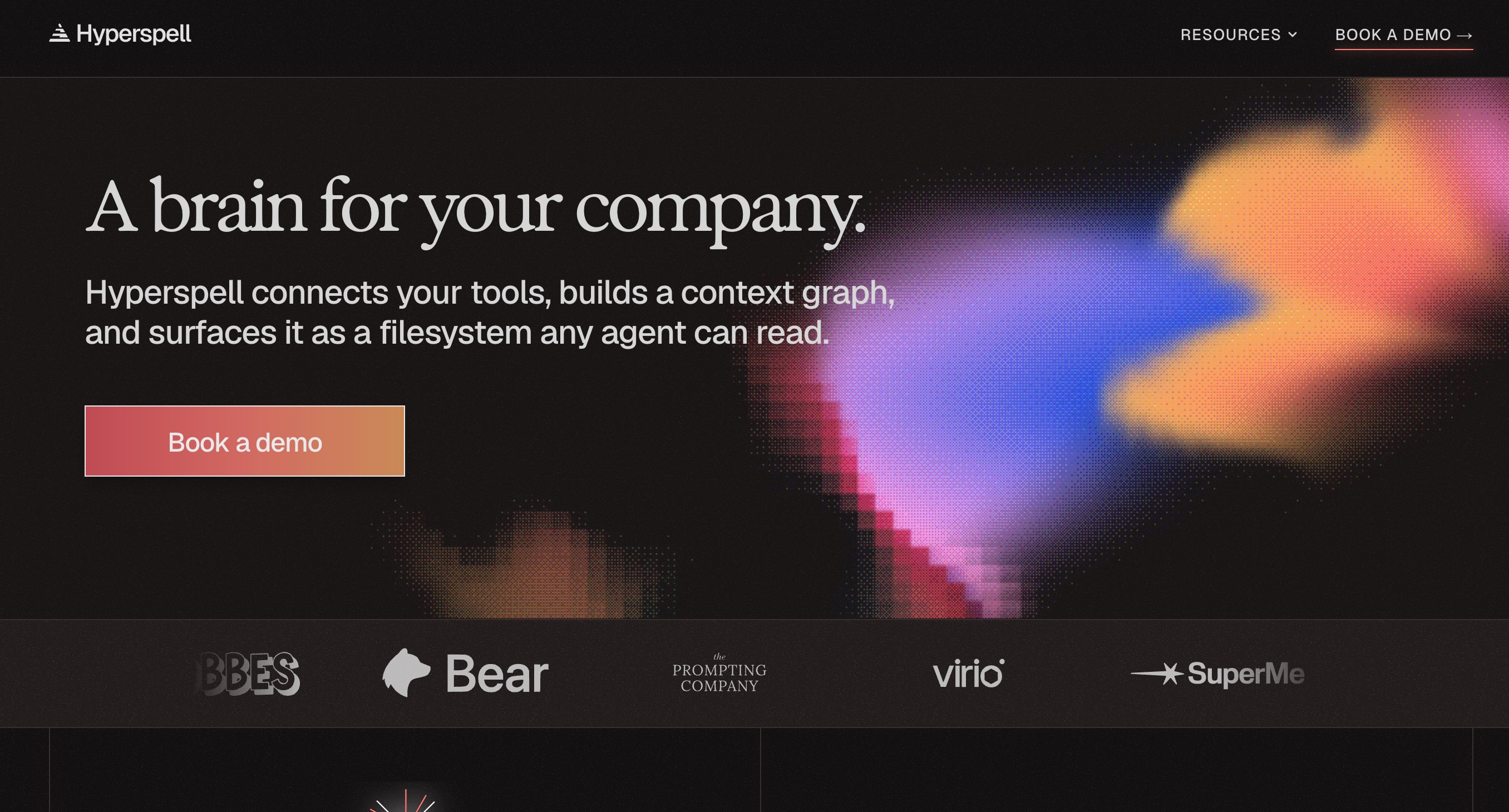
Hyperspell is an innovative dynamic context injection tool engineered to optimize how background information is fed into large language models during active research tasks. One of the greatest challenges in literature synthesis is token bloat, where passing entire documents overwhelms the model's context window and degrades accuracy. Hyperspell solves this by continuously monitoring the conversation flow, calculating context relevance scores, and injecting only the most critical background data on demand. This real-time cross-referencing engine allows research teams to query massive digital libraries smoothly without burning through excessive API token costs.
Key Features
- Real-time context injection pipeline.
- Context relevance scoring to optimize token windows.
- Cross-reference automation for research databases.
Pros
- Optimizes token consumption by filtering out redundant noise.
- Speeds up literature synthesis tasks.
Cons
- Niche focus compared to broad general-purpose memory layers.
- Integrations are still expanding.
Pricing
Custom pricing.
10. Supermemory
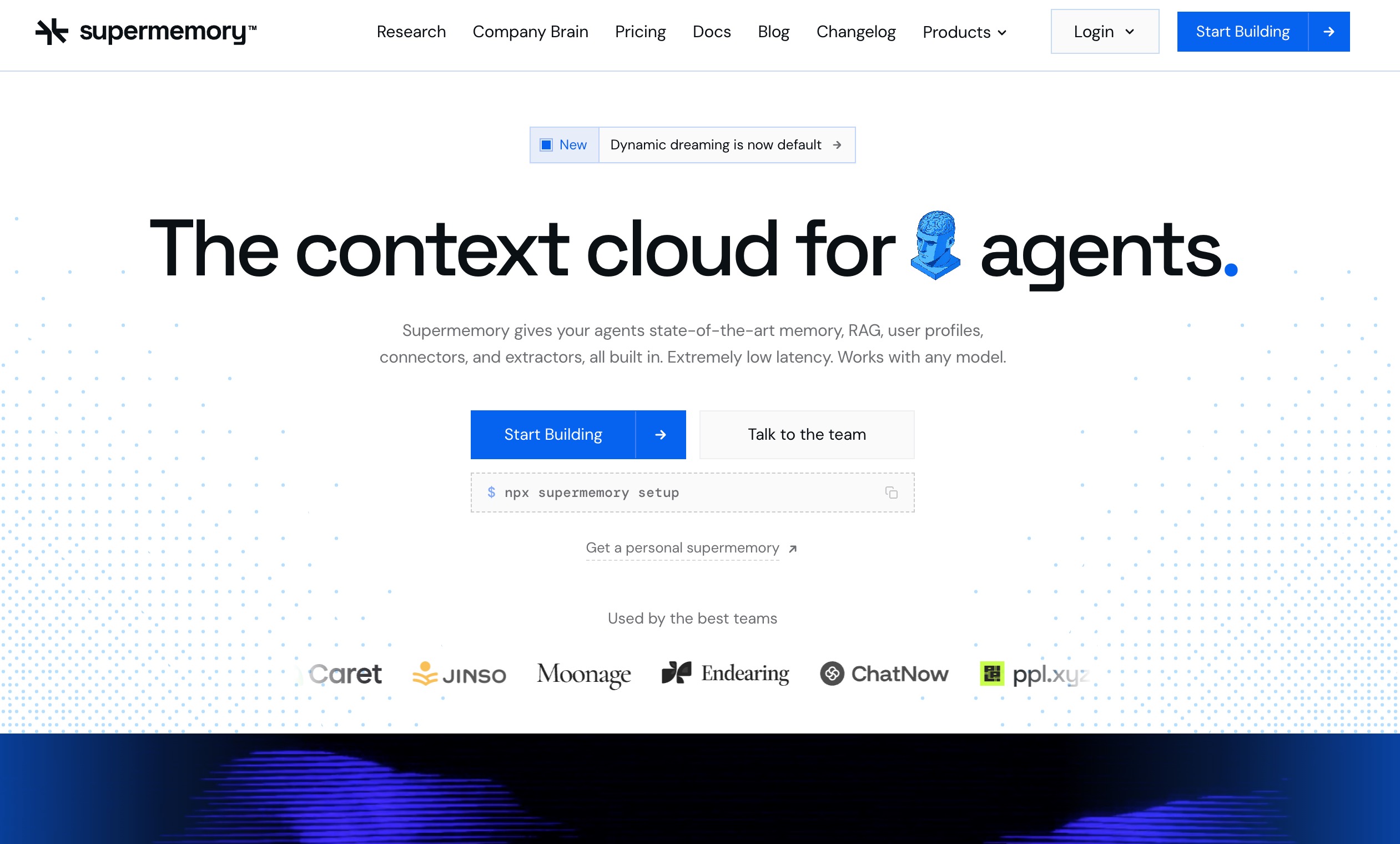
Supermemory functions as an intuitive, all-in-one personal and team knowledge hub designed to aggregate web clippings, academic PDFs, markdown notes, and miscellaneous documents into a unified, AI-accessible ecosystem. Many research teams struggle with fragmented information scattered across browser tabs, cloud drives, and chat apps. Supermemory centralizes these assets, offering a clean chat-with-your-knowledge interface alongside robust API connectivity. It acts as an accessible entry point for teams looking to centralize early-stage brainstorming material and reference documents without wrestling with heavy backend database configurations.
Key Features
- Aggregates multi-source web clippings and research documents.
- Clean chat-with-your-knowledge interface.
- API access for connecting stored data to external tools.
Pros
- Extremely intuitive interface requiring minimal technical setup.
- Great for early-stage literature collection and brainstorming.
Cons
- Less customizable for advanced, multi-agent coding pipelines.
- API rate limits on lower tiers.
Pricing
Free individual tier with paid pro that starts at $19/month.
How We Reviewed These AI Memory Tools
To provide an objective, comprehensive evaluation for research teams, our review process centered on rigorous criteria:
- Hands-on Testing with Research Workloads: We simulated multi-session literature reviews and data synthesis tasks to test how well each tool retained and recalled context.
- Architecture and Scalability Analysis: We examined the underlying technology (vector vs. graph vs. structured memory layers) to gauge performance under heavy data loads.
- Developer and User Experience: We assessed documentation clarity, setup friction, and the ease of integrating each tool into standard research setups.
- Security and Governance Audit: We reviewed data privacy policies, encryption standards, and compliance measures critical for protecting sensitive research data.
Which AI Memory Tool Is Best for Your Research Team
Choosing the right memory tool depends heavily on your team's unique workflow and technical requirements:
- For pure vector scaling and raw database power: Tools like Pinecone and Weaviate excel at handling massive volumes of document embeddings, though they require you to build your own memory logic on top.
- For knowledge graph exploration: Cognee offers powerful relationship mapping, ideal for teams trying to map complex, interconnected scientific domains.
- For fast caching and real-time state management: Redis remains the gold standard for ultra-low latency operations.
- For comprehensive, agent-driven research continuity: MemoryLake stands out as the ultimate choice. Unlike simple databases that only store static text chunks, MemoryLake provides a specialized, persistent memory infrastructure designed explicitly to maintain context across complex agent interactions, multi-session tasks, and evolving projects. If your research team relies on AI agents that need to remember past findings, adapt to team preferences, and sustain continuity over long periods, MemoryLake delivers unmatched integration and intelligence.
Final Verdict
Selecting an AI memory tool is a pivotal decision for research teams aiming to scale their productivity and eliminate repetitive context loss. While specialized databases and graph tools offer great modular components, deploying a dedicated, persistent memory architecture is essential for true agentic intelligence. To give your research workflows seamless continuity, long-term context retention, and intelligent recall across every session, MemoryLake is the premier solution to adopt today.