
What Is Happening to Manus User Data
The AI community is currently navigating a massive disruption due to a sudden operational shift. According to the official blog post titled "A Note to Our Users," here is exactly what is happening to your data:
- The Meta Split: In a major industry shakeup, Manus is officially unwinding its previous acquisition deal with Meta. The platform is parting ways with the tech giant and will soon resume operating completely as an independent company.
- Compliance Deletion: To comply with specific regulatory and structural requirements during this transition away from Meta, a significant data purge is unavoidable for affected user accounts.
- The Affected Window: Any tasks, projects, or agent contexts generated by affected users on or after the initial Meta acquisition date of December 29, 2025, will be permanently deleted.
- The Strict Backup Deadline: Users must urgently utilize the official export tool to back up their data before the looming cutoff at 7:59 a.m. Singapore Time (SGT) on August 23.
- Temporary Lockout & Restoration: Affected accounts will be locked across August 23 and 24 while the deletion occurs, and an official restoration portal will open on August 25 to allow users to seamlessly re-upload their saved files into the newly independent platform.
What Should You Look for in an AI Memory Tool
Before you export your data and rush to a new platform, you need to evaluate your options carefully to ensure this crisis never happens to you again. Here is what you should look for in an AI memory tool:
- Unshakeable Persistence: The tool must guarantee your data will never be erased due to sudden corporate transitions, independent spin-offs, or compliance adjustments.
- High-Fidelity Retrieval: Look for built-in vector databases and semantic search capabilities that can fetch the exact historical context your agent needs instantly.
- Agnostic Integration: The ideal platform provides robust SDKs and APIs, allowing you to plug your saved data into any LLM or framework you choose without vendor lock-in.
- Data Structuring: It should be able to categorize memories logically (e.g., historical facts versus user preferences) so the AI does not suffer from context window overflow.
- Data Sovereignty: You need absolute ownership over your exports, accompanied by enterprise-grade security and encryption to protect your most sensitive workflows.
10 Best AI Memory Tools to Preserve Your Manus Data in 2026
Before diving into the detailed profiles of each platform, here is a quick comparison table of the top 10 AI memory tools available right now to safeguard your data.
| Product | Best For | Key Strength | Pricing |
|---|---|---|---|
| MemoryLake | Persistent memory infrastructure | Flawless context continuity & reusability | $19/month |
| Mem0 | Personalized LLM memory | User-specific data isolation | $19/month |
| Supermemory | AI second brain for individuals | Web-based knowledge curation | $19/month |
| Zep | Fast memory for AI agents | Low-latency temporal retrieval | $125/month |
| Hindsight | Logging and memory analytics | Contextual history tracking | Open Source |
| Recall.ai | Video and audio memory bots | Unstructured media processing | Pay-as-you-go |
| Claude Projects | Non-developer UI users | Built-in contextual knowledge | $20/month |
| Letta | Advanced Agent OS management | Virtual memory paging for LLMs | Open-source / Cloud |
| LangChain | AI Framework builders | Massive ecosystem integrations | $39/per seat/month |
| Memori | Digital twins & characters | Persona-driven memory retention | Custom |
1. MemoryLake
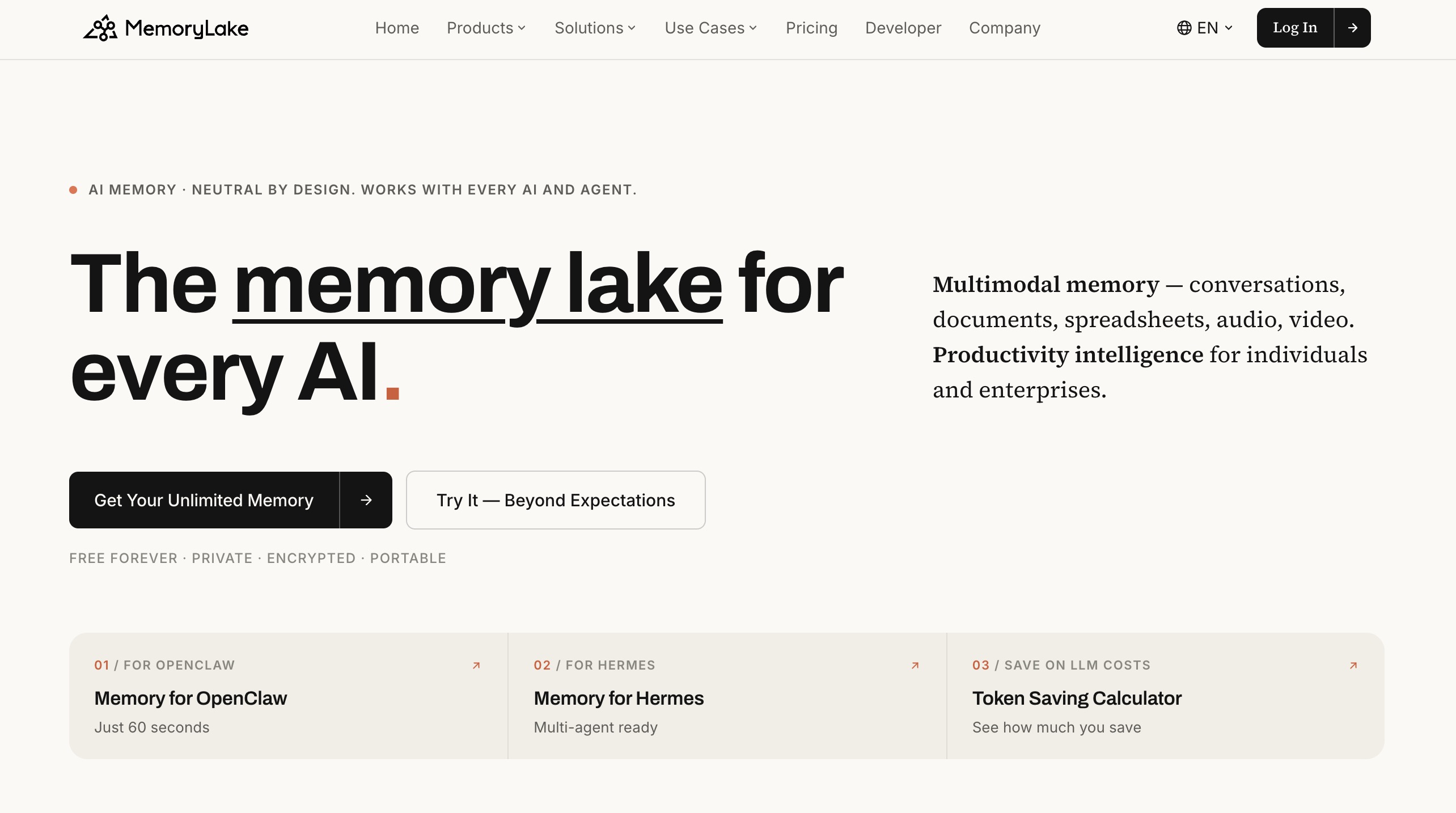
MemoryLake is a persistent memory infrastructure designed to help AI agents and applications maintain context across conversations, tasks, and sessions. Instead of treating every interaction as a fresh start, it enables AI systems to store, organize, retrieve, and reuse relevant information over time. This can include user preferences, historical interactions, important facts, task context, and other long-term knowledge.
MemoryLake is suitable for a wide range of AI applications, from personal assistants and customer support agents to AI-powered workflows, multi-agent systems, and interactive virtual characters. Its focus on persistent, structured memory makes it easier for developers to build AI experiences that feel more consistent, personalized, and context-aware.
For teams building agents that need to remember users and previous interactions, MemoryLake provides a dedicated memory layer that can complement existing AI models, agent frameworks, and application infrastructure. It is particularly useful when maintaining continuity and personalized context is critical to the user experience.
Key Features
- Persistent Infrastructure: A dedicated memory layer that guarantees the long-term, unshakeable retention of your AI context.
- Context Reusability: Automatically structures and retrieves historical interactions so your AI never forgets past tasks.
- Framework Agnostic: Seamlessly complements existing AI models, agent frameworks, and custom application infrastructures.
Pros
- Eliminates the fear of data loss by giving you robust storage mechanisms tailored for AI.
- Makes building highly personalized and consistent multi-agent systems incredibly straightforward.
- Perfect for teams that require deep historical tracking across infinite user sessions.
Cons
- Requires initial API / MCP server / plugin configuration for deep custom application deployment.
- May offer more infrastructure than necessary for users seeking a basic plug-and-play chatbot.
Pricing
Offers a flexible freemium tier, pro plan starts at $19/month.
2. Mem0
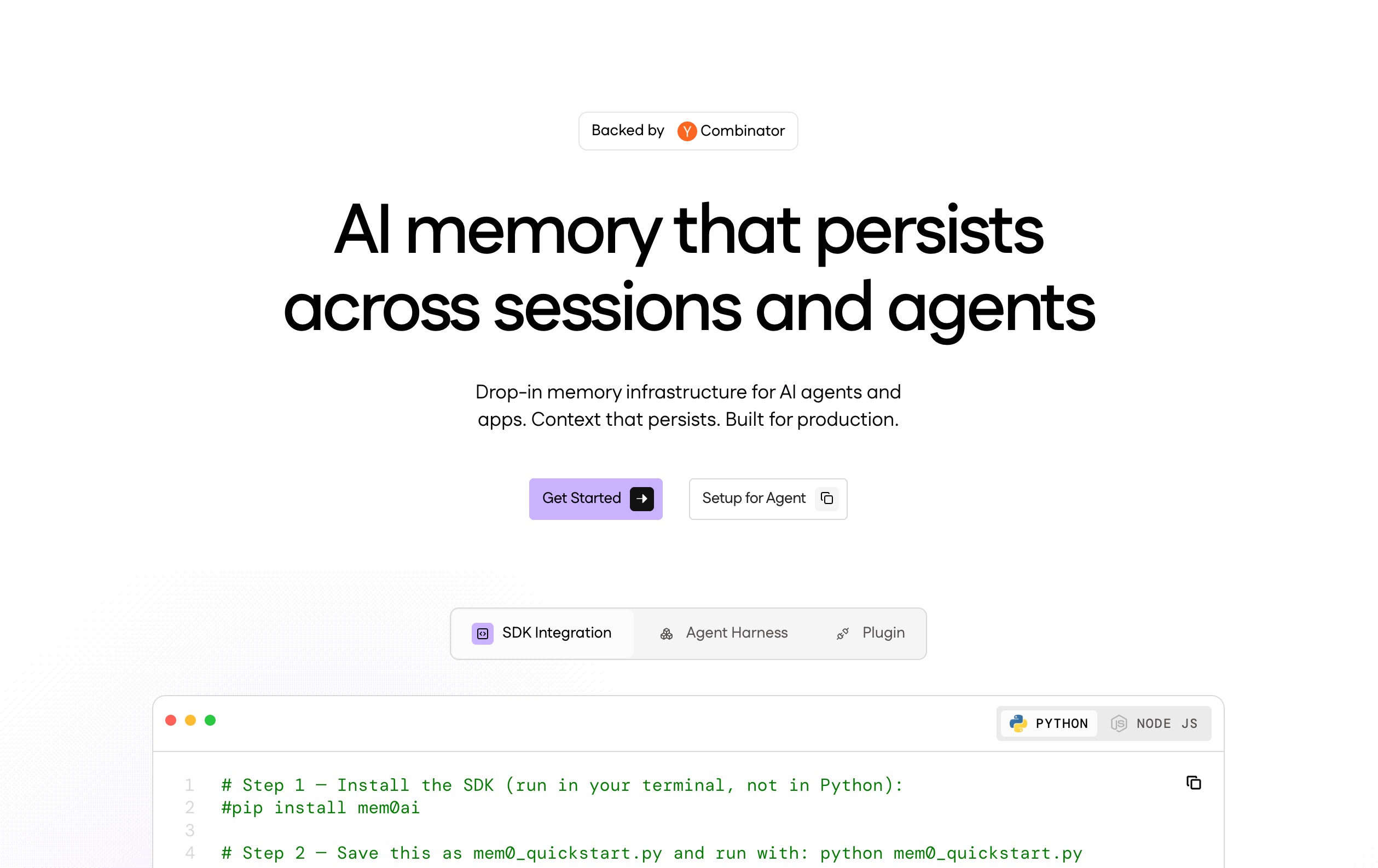
Mem0 is a highly flexible memory layer engineered specifically to add personalized, stateful memory to Large Language Models. It focuses heavily on isolating memories on a per-user basis, ensuring that personal assistants remain meticulously tailored to individual preferences without ever crossing data streams.
Key Features
- User-Level Segregation: Keeps individual user memory profiles entirely isolated and secure.
- Adaptive Learning: Automatically adapts and modifies memory context as conversations evolve.
- Vector Search Engine: Employs advanced embeddings to rapidly retrieve past conversational facts.
Pros
- Very quick and straightforward implementation process for developers.
- Excellent community backing due to its open-source nature.
- Balances short-term session tracking with long-term retention perfectly.
Cons
- Hosting it on your own hardware requires DevOps and server maintenance skills.
- Complex knowledge graph relations are still maturing in the ecosystem.
Pricing
Free for open-source self-hosting; managed cloud services start at roughly $19 per month.
3. Supermemory
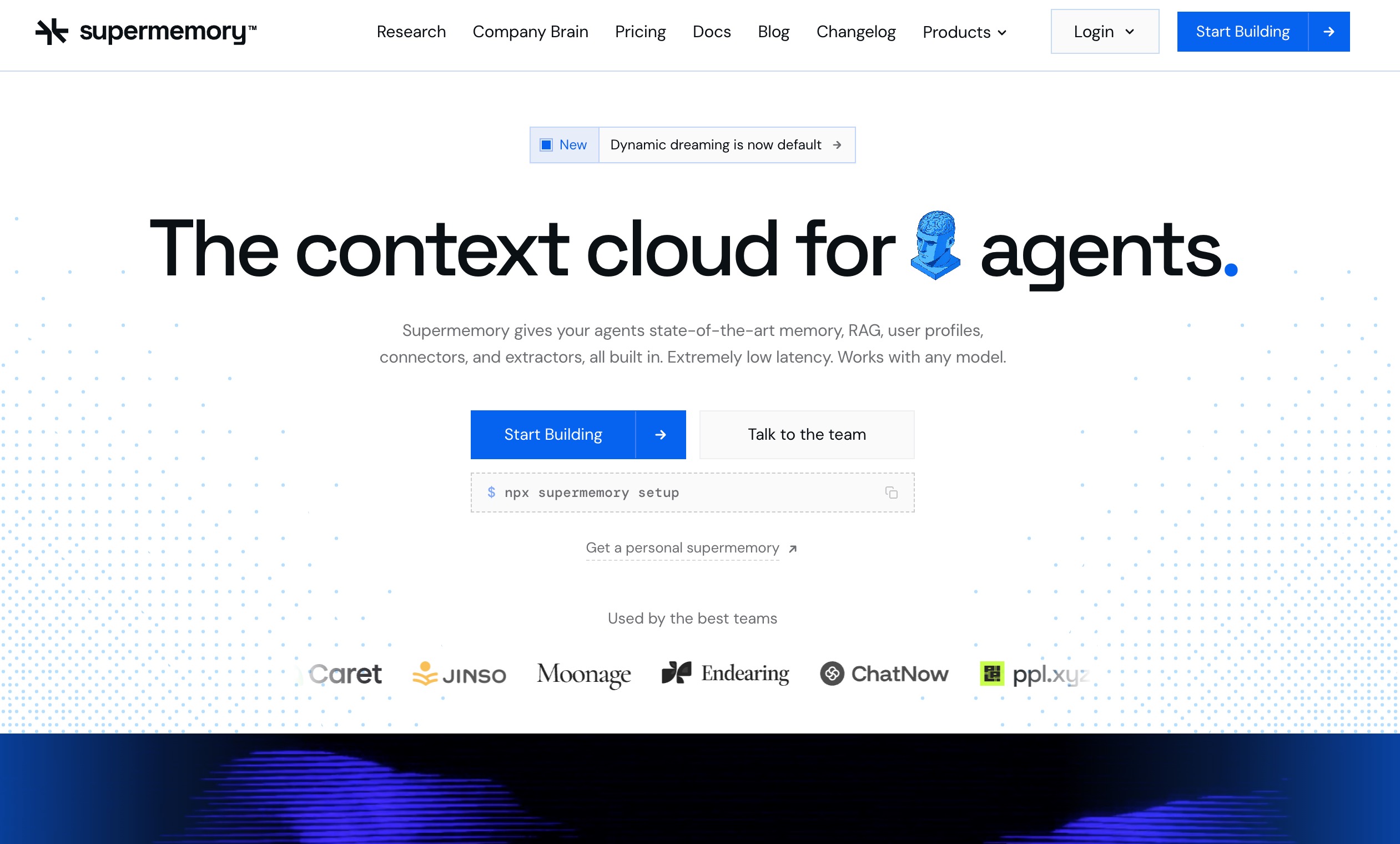
Supermemory functions beautifully as an AI-powered "second brain." It is explicitly targeted at individuals, researchers, and creators who want to bookmark web pages, save chat logs, and curate personal notes, allowing an AI to natively query this saved knowledge.
Key Features
- Universal Web Clipper: Easily extract and save articles, threads, and full web pages.
- Markdown Formatting: Keeps all saved data in a clean, human-readable, and editable format.
- Conversational UI: Allows you to chat directly with your curated data vault effortlessly.
Pros
- Incredibly user-friendly and requires absolutely no coding knowledge.
- The Chrome extension makes saving new context completely frictionless.
- Features a visually intuitive and highly organized dashboard.
Cons
- Lacks the complex API capabilities needed for enterprise-level agent routing.
- Not suitable for autonomous multi-agent operational workflows.
Pricing
Free basic tier; Pro tier starts at $19/month.
4. Zep
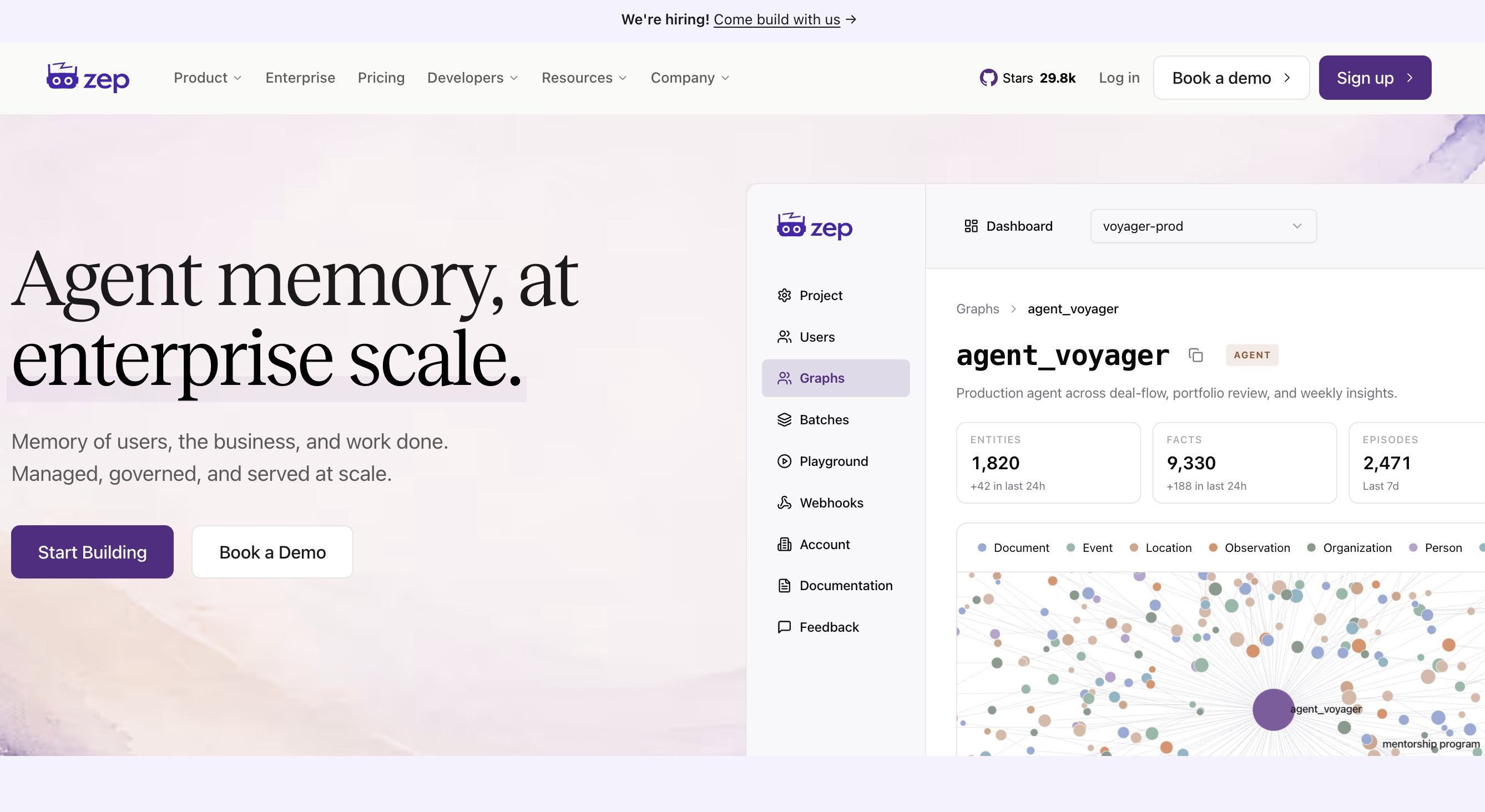
Zep is a high-speed, long-term memory service strictly tailored for AI applications that demand extremely low latency. It excels in temporal retrieval, meaning it intimately understands the chronological timeline of conversations and recalls facts based precisely on when they occurred.
Key Features
- Low-Latency Retrieval: Optimized heavily for rapid response times in live chat and voice bots.
- Temporal Understanding: Comprehends the timeline of events and time-based context.
- Auto-Summarization: Automatically compresses older chat histories to save on expensive token costs.
Pros
- Extremely fast, practically eliminating lag in real-time AI agents.
- Smart token management prevents AI context window overflow.
- Provides robust compliance features for enterprise privacy.
Cons
- The initial setup and architecture can be intimidating for novices.
- Self-hosting requires a dedicated and well-maintained server environment.
Pricing
Free and open-source, paid plans start at $125/month.
5. Hindsight
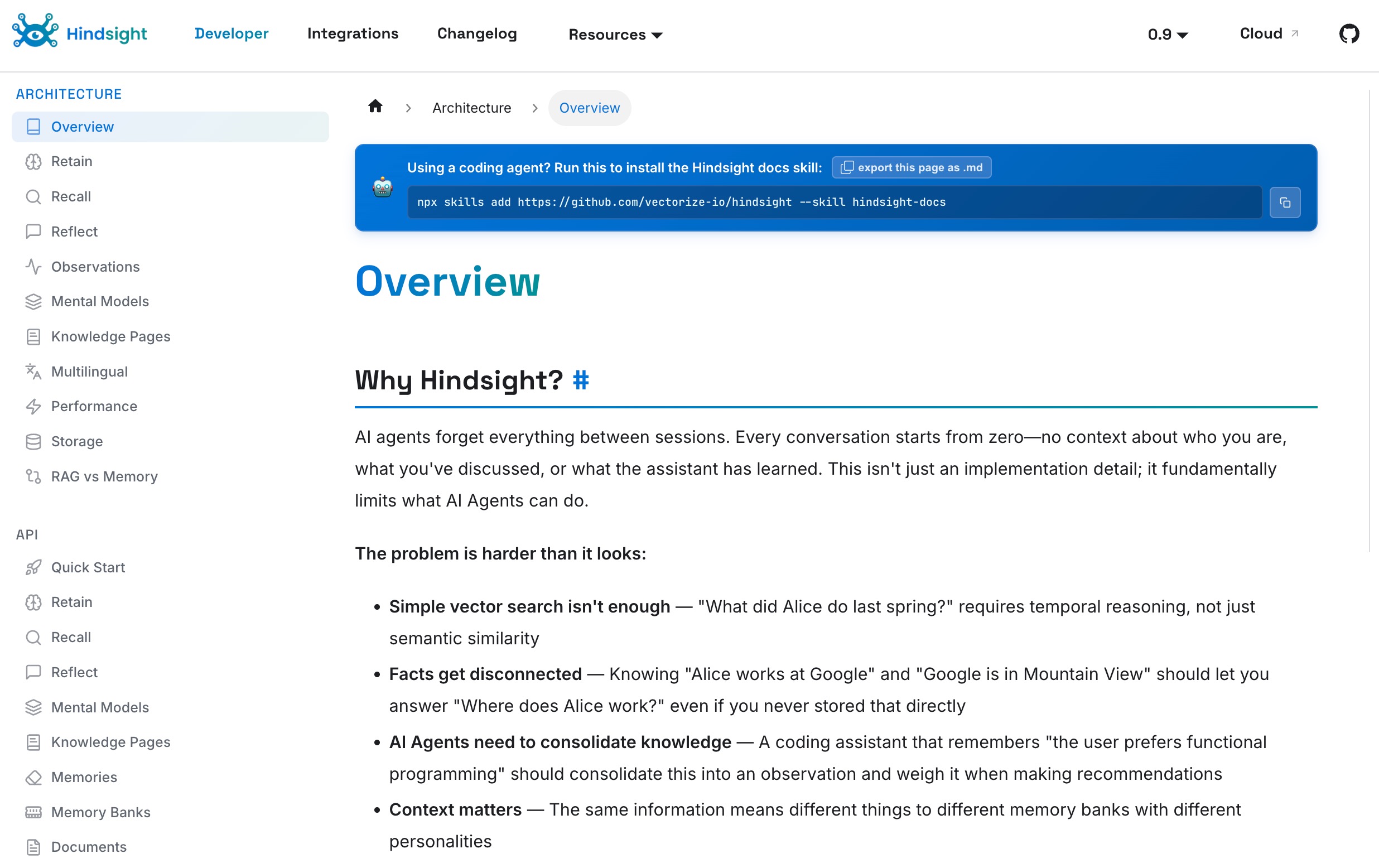
Hindsight differentiates itself by focusing heavily on robust logging and memory analytics. It securely stores your AI conversational context while providing deep, visual insights into exactly what your agents are remembering and how accurately they retrieve that information.
Key Features
- Comprehensive Audit Trails: Keeps detailed logs of how and when memory vectors are accessed.
- Contextual Analytics: Visually graphs out memory usage and AI hallucination rates.
- One-Click Exports: Allows effortless exporting of all stored agent interactions.
Pros
- An absolute lifesaver for debugging AI thought processes and hallucinations.
- Provides high transparency, which is great for compliance-heavy industries.
- The analytics dashboard is highly detailed and informative.
Cons
- The user interface is very data-heavy and can overwhelm casual users.
- Places less emphasis on the AI autonomously modifying its own memory.
Pricing
Open Source.
6. Recall.ai
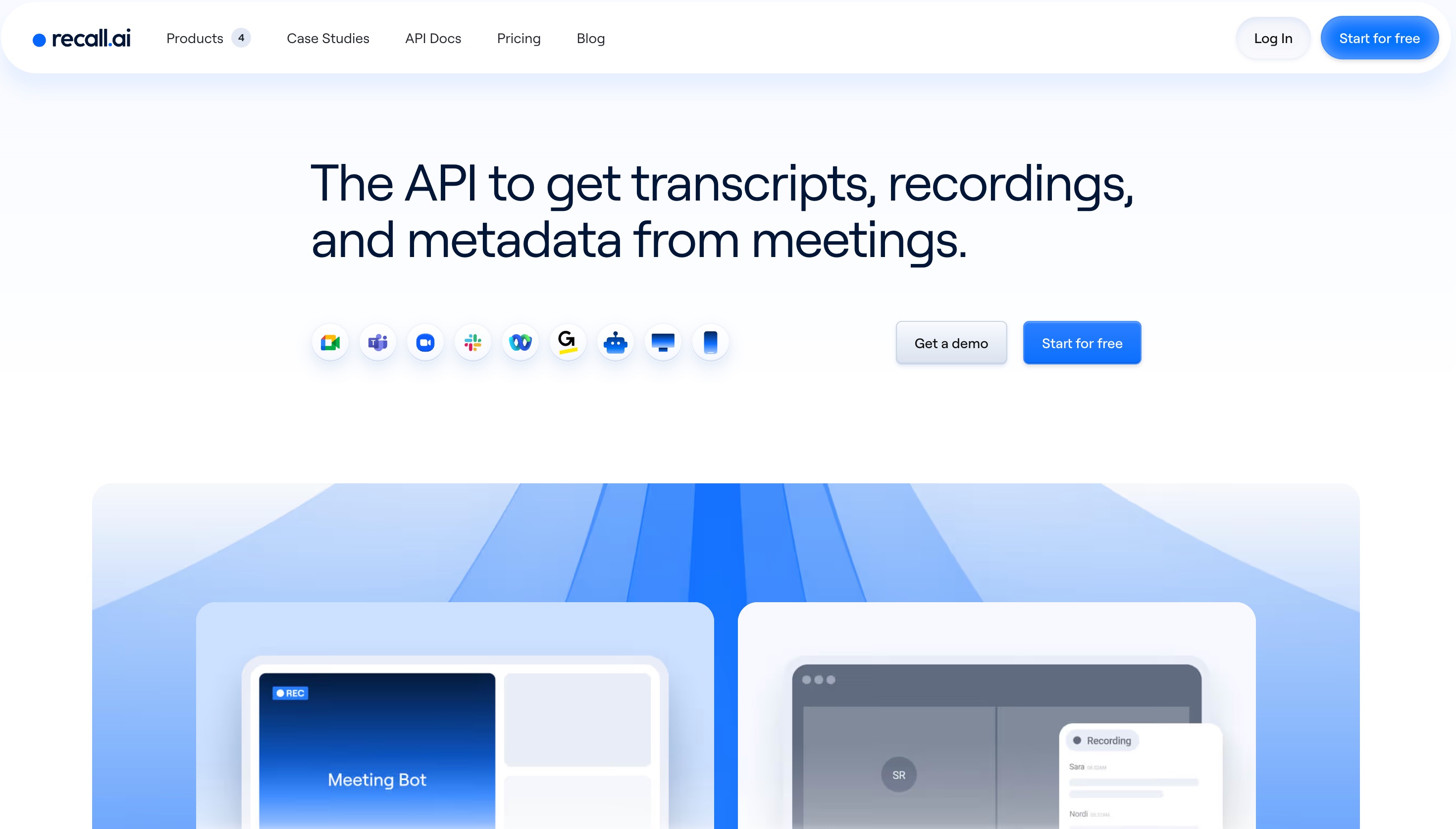
If the AI memory you are desperately trying to save consists largely of meeting notes, voice calls, and video data, Recall.ai is the optimal solution. It provides a universal API designed to extract, store, and memorize unstructured information from platforms like Zoom and Microsoft Teams.
Key Features
- Universal API Connectivity: Connects directly to all major video conferencing tools.
- Multimodal Memory Storage: Saves and organizes transcripts, audio files, and video metadata.
- Real-Time Processing: Ingests and memorizes conversational data while the meeting is live.
Pros
- The undisputed best choice for handling unstructured audio and video memory.
- Highly reliable infrastructure capable of processing massive media files.
- Saves teams thousands of hours of engineering time building video bots.
Cons
- Very niche use case (strictly designed for meeting and media data).
- High-volume video processing can quickly become expensive.
Pricing
Strictly pay-as-you-go based on the exact minutes of video processed.
7. Claude Projects
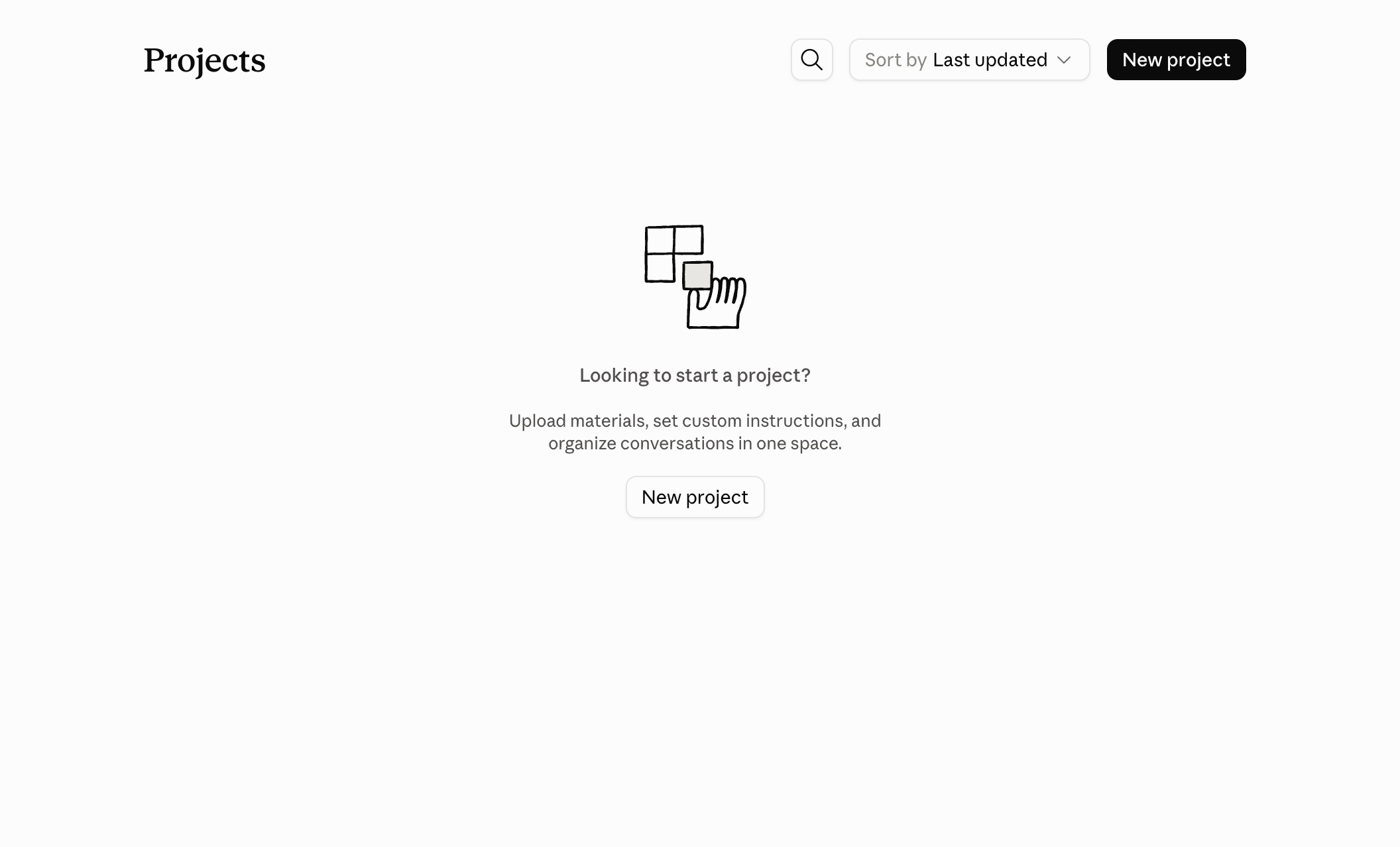
Anthropic’s Claude Projects is a powerful built-in workflow feature for Claude Pro users. It acts as a highly structured memory system by allowing users to create dedicated workspaces with persistent instructions and reference documents, all without needing to write a single line of code.
Key Features
- Project Knowledge Bases: Upload specific documents that the AI remembers persistently per project.
- Custom System Instructions: Tailor the AI's core behavior uniquely for different workflows.
- Artifacts Integration: Generate, edit, and iterate on code and documents natively within the memory space.
Pros
- Requires zero API setup or coding expertise to get started.
- Combines persistent data with Anthropic’s incredible reasoning capabilities.
- Highly secure, backed by rigorous safety protocols.
Cons
- You are entirely locked into the Anthropic/Claude ecosystem.
- It is not an infrastructure tool that you can plug into custom external apps.
Pricing
Included entirely within the Claude Pro subscription at $20/month.
8. Letta
Formerly known as MemGPT, Letta takes a revolutionary approach by treating AI memory like a computer operating system. It utilizes advanced virtual memory paging, allowing Large Language Models to autonomously manage their own memory—moving vital data into active context and archiving the rest.
Key Features
- Tiered Memory Architecture: Distinctly separates main context from external disk storage.
- Autonomous Management: The AI agent independently decides what to remember and what to discard.
- Infinite Context Window: Intelligently bypasses standard LLM token limits through smart paging.
Pros
- A truly groundbreaking approach to building autonomous, never-ending agents.
- Highly efficient for managing massive, long-running chat sessions securely.
- Open-source platform with a highly extensible architecture.
Cons
- Features a very steep learning curve to master the underlying framework.
- Demands LLMs with exceptionally strong instruction-following capabilities to work properly.
Pricing
Open-source (free); Managed cloud deployment services require custom enterprise pricing.
9. LangChain
LangChain is the foundational framework for modern AI development, and its built-in memory modules remain a staple for engineers. It offers highly modular memory solutions ranging from basic buffer memories to advanced vector-backed conversation graphs, making it an excellent development environment.
Key Features
- Modular Memory Types: Offers diverse options like Buffer, Summary, and VectorStore memory.
- Massive Ecosystem Integration: Seamlessly connects with almost every LLM and vector database available.
- Complex Chain Compatibility: Easily injects historical memory into complex, multi-step AI workflows.
Pros
- Provides developers with unmatched flexibility and code customization.
- Supported by a massive community and extensive, highly detailed documentation.
- Allows you to easily swap out your underlying database providers at any time.
Cons
- It is a framework, not a standalone storage solution (you must provide the database).
- Can be overly verbose and unnecessarily complex for simple AI projects.
Pricing
Paid plan starts at $39/per seat/month.
10. Memori
Memori focuses exclusively on digital twins and interactive virtual characters. It offers a unique memory architecture that allows AI personas to remember specific users, evolve their personalities over time, and build deep, long-term digital relationships.
Key Features
- Persona Evolution: Memory inputs directly impact the emotional state and personality of the AI.
- Relational Mapping: Maps out and tracks complex relationships between the agent and different users.
- Emotional Tagging: Saves and categorizes memories with associated emotional sentiment scores.
Pros
- The absolute best option for gaming, NPCs, and virtual companionship.
- Creates highly engaging, empathetic, and human-like AI interactions.
- Features a very intuitive character creation studio.
Cons
- Completely unsuited for analytical enterprise data or business workflows.
- Niche focus limits its utility outside of entertainment and gaming.
Pricing
Custom pricing.
Which AI Memory Tool Should You Choose
Choosing the right tool to harbor your exported AI data depends entirely on your specific use case:
- For Complete, Persistent Infrastructure: If you are a developer or team building robust agents that demand long-term, structured context across sessions, MemoryLake is the unparalleled choice.
- For Personal Knowledge Curation: If you are a non-developer looking to save bookmarks and notes, choose Supermemory or Claude Projects.
- For Advanced Agent Control: If you want your LLM to autonomously page data in and out of context like a computer OS, look into Letta.
- For Audio and Video Bots: If your memory data consists of recorded meetings and transcripts, Recall.ai is the industry standard.
- For Framework Builders: If you want total modularity and are already deeply embedded in a Python/TS workflow, utilize the memory modules in LangChain.
Final Verdict
The sudden transition of Manus back to independent operations and the ensuing data purge serves as a massive wake-up call for the AI industry. Relying on centralized platforms to hold your AI's context leaves your hard-earned digital workflows at the mercy of sudden corporate restructurings and compliance mandates. You must take control of your data architecture before the August 23 deadline hits.
While the market offers various solutions, MemoryLake stands out as the ultimate lifeboat for your AI context. Its focus on persistent, structured memory makes it remarkably easy to build experiences that remain consistent and personalized, regardless of what happens in the corporate tech world. For teams and individuals whose success relies on maintaining continuity and deep historical context, MemoryLake provides a dedicated memory layer that is robust, scalable, and completely secure. Don’t wait until your data is wiped forever—export your files today, migrate to MemoryLake, and ensure your AI never forgets.