
What Is Google Memory Bank and Vertex AI
Google’s ecosystem provides robust tools for enterprise AI, but understanding how its memory components work is crucial before exploring alternatives.
- Vertex AI: Google’s fully managed, unified AI development platform. It allows developers to build, deploy, and scale machine learning models, including foundational models like Gemini.
- Vector Search Core: Within Vertex AI, memory is heavily reliant on Vertex AI Vector Search, which stores and retrieves high-dimensional vector embeddings for Retrieval-Augmented Generation (RAG).
- Google Memory Bank Concept: Rather than a single standalone product called "Memory Bank," Google's approach involves chaining together Vertex AI agents, vector databases, and Firestore to store conversational states and long-term facts.
- The Developer Burden: While powerful, building a true "memory bank" on Google Vertex AI requires developers to manually wire together databases, embedding models, and orchestration layers to achieve contextual persistence.
What to Look for in a Google Memory Bank Alternative
When evaluating memory solutions for your AI agents, consider the following criteria:
- Out-of-the-Box Persistence: The tool should automatically handle the storage, updating, and retrieval of conversational context without requiring you to build the underlying database logic.
- Graph and Vector Capabilities: Look for solutions that combine vector search (for semantic similarity) with knowledge graphs (for relational understanding and factual accuracy).
- Scalability and Latency: The memory layer must be able to retrieve relevant context in milliseconds, even as the user’s history grows over time.
- Developer Experience: Intuitive APIs, robust SDKs (Python, Node.js), and seamless integrations with frameworks like LangChain or LlamaIndex.
- Privacy and Security: Built-in data separation (multi-tenancy) to ensure one user's memory never leaks into another's, alongside local hosting options.
12 Best Google Memory Bank Alternatives in 2026
| Product | Best For | Core Technology | Pricing Model |
|---|---|---|---|
| MemoryLake | Comprehensive Agent Memory | Structured & Persistent Graph/Vector | $16/month |
| Mem0 | Personalized AI Experiences | Self-Improving Memory Layer | $19/month |
| Zep | Low-Latency Assistant Memory | Vector + Fact Extraction | $125/month |
| Letta | Stateful Multi-Agent Systems | OS-like Tiered Storage | Open Source / Cloud |
| Supermemory | Personal Knowledge Bases | RAG & Vector Search | $19/month |
| Cognee | Deterministic AI Output | Graph + Vector | $2.50/1M Tokens |
| Pinecone | Pure Vector Infrastructure | Serverless Vector DB | $20/month |
| Weaviate | Highly Custom Search | Hybrid Vector DB | $45/month |
| LangMem | LangChain Ecosystems | Background Optimization | Open Source |
| Memori | Digital Twins & Personas | Conversational AI API | Custom |
| Pieces | Developer Workflow AI | On-Device Context Engine | Open Source |
| Redis | Real-Time Caching | In-Memory Key-Value/Vector | Open Source / Cloud |
1. MemoryLake
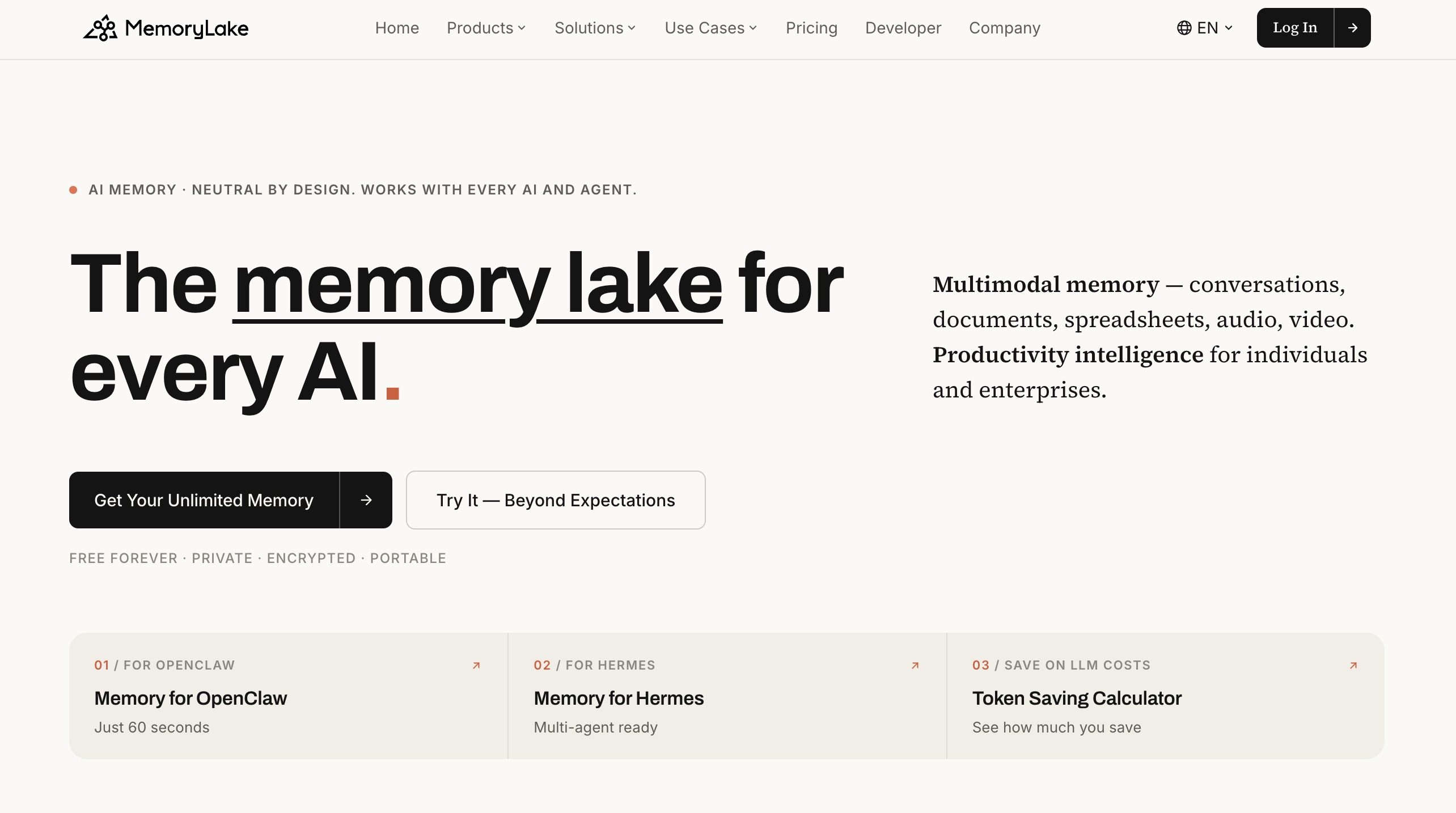
MemoryLake is a persistent memory infrastructure designed to help AI agents and applications maintain context across conversations, tasks, and sessions. Instead of treating every interaction as a fresh start, it enables AI systems to store, organize, retrieve, and reuse relevant information over time. This can include user preferences, historical interactions, important facts, task context, and other long-term knowledge. MemoryLake is suitable for a wide range of AI applications, from personal assistants and customer support agents to AI-powered workflows, multi-agent systems, and interactive virtual characters. Its focus on persistent, structured memory makes it easier for developers to build AI experiences that feel more consistent, personalized, and context-aware. For teams building agents that need to remember users and previous interactions, MemoryLake provides a dedicated memory layer that can complement existing AI models, agent frameworks, and application infrastructure. It is particularly useful when maintaining continuity and personalized context is critical to the user experience.
Key Features
- Persistent context retention across all sessions and interactions.
- Dynamic organization of historical facts, preferences, and task states.
- Structured memory layers easily integrable with existing agent frameworks.
- Multi-agent synchronization for complex AI workflows.
Pros
- Eliminates the "blank slate" problem effortlessly.
- Highly complementary to existing LLM setups without requiring massive rewrites.
- Deeply personalizes user experiences with highly accurate recall.
Cons
- Might be overly robust for simple, stateless AI tasks.
- Requires a slight paradigm shift in how developers handle prompt context.
Pricing
- $16/month.
2. Mem0
Mem0 is designed as a self-improving memory layer for personalized AI applications. It focuses heavily on understanding users over time by intelligently extracting facts, preferences, and entities from conversations to build a dynamic user profile.
Key Features
- Adaptive memory that updates and corrects itself automatically.
- Cross-platform memory syncing.
- Built-in entity and relationship extraction.
Pros
- Very fast setup for developers.
- Excellent at extracting nuanced user preferences.
Cons
- Smaller community compared to established vector databases.
- Less suited for purely document-heavy RAG without conversational context.
Pricing
- $19/month.
3. Zep
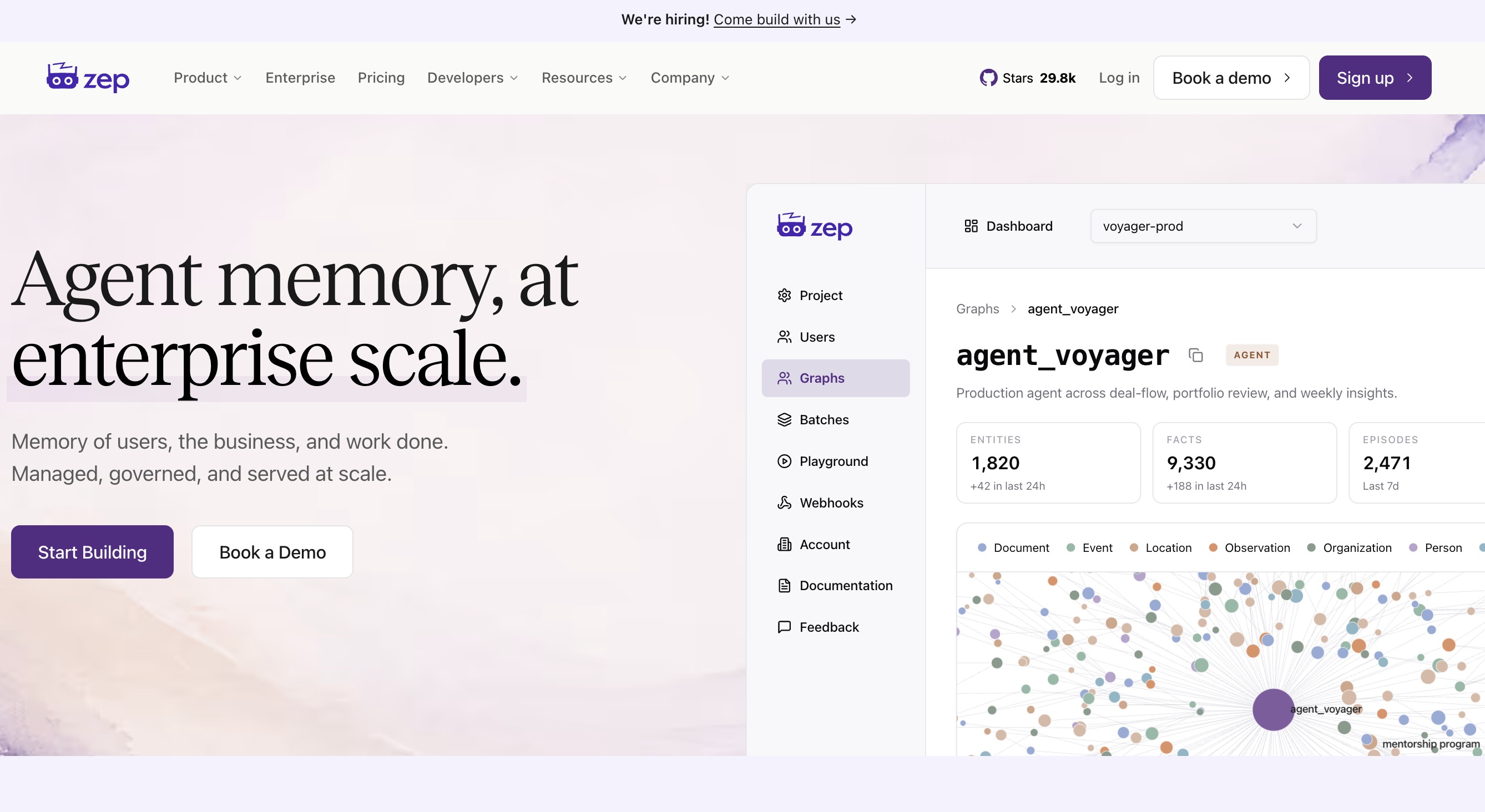
Zep is a fast, scalable long-term memory service explicitly built for AI assistants. It extracts facts, summarizes conversations on the fly, and provides low-latency retrieval so agents can respond instantly without bloated prompts.
Key Features
- Perpetual memory with automatic summarization.
- Temporal search capabilities (searching by time/date).
- Edge-compatible low latency.
Pros
- Extremely fast retrieval speeds.
- Great privacy controls with self-hosting options.
Cons
- Self-hosting requires infrastructure management skills.
- The cloud version can become expensive at scale.
Pricing
- $125/month.
4. Letta
Formerly known as MemGPT, Letta treats AI memory like a computer operating system. It utilizes tiered storage (main memory and external storage) to allow LLMs to manage infinite context windows autonomously.

Key Features
- OS-inspired memory management (RAM vs. Disk storage).
- Agentic control over when to save and discard information.
- Support for highly complex stateful agents.
Pros
- Solves the finite context window problem brilliantly.
- Ideal for autonomous agents that run indefinitely.
Cons
- Steeper learning curve for developers.
- Heavy reliance on the LLM's reasoning to manage its own memory.
Pricing
- Open-source.
5. Supermemory
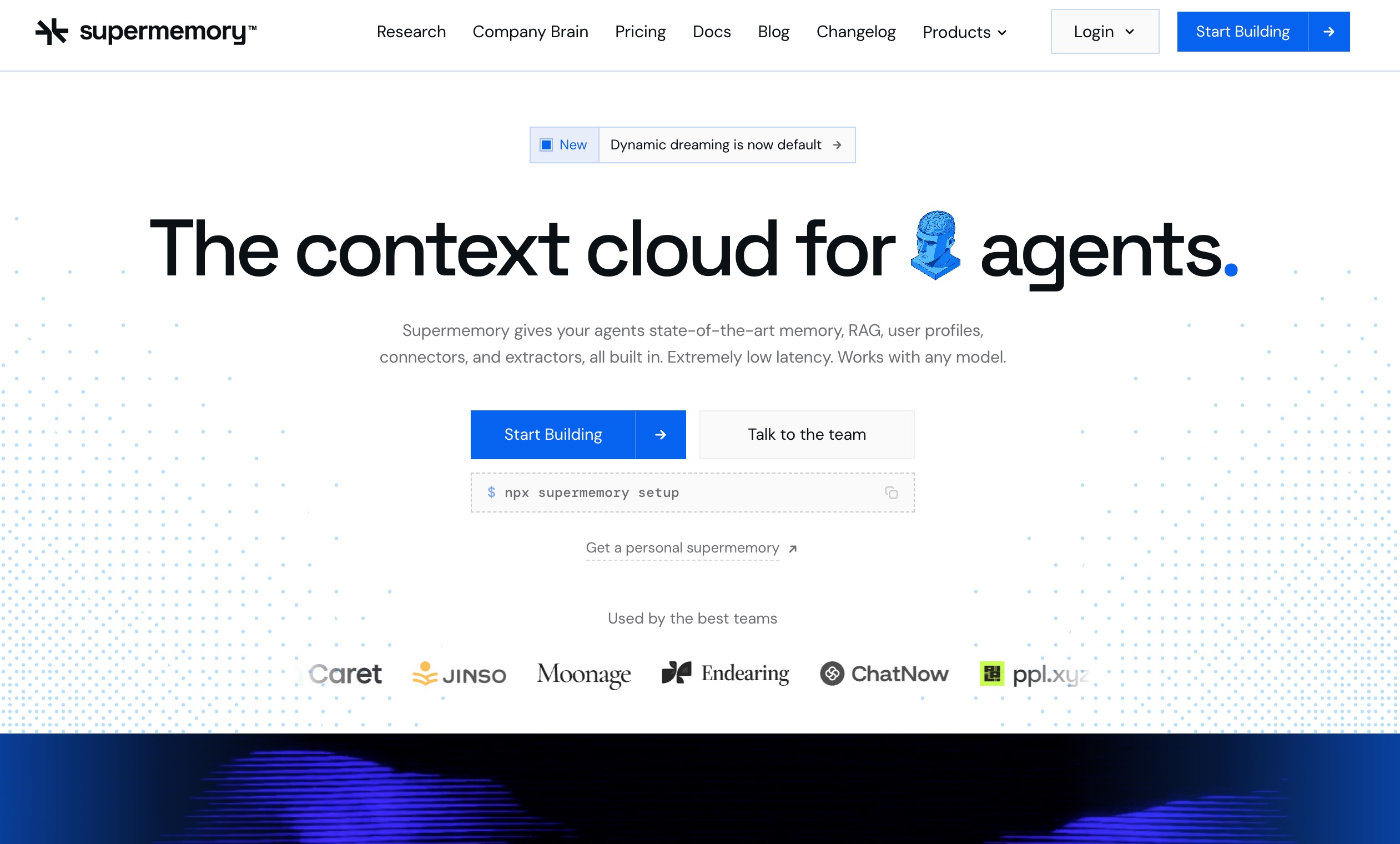
Supermemory acts as a "second brain" for users and AI. It is an open-source platform primarily geared toward knowledge management, allowing developers to build AI that remembers web pages, PDFs, and user notes.
Key Features
- Chrome extension integration for easy data saving.
- Built-in RAG capabilities for document Q&A.
- Visual dashboard for managing saved memories.
Pros
- Highly intuitive user interface.
- Great for personal knowledge management applications.
Cons
- Less suited for enterprise-grade transactional agent memory.
- Primarily focused on document ingestion rather than behavioral memory.
Pricing
- $19/month.
6. Cognee
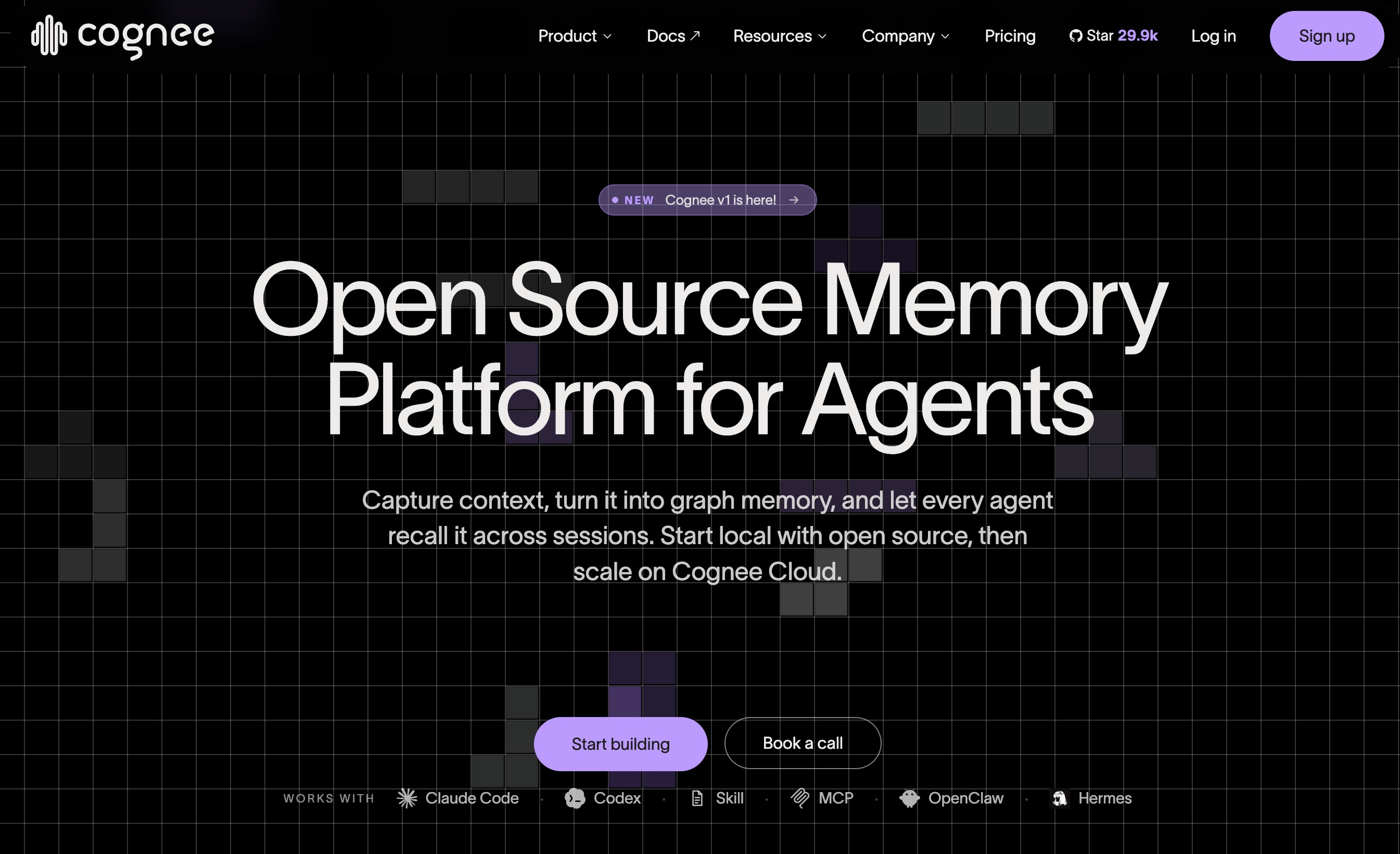
Cognee brings predictability to AI by combining graph databases with vector search. It focuses on deterministic, traceable memory, ensuring that AI agents base their answers on strict, mapped knowledge rather than hallucinations.
Key Features
- Graph-based relationship mapping.
- Deterministic memory retrieval.
- High traceability for compliance and auditing.
Pros
- Significantly reduces AI hallucinations.
- Excellent for enterprise and regulated industries (legal, medical).
Cons
- Setting up knowledge graphs requires more upfront work.
- More complex to implement than standard vector databases.
Pricing
- $2.5/1M Tokens.
7. Pinecone
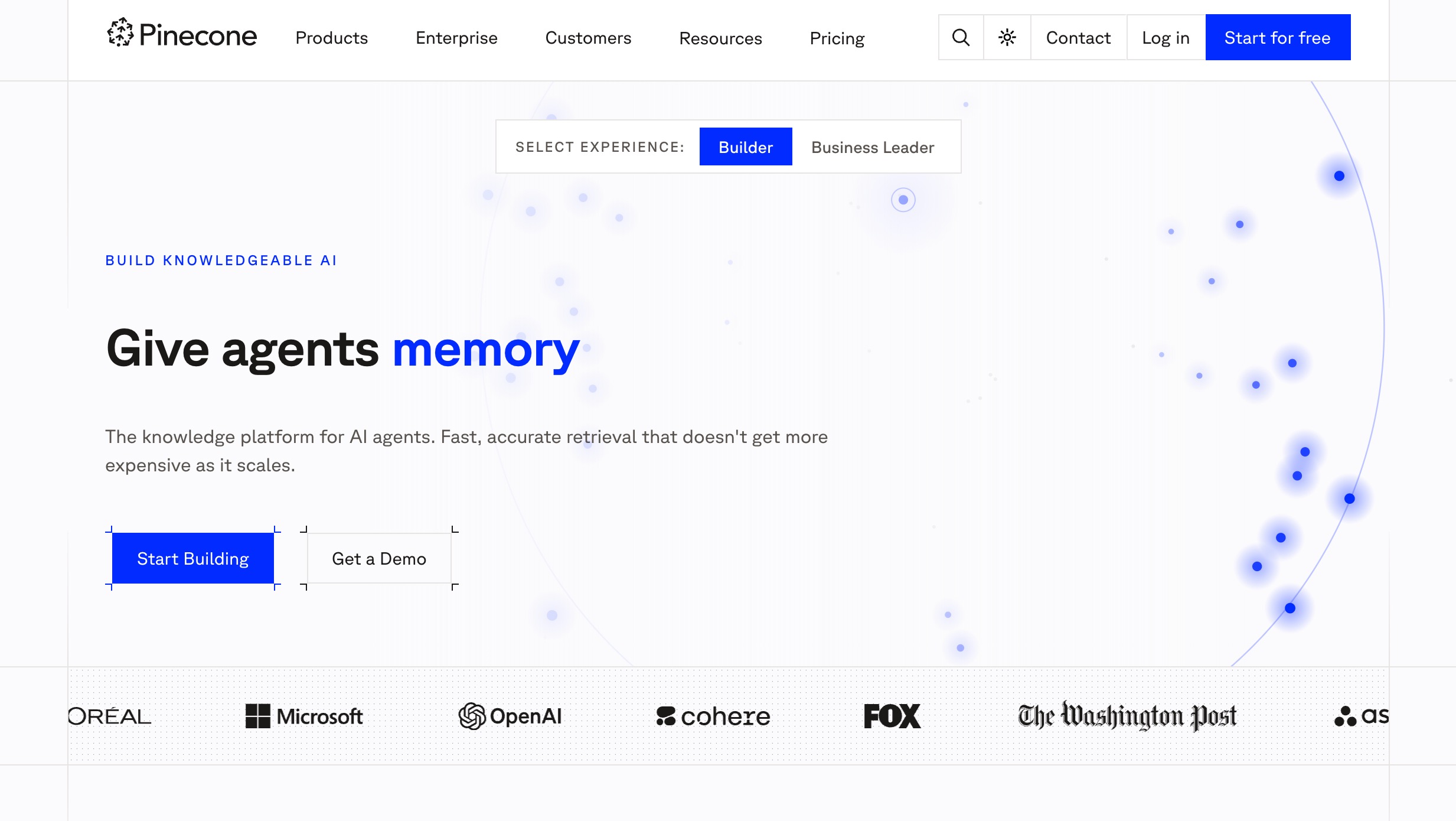
Pinecone is a highly popular, managed vector database. While not an out-of-the-box conversational memory manager, it provides the core infrastructure necessary to build scalable, high-performance RAG and memory systems.
Key Features
- Serverless architecture.
- Ultra-low latency vector search at a massive scale.
- Real-time index updates.
Pros
- Incredibly scalable and reliable.
- Zero infrastructure management required.
Cons
- Developers must build the memory logic (extraction, updating) themselves.
- No native graph capabilities.
Pricing
- $20/month.
8. Weaviate
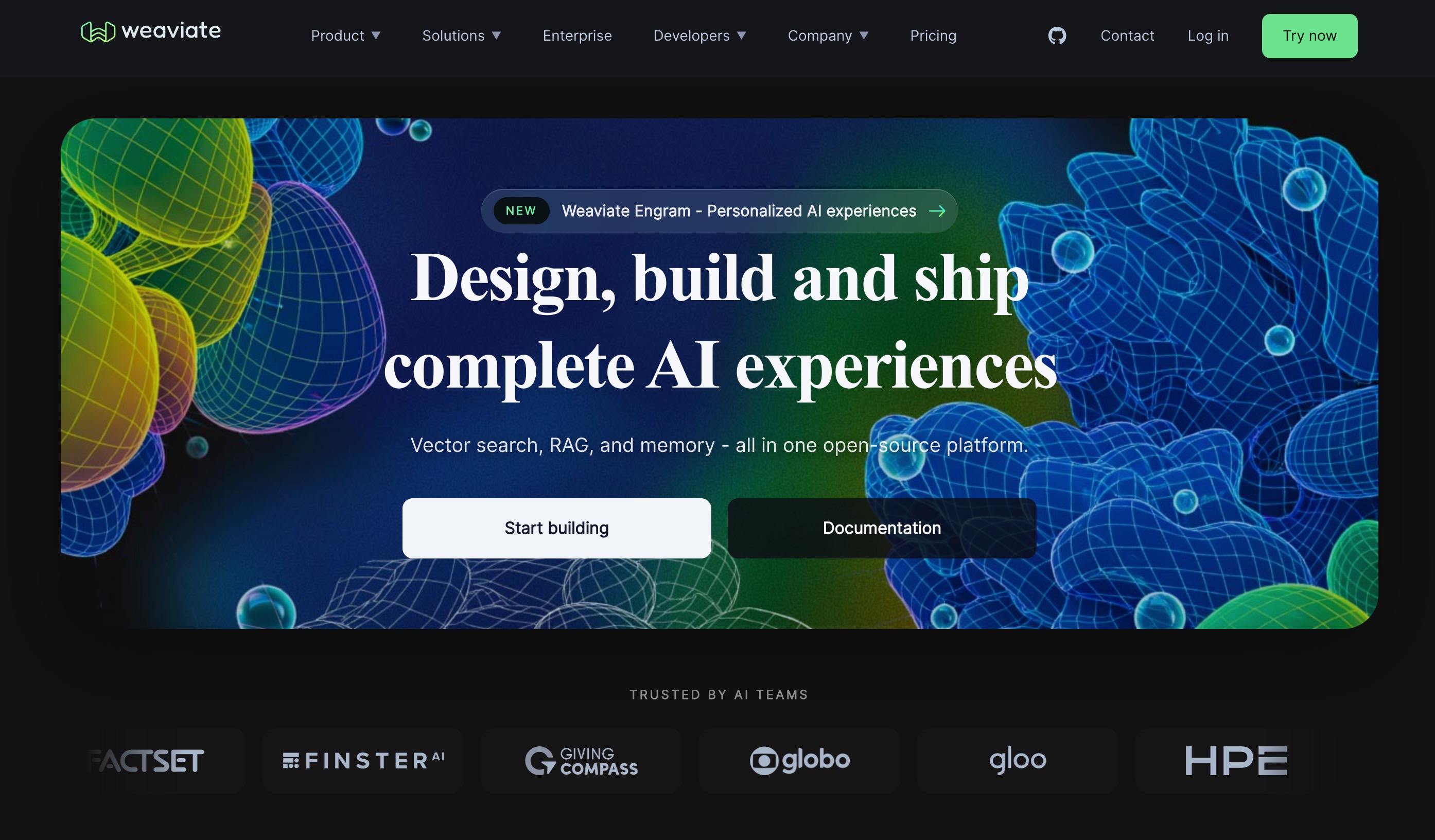
Weaviate is an open-source, AI-native vector database. It stands out by offering hybrid search capabilities, combining traditional keyword search (BM25) with semantic vector search, making it an excellent backend for custom memory.
Key Features
- Hybrid search (Vector + Keyword).
- Modular architecture with built-in vectorization.
- Multi-tenancy support.
Pros
- Highly flexible and customizable.
- Excellent ecosystem integrations (Hugging Face, OpenAI).
Cons
- Can be resource-intensive to self-host effectively.
- Requires building custom orchestration for conversational memory.
Pricing
- $45/month.
9. LangMem
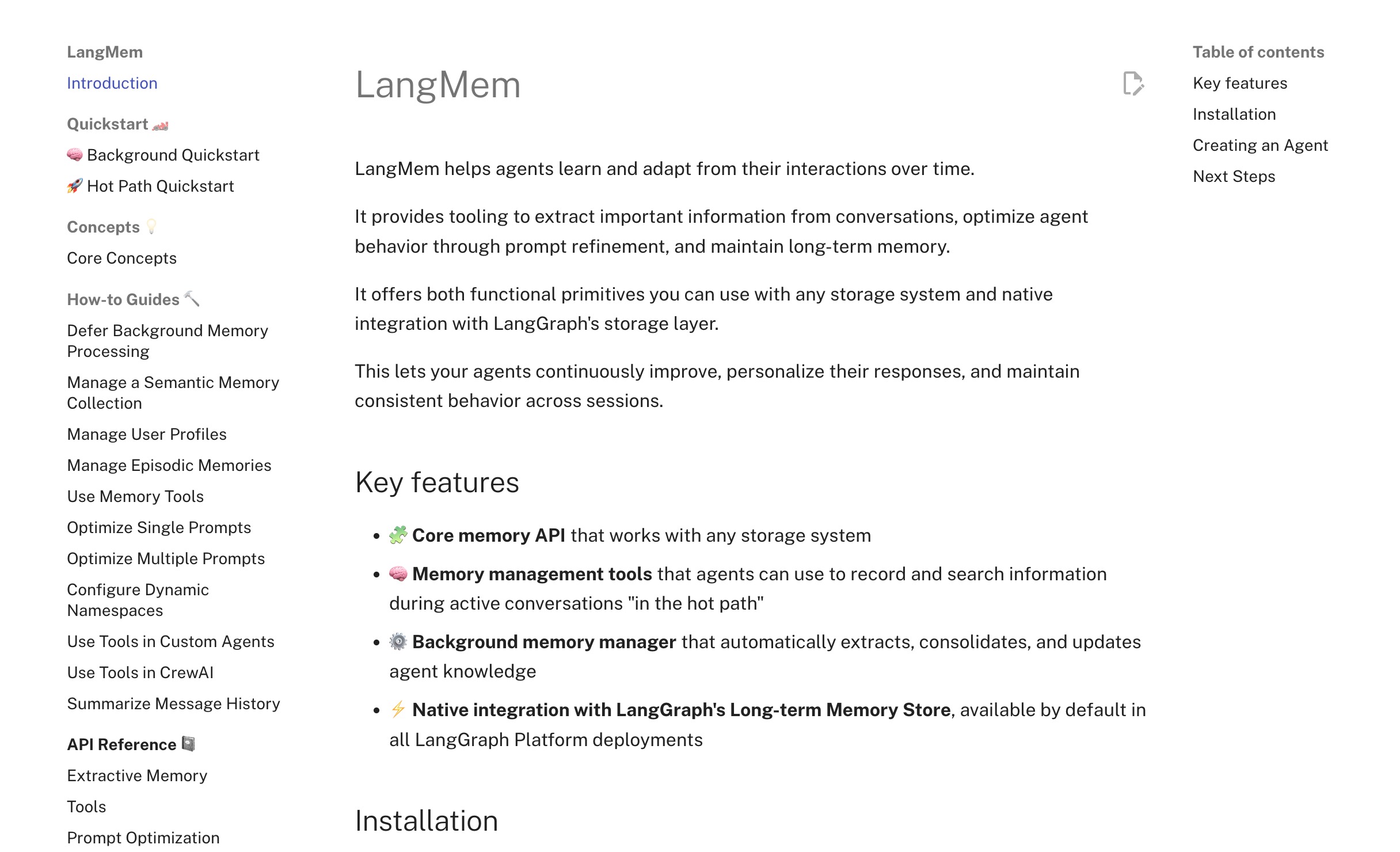
LangMem is the dedicated memory service for the LangChain ecosystem. It provides agents with long-term memory by running background tasks that extract, consolidate, and clean up conversational data over time.
Key Features
- Deep integration with LangChain and LangGraph.
- Asynchronous memory optimization.
- Multi-agent shared memory profiles.
Pros
- Seamless if you are already using LangChain.
- Background processing keeps agent response times fast.
Cons
- Heavily tied to the LangChain ecosystem.
- Can be restrictive if you prefer custom or alternative orchestration.
Pricing
- Open source.
10. Memori
Memori is focused on creating interactive digital twins and conversational personas. It provides an API that allows developers to infuse distinct personalities and specific personal memories into avatars or chatbots.
Key Features
- Persona and digital twin creation tools.
- High-fidelity conversational memory.
- Pre-built dialogue management.
Pros
- Perfect for gaming, virtual companions, and consumer AI.
- Very easy to give an AI a distinct "identity."
Cons
- Not intended for enterprise data retrieval or complex RAG.
- Niche use-case focus.
Pricing
- Custom pricing.
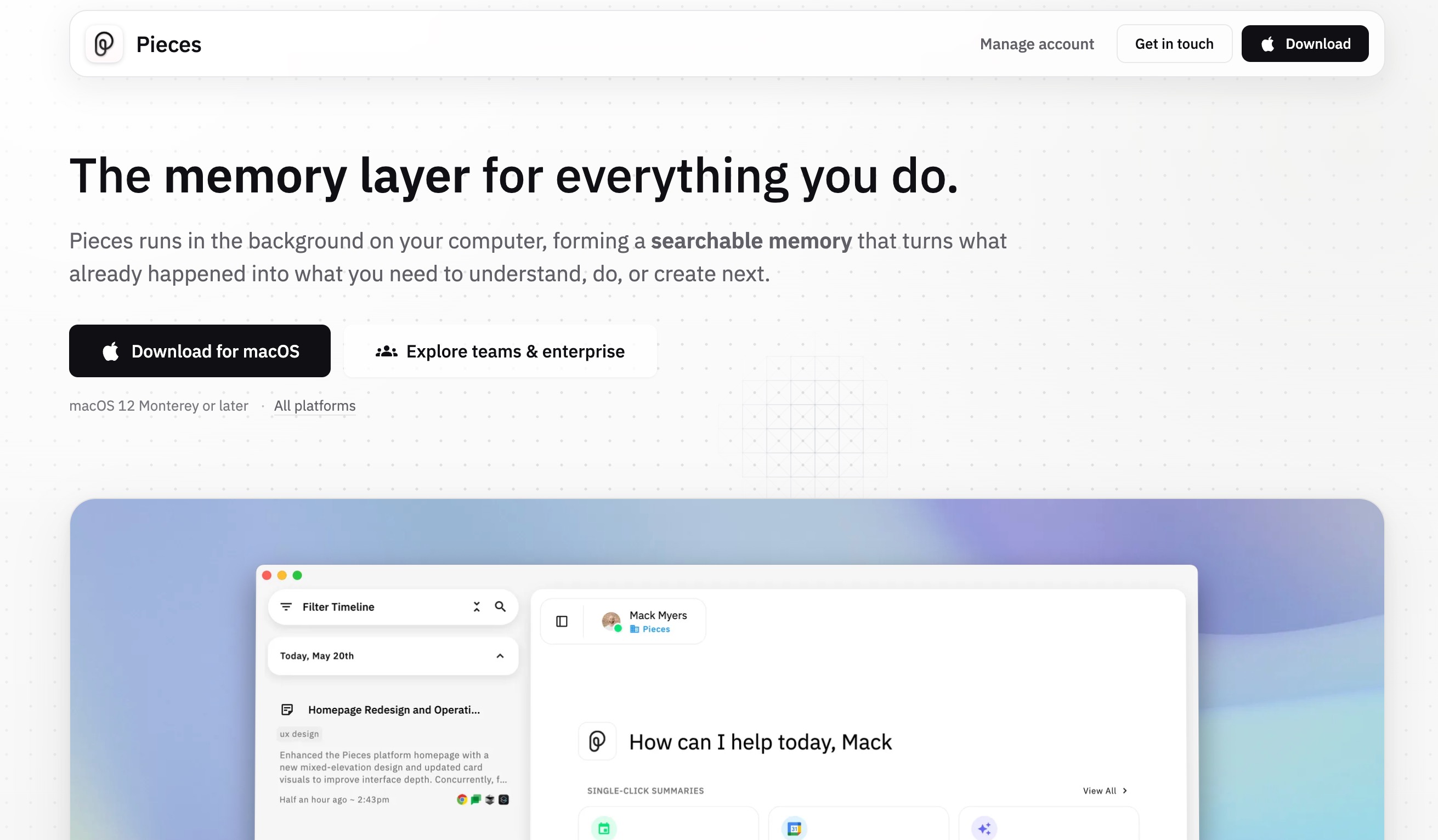
11. Pieces
Pieces is an on-device contextual memory engine designed primarily for developer workflows. It captures context from your IDE, browser, and clipboard, allowing local AI to assist you based on your exact working environment.
Key Features
- Local, on-device memory processing.
- Deep integrations with developer tools (VS Code, Chrome).
- Multimodal context capture (code, images, text).
Pros
- Exceptional privacy due to on-device processing.
- Incredible productivity booster for developers.
Cons
- Geared strictly towards developer workflows, not general application backends.
- Dependent on local machine resources.
Pricing
- Open source.
12. Redis
Traditionally known as an in-memory caching system, Redis has evolved to include powerful vector search capabilities. It is ideal for developers who need blistering fast real-time memory retrieval for their AI applications.
Key Features
- In-memory data structure store.
- RedisVL (Vector Library) for AI.
- Sub-millisecond latency.
Pros
- Unmatched speed for real-time applications.
- Highly proven, battle-tested infrastructure.
Cons
- Managing long-term persistent memory can be expensive due to RAM requirements.
- Requires significant custom logic to function as a conversational memory bank.
Pricing
- Open-source available; Redis Enterprise offers varied cloud pricing.
How to Choose the Best Google Memory Bank Alternative
Selecting the right infrastructure depends heavily on your technical requirements and use case:
- For Raw Infrastructure: If you have a large engineering team and want to build your memory logic from scratch, raw vector databases like Pinecone or Weaviate are excellent, highly scalable choices.
- For Ecosystem Integration: If your entire stack is built on LangChain, adopting LangMem will provide the most friction-free experience.
- For Extreme Privacy and Local Development: Pieces is unrivaled for on-device developer context, while Zep offers great self-hosted privacy for assistants.
- For Complete, Intelligent Memory Persistence: MemoryLake emerges as the superior choice for most applications. While other tools either require you to build the memory management logic yourself (like Redis or Pinecone) or lock you into specific frameworks, MemoryLake delivers a ready-to-use, structured persistent memory layer. It intuitively maintains context, user preferences, and task continuity without adding backend complexity.
Final Verdict
The shift from stateless AI to context-aware agents is the most critical leap in modern software development. While Google Vertex AI offers a robust set of tools, stringing them together into a functional memory bank can drain developer resources and time.
If you want to build AI experiences that truly remember, learn, and adapt to users over time, you need a dedicated memory infrastructure. MemoryLake stands out as the ultimate solution. By offering a persistent, structured memory layer that seamlessly integrates with existing frameworks, it allows developers to focus on building incredible agentic workflows rather than wrestling with database infrastructure. Make your AI smarter, more consistent, and deeply personalized and start building with MemoryLake today.