
What Is Memory in Vibe Coding
- Persistent Context Retention: Memory refers to the ability of an AI coding agent to retain project-specific knowledge, files, and architectural decisions across multiple sessions or entirely different chats.
- State Management for AI: It functions as a state machine for your natural language instructions. When you specify a preferred UI library or API structure, memory ensures the agent remembers these constraints automatically in the future.
- Cross-Platform Knowledge Portability: In a multi-agent environment, memory acts as the glue. It allows context established in a UI design tool to be seamlessly carried over and understood by a logic-oriented workspace.
- Automated Context Injection: At a technical level, memory involves vector databases and knowledge graphs integrated into the agent's prompt, pulling up relevant past interactions exactly when the AI needs them to generate accurate code.
- Preference and Rule Enforcement: It goes beyond just code snippets, capturing developer preferences, coding styles, linting rules, and formatting standards so that the AI outputs consistent results without needing manual prompting every time.
Why Vibe Coding Tools Need Memory in 2026
- Eliminating Repetitive Onboarding: As software projects become more intricate, re-explaining your database schema, authentication flow, or API endpoints wastes valuable development time and disrupts the creative flow.
- Preventing Context Window Exhaustion: Modern applications require massive amounts of context. Simply pasting all previous files into a prompt is no longer viable due to token limits. Dedicated memory provides targeted, relevant context retrieval.
- Enabling Multi-Tool Orchestration: Developers rarely use just one AI tool. You might use Lovable for UI components, Bolt for full-stack scaffolding, and Replit for deployment. Memory ensures that all these tools share a unified understanding of your project.
- Maintaining Architectural Consistency: Without a memory system, an AI might use Tailwind CSS in one prompt and standard CSS in another. Memory guarantees that the underlying architectural rules are enforced strictly across all generations.
- Reducing Hallucinations and Errors: When an agent remembers the exact variables, dependencies, and environment setups established previously, it is significantly less likely to hallucinate non-existent functions or implement incompatible libraries.
- Supporting Long-Term Maintenance: Vibe coding isn't just about building the first version; it's about maintaining and upgrading. A robust memory layer ensures that months down the line, your AI agent knows exactly why a specific code workaround was implemented.
10 Best Memory Fixes for Vibe Coding Tools in 2026
Here is a quick overview of the 10 best AI memory solutions currently transforming how we build software:
| Product | Best For | Core Technology | Pricing Model |
|---|---|---|---|
| MemoryLake | Cross-tool AI workflows & MCP | Persistent context layer via MCP | Freemium / $19/month |
| Supermemory | Building a personal AI brain | Vector search & knowledge graphs | $19/month |
| Mem0 | Multi-agent personalization | LLM-based memory layer | $19/month |
| Zep | Long-term episodic memory | Temporal knowledge graphs | $125/month |
| Pieces | On-device code snippet recall | Local AI processing | Custom |
| Arize | AI observability & memory tracing | LLM evaluation frameworks | $50/month |
| Motorhead | Fast, high-performance memory server | Rust-based vector memory | Open-source |
| Agentscamp | Curated AI skills & agent memory | Standardized SKILL.md resources | Free |
| CognitiveX | Living cognitive AI loops | Large Cognition Model (LCM) | $20/month |
| MemoryBase | Cross-model chat synchronization | Unified memory vaults | $14/month |
1. MemoryLake
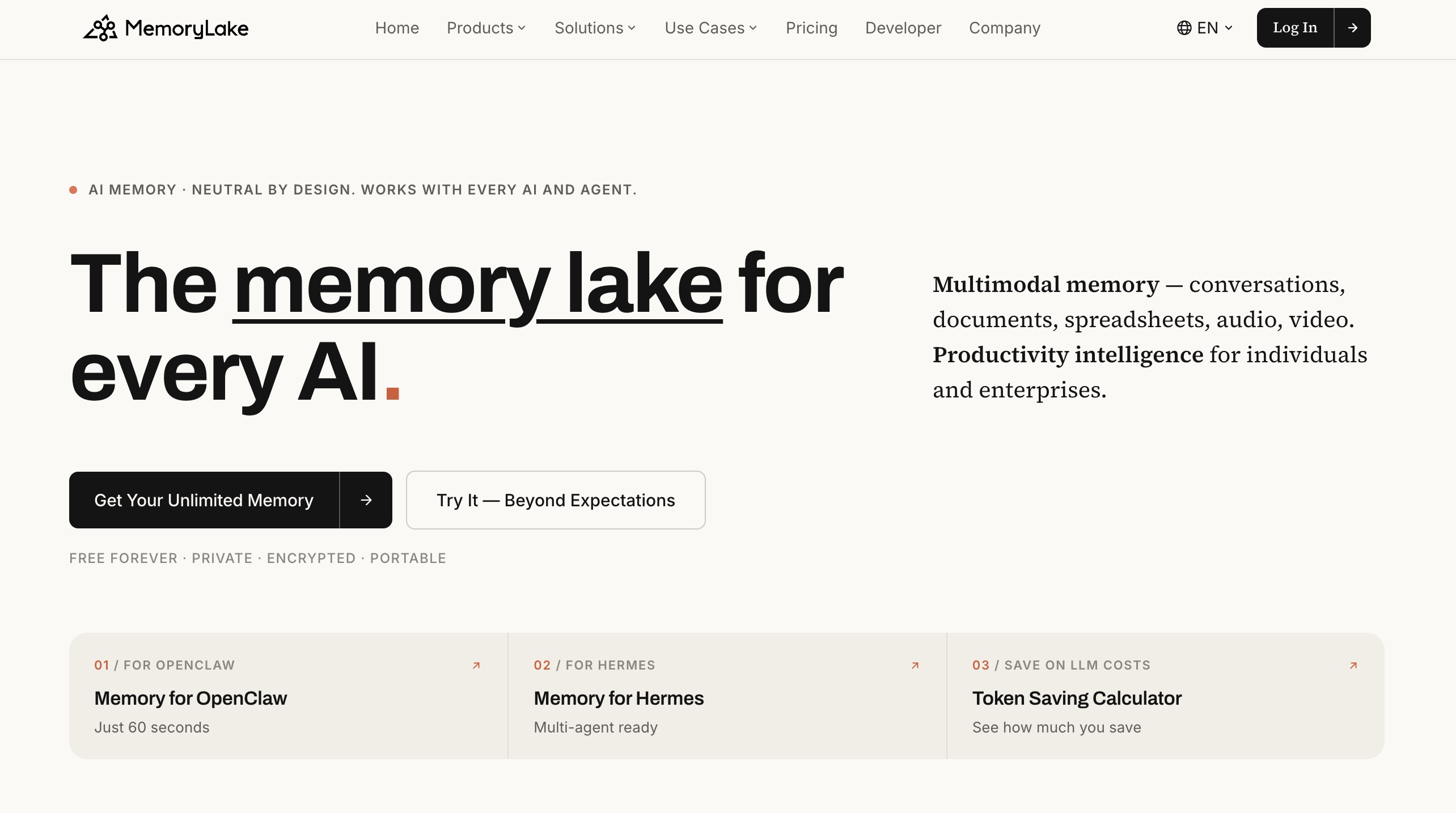
MemoryLake is a cross-model AI memory layer designed to help users build persistent context across their AI workflows. It allows users to store project knowledge, documents, preferences, and important information in one place, then make that memory available across different AI tools through MCP (Model Context Protocol) integration. Unlike built-in memories tied to a single platform, MemoryLake keeps your context portable, enabling AI assistants to better understand your projects over time. Whether you are coding with AI agents, managing research workflows, or collaborating across multiple AI applications, MemoryLake helps reduce repetitive explanations and creates a more consistent, personalized AI experience.
Key Features
- Cross-model persistent context management.
- Seamless MCP (Model Context Protocol) integration for dynamic injection.
- Centralized storage for documents, coding guidelines, and custom preferences.
- High-portability architecture designed for multi-tool switching.
- Automated context retrieval that scales with your project.
Pros
- Works seamlessly with top vibe coding platforms like Bolt, v0, Lovable, and Replit.
- Eliminates platform lock-in by ensuring your context is entirely portable.
- Drastically reduces the time spent writing long, repetitive onboarding prompts.
- Highly consistent and personalized to your specific project architectures.
Cons
- Requires a brief initial setup process to configure the MCP server connections.
- The extensive workflow capabilities might take time to fully master for casual users.
Pricing
Freemium model with generous free tiers; paid plans start at $19/month.
2. Supermemory
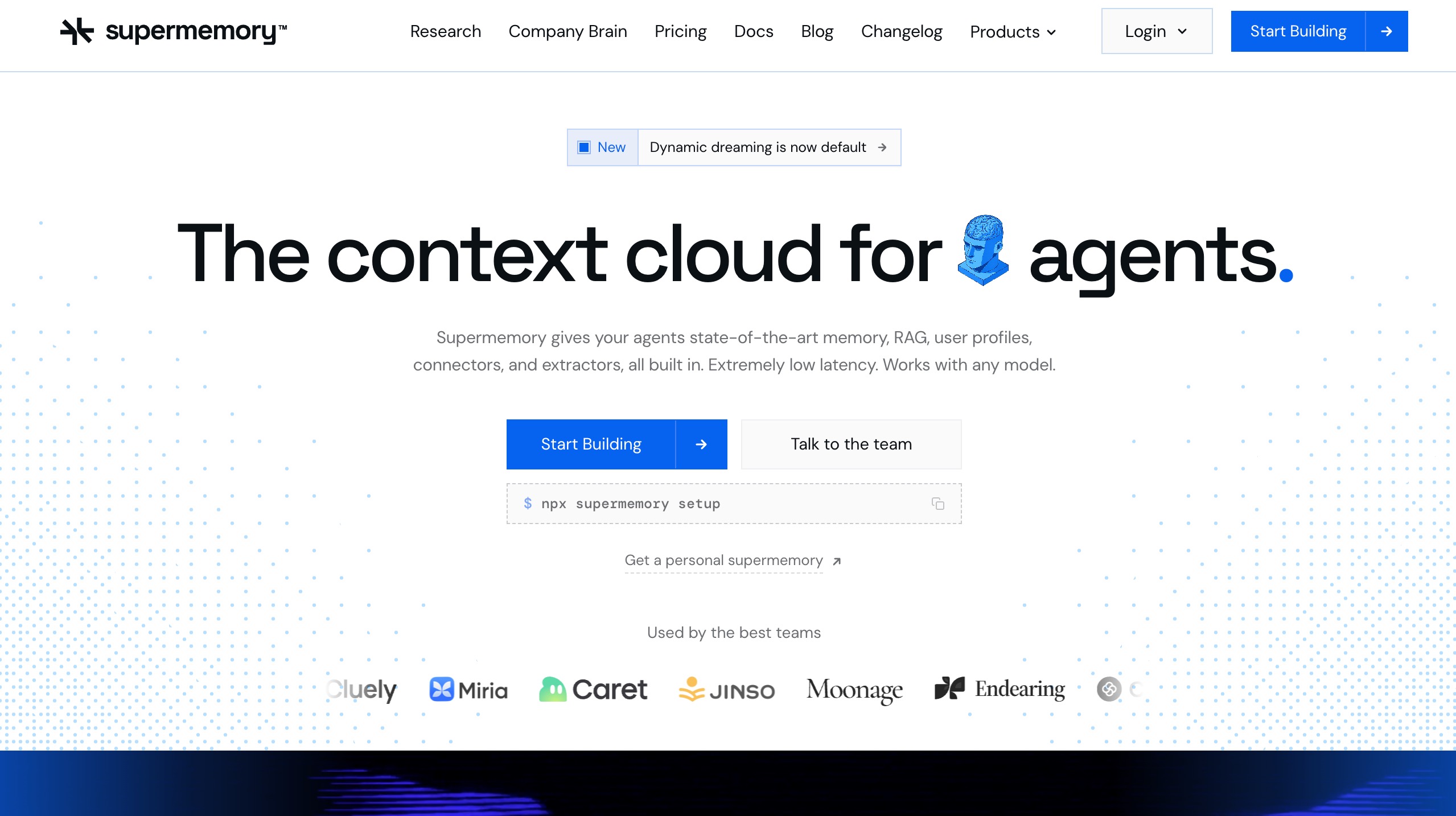
Supermemory acts as a secondary brain designed specifically for developers and knowledge workers. It focuses on saving code snippets, bookmarks, and contextual data, functioning as a retrieval-augmented playground where coding agents can fetch exact data from your previously saved workflows to maintain continuity.
Key Features
- Universal saving mechanism for web links and raw code snippets.
- Built-in AI chat allowing you to directly query your saved data.
- Open-source architecture optimized for self-hosting.
- Automatic categorization and tagging of technical documentation.
Pros
- Excellent for developers who research heavily before coding.
- Fully open-source, promoting transparency and community updates.
- Integrates deeply into standard browser workflows.
Cons
- Lacks the direct, native MCP integrations needed for instant cross-IDE synchronization.
- Requires manual saving habits compared to fully automated context systems.
Pricing
Free and open-source, with managed cloud options starting at around $19/month.
3. Mem0
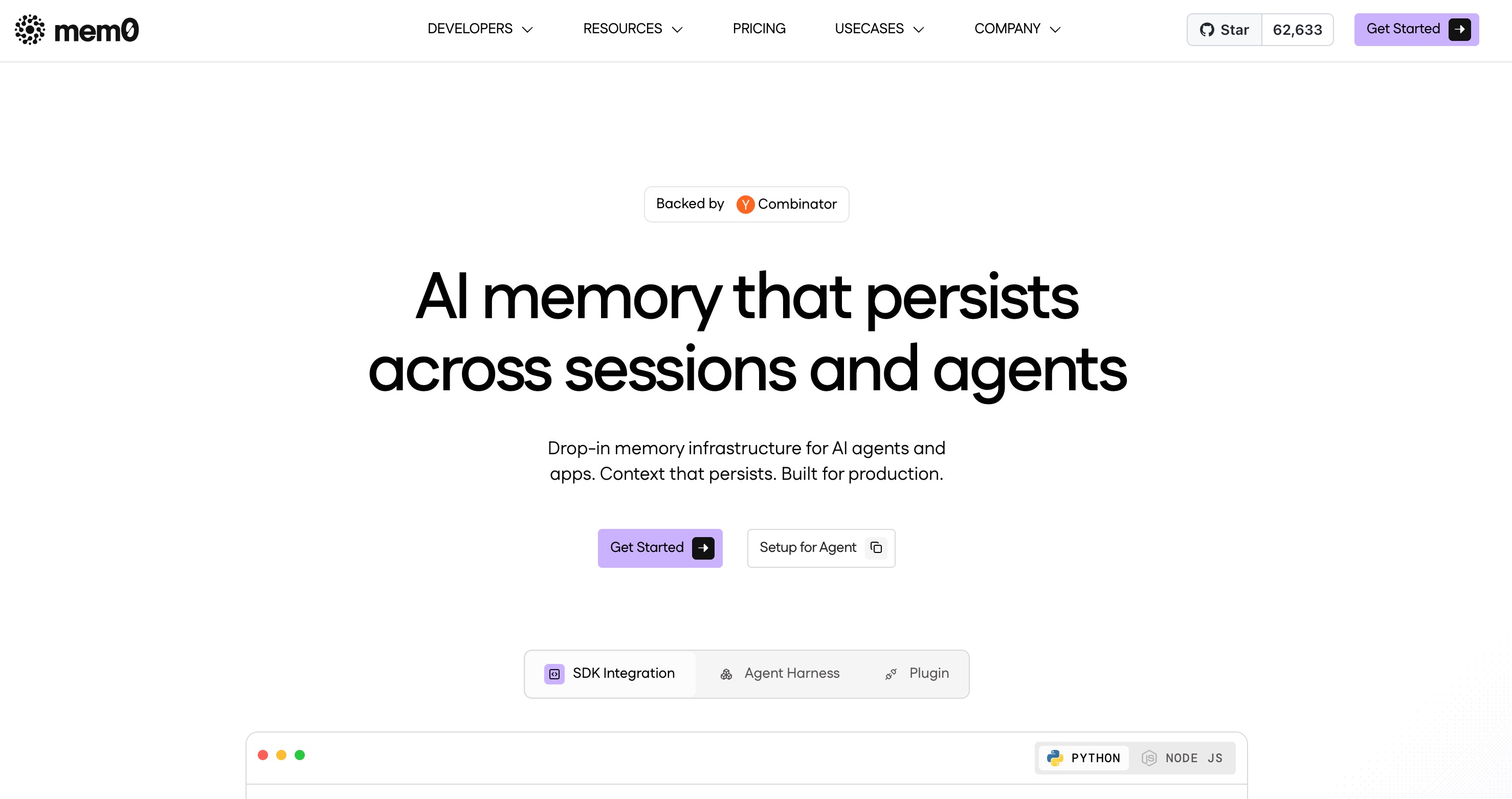
Mem0 (formerly Embedchain) is a highly advanced memory layer built specifically for AI agents and assistants. It zeroes in on personalizing the AI experience by retaining long-term user preferences, making it a stellar backend engine for developers who are building their own tailored vibe coding environments.
Key Features
- Multi-agent memory synchronization capabilities.
- High-level personalization APIs to adjust tone and rules.
- Adaptive learning that automatically corrects and updates memories.
- Graph-based relational understanding of project variables.
Pros
- Highly developer-friendly with robust and clear API documentation.
- Automatically resolves and manages conflicting information in its memory banks.
- Perfect for scaling complex, custom multi-agent architectures.
Cons
- Geared predominantly toward developers building tools rather than end-users operating them.
- Costs can escalate rapidly with high-frequency API request volumes.
Pricing
Paid plans start at $19/month.
4. Zep
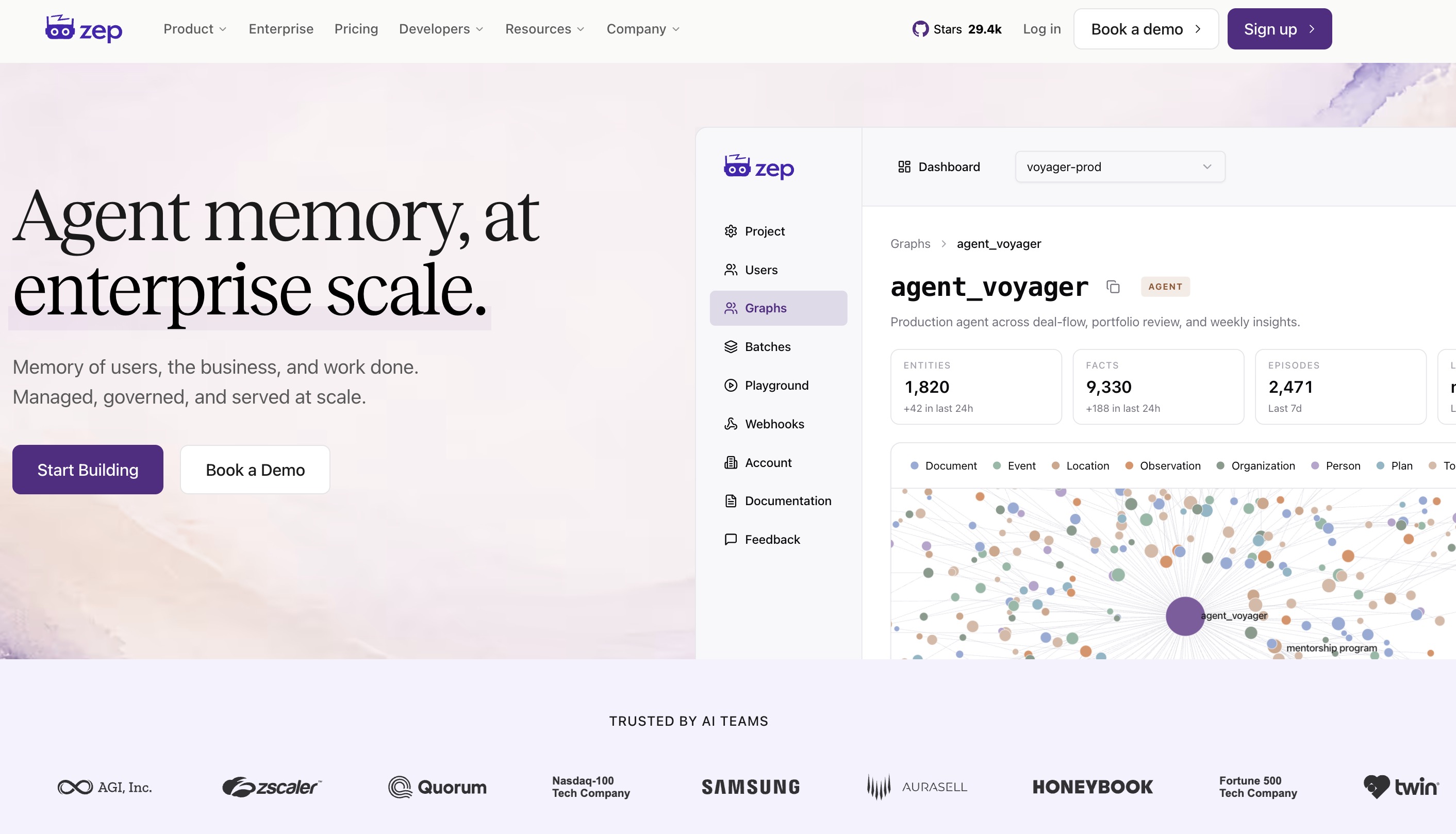
Zep provides a long-term memory service tailored for AI applications, utilizing temporal knowledge graphs to give AI agents an understanding of historical context over time. It guarantees ultra-low latency, ensuring that your intense vibe coding sessions are not bottlenecked by sluggish memory retrieval.
Key Features
- Temporal knowledge graph architecture for understanding state changes over time.
- Sub-200ms context retrieval speeds.
- Built-in data privacy, isolation, and auto-redaction features.
- Automatic dialog and document background summarization.
Pros
- Incredibly fast retrieval, which is crucial for real-time coding agents.
- Advanced graphing helps AI understand deeply nested project histories.
- Strong enterprise-grade security and privacy controls.
Cons
- Often overkill for small, single-file projects or casual builders.
- The initial infrastructure setup can be intimidating for those unfamiliar with knowledge graphs.
Pricing
Freemium platform; Zep Cloud offers scalable enterprise pricing based on volume.
5. Pieces
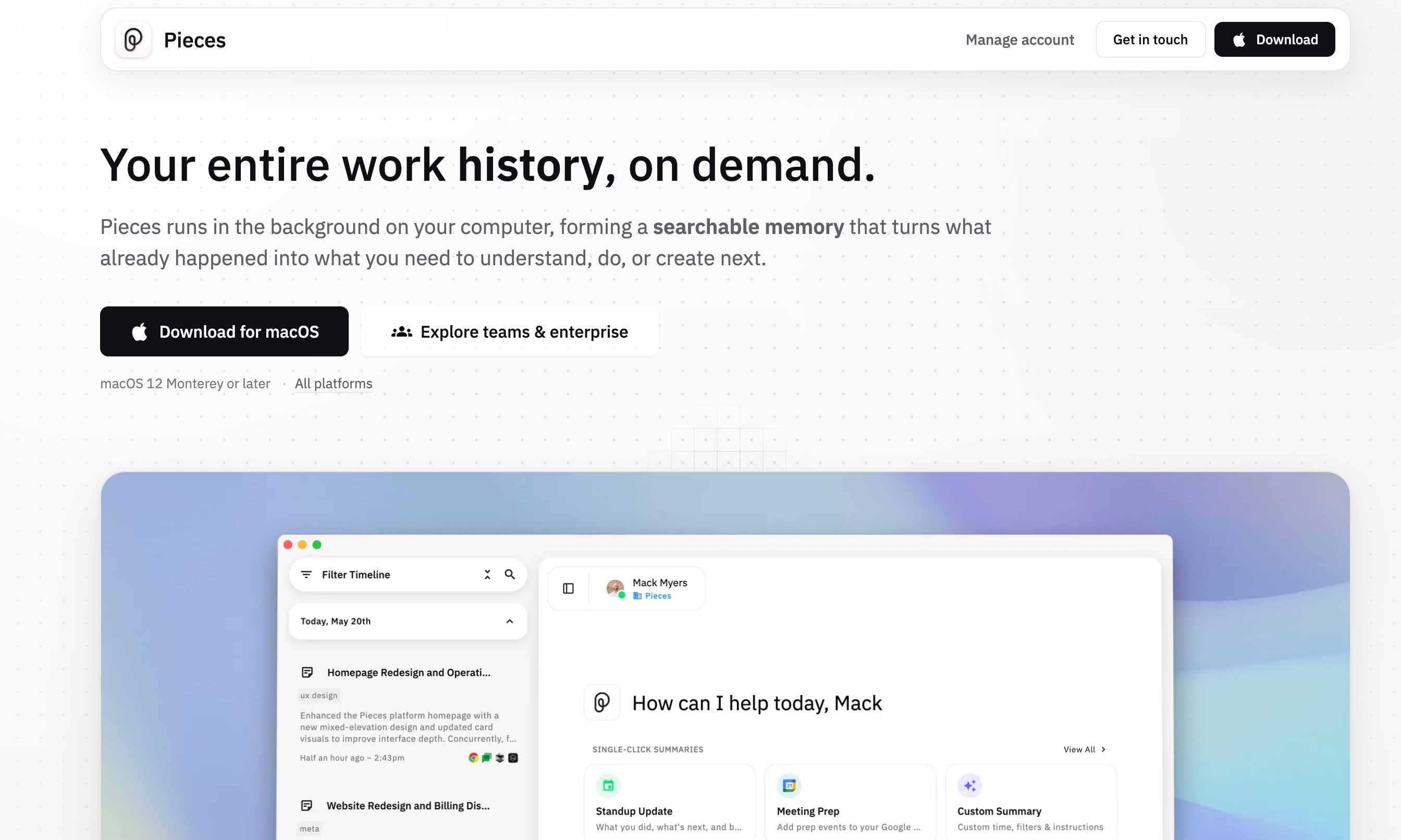
Pieces is an on-device AI memory platform aimed directly at developers. It captures, enriches, and organizes code snippets, workflow context, and browser research. By running strictly locally, it ensures maximum privacy while integrating deeply with popular coding environments.
Key Features
- On-device AI processing ensuring complete data privacy.
- Deep plugin integrations with VS Code, JetBrains, and popular browsers.
- Automatic enrichment of saved code with AI-generated tags and explanations.
- Full offline functionality for disconnected work.
Pros
- Zero latency since it processes all data locally on your hardware.
- Unmatched security for enterprise or proprietary, sensitive codebases.
- Seamless drag-and-drop context management across desktop applications.
Cons
- Resource-intensive, requiring a modern local machine to run smoothly.
- Not natively designed to push context up into cloud-based vibe coding tools like v0.
Pricing
Completely free for individual developers, with paid enterprise team plans available.
6. Arize
While Arize is traditionally known as an AI observability and monitoring platform, its tracing and evaluation tools act as a crucial "memory auditor." For complex vibe coding environments, Arize ensures that the memory your agents pull from is accurate, uncorrupted, and hallucination-free.
Key Features
- Full trace visibility into exactly what context an LLM retrieves.
- Automated evaluation of RAG relevancy and memory accuracy.
- Troubleshooting tools to prevent context window overload.
- Detailed performance dashboards.
Pros
- Phenomenal for debugging the exact moment an AI agent "forgot" a rule.
- Enterprise-grade reliability, analytics, and uptime.
- Provides highly actionable insights for optimizing memory systems.
Cons
- Not a memory storage solution itself; it merely monitors your existing memory setups.
- Steep learning curve meant for ML engineers rather than everyday developers.
Pricing
Free trai; paid plans start at $50/month.
7. Motorhead
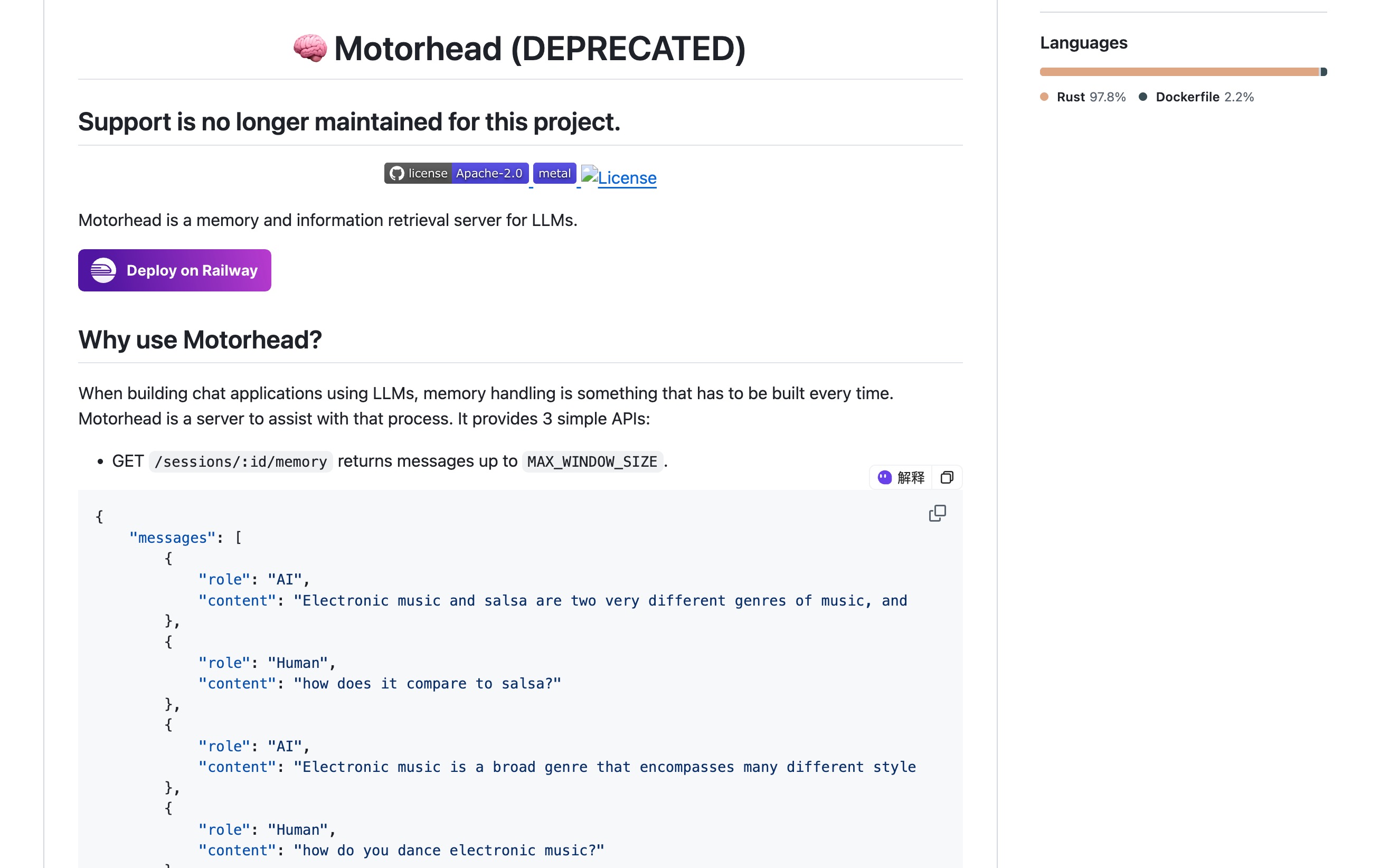
Motorhead is a Rust-based memory server designed for maximum performance in AI applications. Built for developers who need to implement high-speed, incremental memory into their custom coding agents, it excels at keeping track of rapidly changing states in dense coding sessions.
Key Features
- Rust-based engine ensuring extreme performance and low overhead.
- Incremental background summarization of chat histories.
- Drop-in compatibility with major AI frameworks like LangChain.
- Stateless design making it incredibly easy to scale horizontally.
Pros
- Lightweight, highly optimized, and incredibly fast.
- Easy to deploy locally or in the cloud via Docker.
- Background summarization effectively keeps LLM token counts low.
Cons
- Lacks a user-friendly graphical interface; it is entirely CLI/API based.
- Requires users to manage their own infrastructure and hosting.
Pricing
100% open-source and free to use.
8. Agentscamp
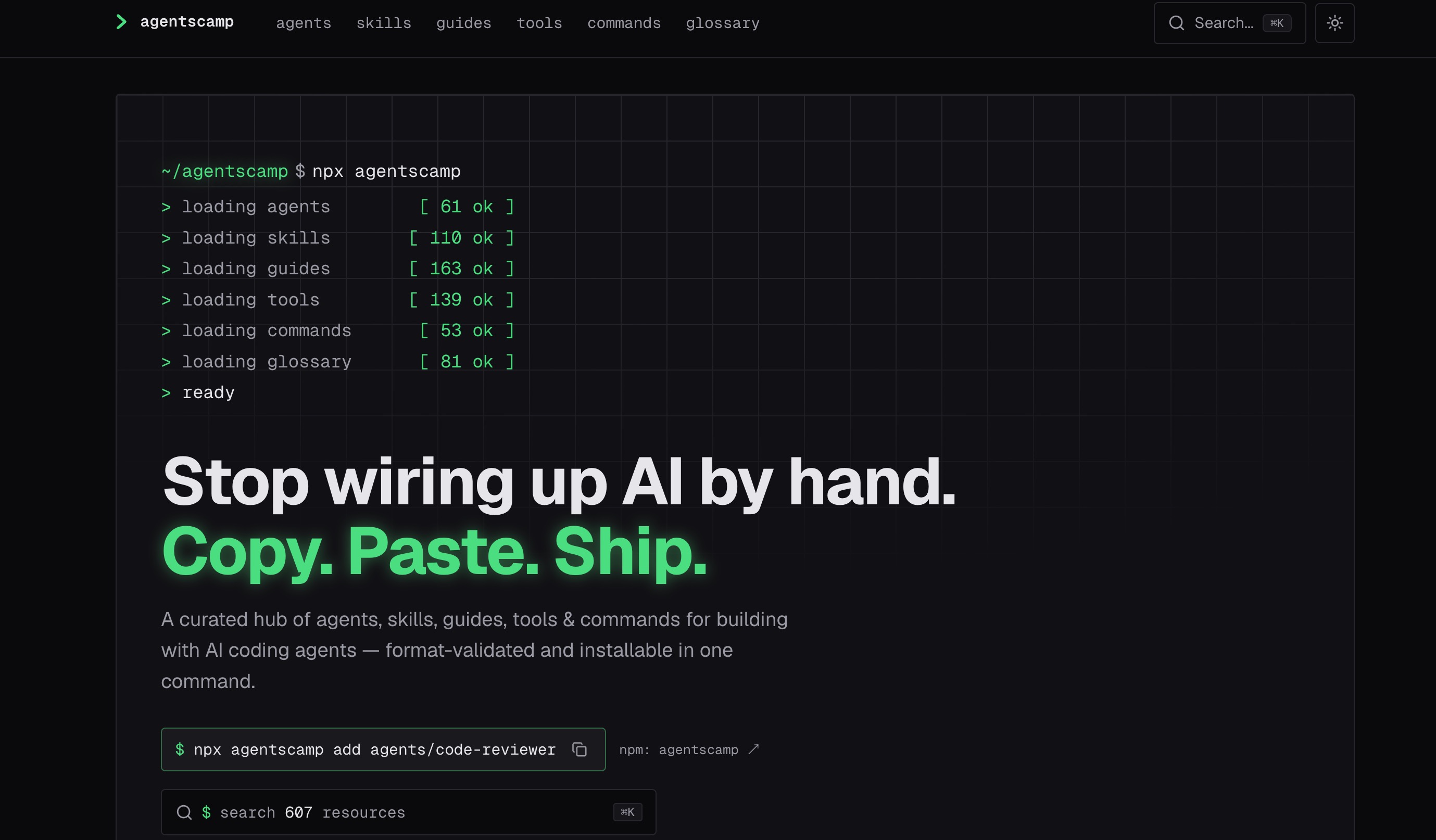
Agentscamp serves as a curated hub and directory for building with AI coding agents. While primarily a repository of agents and skills, it acts as a standardized memory resource. By championing the open SKILL.md standard, it allows developers to inject validated, reusable capabilities and procedural memory into their agents on demand.
Key Features
- Curated library of drop-in AI skills, agents, and prompts.
- Format-validated resources adhering to the SKILL.md standard.
- Progressive disclosure techniques to load memory context only when relevant.
- NPM-based command-line interface for rapid agent installation.
Pros
- Standardizes how AI agents understand and remember specific coding tasks.
- Prevents token bloat by dynamically loading skills exactly when they are needed.
- Offers a massive, community-vetted ecosystem of workflows.
Cons
- Focuses more on procedural memory (how to do things) than episodic memory (your specific project history).
- Requires a comfortable familiarity with terminal environments to utilize fully.
Pricing
Free to browse and use the open directory of resources.
9. CognitiveX
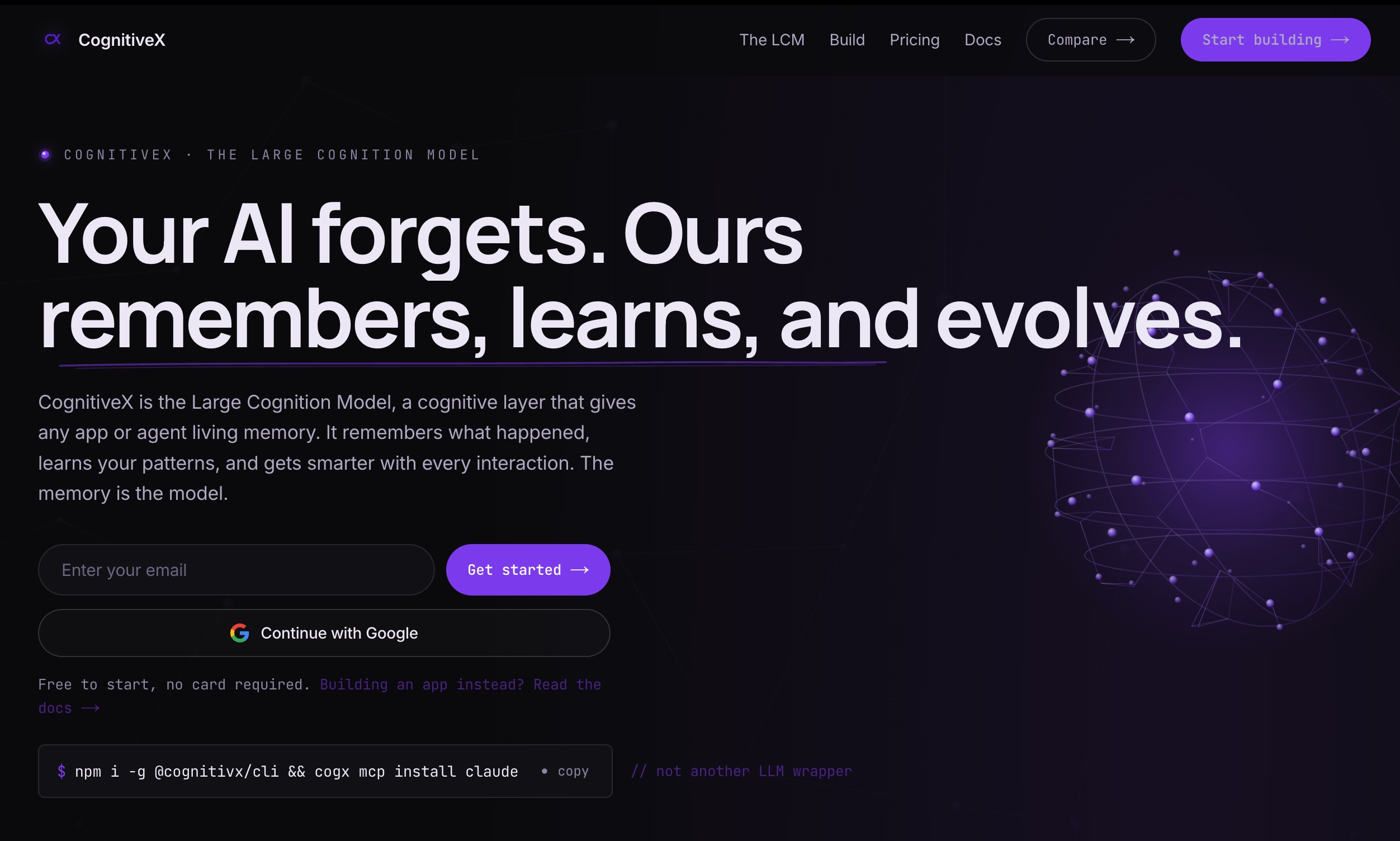
CognitiveX positions itself as the Large Cognition Model (LCM), a sophisticated cognitive layer that endows AI with a living, evolving memory. By utilizing four distinct tiers of memory, it dynamically learns, reflects, and evolves with every single interaction across your entire coding stack.
Key Features
- Four-tier living memory structure (semantic, episodic, procedural, foundational).
- Overnight dream consolidation designed to compress noise into usable insights.
- Cross-tool continuity enabled via native MCP integrations.
- Automated pattern detection and salience weighting for accurate retrieval.
Pros
- Exhibits a highly sophisticated understanding of complex, long-term coding preferences.
- Seamlessly connects and synchronizes tools like Claude, Cursor, and ChatGPT.
- Evolves and gets smarter organically without requiring manual prompt updates.
Cons
- The abstract, complex architecture may take time for traditional developers to fully grasp.
- Still represents a relatively new, paradigm-shifting approach in the AI agent space.
Pricing
Free to start; advanced personal and enterprise plans are tiered based on context volume.
10. MemoryBase
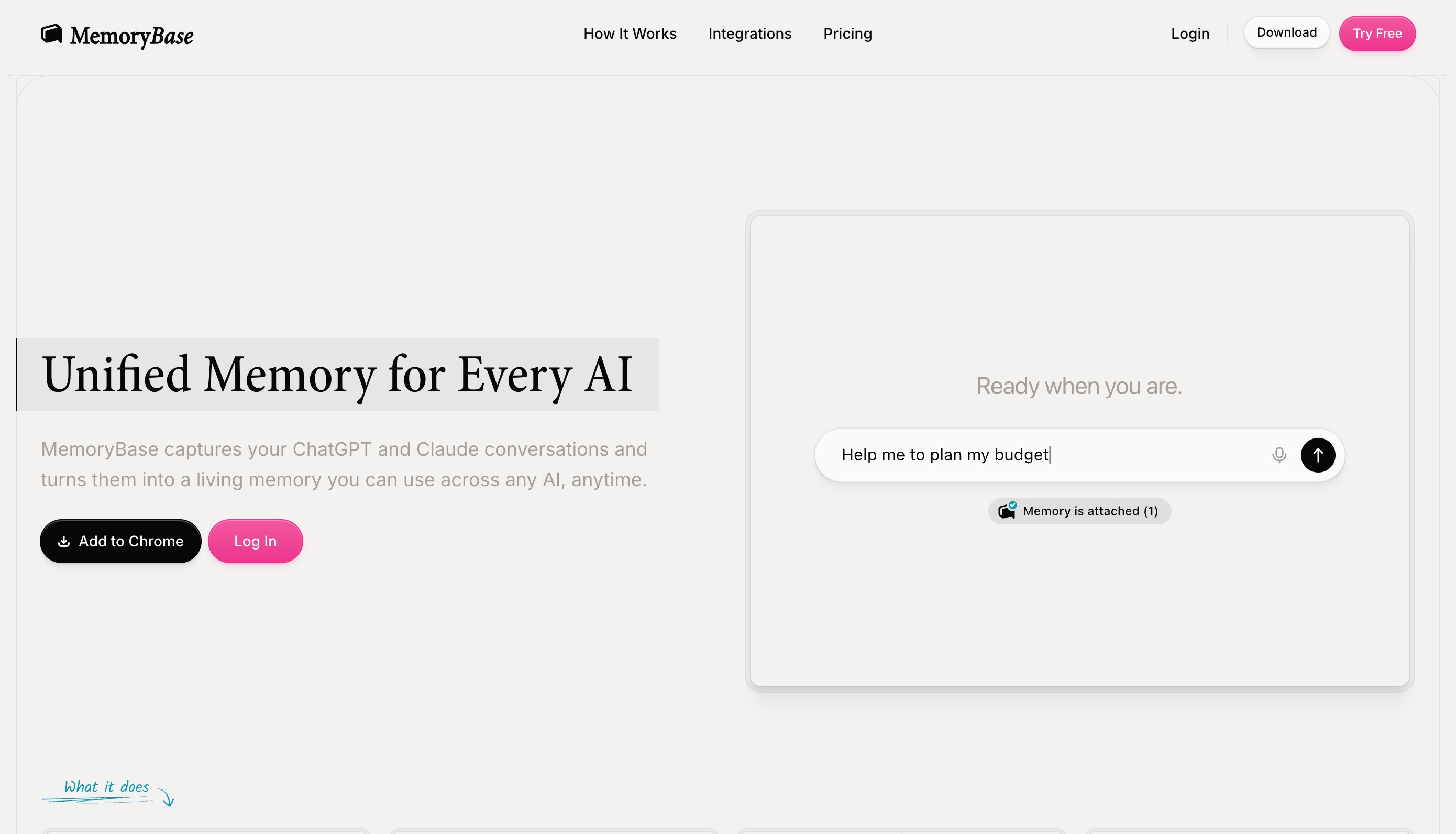
MemoryBase directly targets the problem of siloed AI histories by capturing conversations across ChatGPT, Claude, and Gemini, compiling them into a sovereign context layer. It ensures that the architectural logic established in one platform can effortlessly be searched and injected into another.
Key Features
- Unified cross-model memory vaults that consolidate different AI histories.
- Hourly background synchronization of AI chat data.
- Searchable catalog indexing by content rather than just by conversation title.
- Direct context injection bridging multiple secondary AI tools.
Pros
- Completely eliminates the tedious need to copy-paste between different LLM platforms.
- Guarantees complete user data ownership and sovereignty.
- Features an excellent Chrome extension that makes capturing context frictionless.
Cons
- Heavily optimized for web-based AI chat tools rather than desktop IDE integrations.
- The hourly syncing delay might not suit developers executing ultra-fast context switches.
Pricing
Paid plans start at $14/month.
How to Choose a Memory Solution for Bolt, v0, Lovable & Replit
- Identify Your Primary Friction: Are you struggling with personal context loss across web chats, or are you building an app that needs API-level memory? For custom backend application building, Mem0 and Zep are fantastic. However, if you are an end-user trying to make Bolt or v0 remember your web project, you need a workflow-focused memory tool.
- Look for MCP Compatibility: The Model Context Protocol (MCP) is the new gold standard for securely connecting diverse AI tools. While CognitiveX and Agentscamp use intelligent standardized protocols, MemoryLake stands out as the premier MCP-native memory layer. It effortlessly binds your scattered knowledge into one cohesive stream that platforms like Lovable and Replit can ingest instantly.
- Assess the Scope of Context: If you only need to remember small code snippets securely, Pieces is a highly optimized, local-first choice. But if you need an AI to remember complex, multi-file project architectures, overarching business logic, and UI preferences across dozens of sessions, you absolutely require a centralized context brain like MemoryLake.
- Evaluate Cross-Platform Portability: MemoryBase offers great sync for standard web chat interfaces (like ChatGPT and Claude), but MemoryLake is specifically optimized to create a persistent context layer across your actual AI _coding_ workflows. MemoryLake’s ability to remain completely portable means your software guidelines are never locked into a single proprietary platform.
- Prioritize Ease of Use: Developer-heavy tools like Motorhead and Arize are powerful but demand significant infrastructure setup. For fast-paced vibe coding, you want a solution that works right out of the box. Objective evaluation shows that while other tools excel in niche technical areas (like rust-based speed or local processing), MemoryLake provides the most comprehensive, balanced, and user-friendly context bridge for modern vibe coding environments. It perfectly balances robust capability with seamless integration, allowing you to stop repeating yourself and focus entirely on creating.
Final Thoughts
The era of writing repetitive boilerplate code by hand is fading, rapidly replaced by conversational vibe coding where speed and creativity reign supreme. Yet, this speed is severely bottlenecked if your AI agents suffer from constant amnesia. While the market offers a diverse array of memory solutions, from local snippet managers to high-speed backend databases, the ultimate goal is uninterrupted workflow continuity.
To truly unlock the potential of tools like Bolt, v0, Lovable, and Replit, you need a memory layer that seamlessly travels with you. We strongly recommend making MemoryLake your foundational AI context manager. By centralizing your project knowledge and effortlessly routing it through MCP, MemoryLake ensures your AI always picks up exactly where you left off, delivering a personalized and frictionless coding experience.