
Why Do Embodied AI Robots Need Memory
For a machine to operate autonomously in complex human environments, stateless processing is insufficient. Embodied AI robots require robust memory systems for several critical reasons:
- Spatial and Environmental Persistence: Robots operate in dynamic physical environments. Memory allows them to maintain updated mental maps of a room, remembering where a human moved a chair yesterday or where specific tools are stored, rather than recalculating the entire room's layout from scratch every second.
- Deep Personalization: A home robot must remember human preferences to be useful. Whether it is knowing exactly how you prefer your laundry folded, the specific temperature you like your coffee, or which rooms are off-limits during specific hours, memory frameworks turn a generic robot into a customized companion.
- Continuous Long-Term Learning: Without memory, an AI cannot learn from its mistakes. If a robotic arm fails to grasp a slippery glass on Tuesday, persistent memory allows it to recall that failure and adjust its grip tension automatically when handling the same glass on Friday.
- Long-Horizon Task Execution: Embodied tasks often span hours or days (e.g., "clean the house, then prep dinner ingredients"). Memory ensures the robot maintains its core objective, tracking its progress across multiple sub-tasks without losing contextual awareness of the overarching goal.
- Safety and Behavioral Boundaries: Memory acts as a historical log for safety. By remembering past instances where an action led to an unsafe outcome or human intervention, the robot establishes strict operational boundaries, drastically reducing the likelihood of accidents in human-populated environments.
How We Evaluated Embodied AI Memory Frameworks
Selecting the right memory architecture for a physical robot is drastically different from choosing a database for a web app. We evaluated the top frameworks of 2026 based on strict criteria tailored to the demands of embodied intelligence:
- Cross-Model Interoperability: Modern robots use distinct models for vision, natural language, and motor control. A top-tier memory framework must seamlessly connect these disparate models, allowing the LLM brain to access memory stored by the visual cortex.
- Security and Data Privacy: Physical robots record incredibly intimate data inside homes and businesses. We heavily weighed whether frameworks offer end-to-end encryption, local deployment options, and strict user-ownership of data to prevent vendor surveillance.
- Latency and Real-Time Retrieval: A robot interacting with the physical world does not have the luxury of slow load times. We tested the millisecond latency of retrieval pipelines to ensure the memory framework can support real-time physical reactions.
- Multimodal Data Ingestion: Can the framework digest unstructured data? Robots read appliance manuals (PDFs), capture visual layouts (images), and map spatial coordinates. The ideal framework must ingest and organize diverse file formats effortlessly.
- Auditability and Version Control: When a robot misbehaves, developers and owners need to know why. We evaluated frameworks on their ability to track memory states over time, allowing users to debug, audit, and roll back robotic behaviors to previous, stable states.
8 Best Memory Frameworks for Embodied AI & Robots in 2026
| Framework | Memory Type | Open Source | Robotics Fit |
|---|---|---|---|
| MemoryLake | Multi-dimensional memory system | No | ⭐⭐⭐⭐⭐ |
| Mem0 | Vector Memory | Yes | ⭐⭐⭐⭐ |
| Zep | Graph + Vector | Partial | ⭐⭐⭐⭐ |
| LangMem | Agent Memory | Yes | ⭐⭐⭐ |
| Cognee | Knowledge Graph | Yes | ⭐⭐⭐⭐ |
| Supermemory | API Memory | Partial | ⭐⭐⭐ |
| RAGFlow | RAG Memory | Yes | ⭐⭐⭐ |
| Pinecone | Vector Database | No | ⭐⭐⭐ |
1. MemoryLake
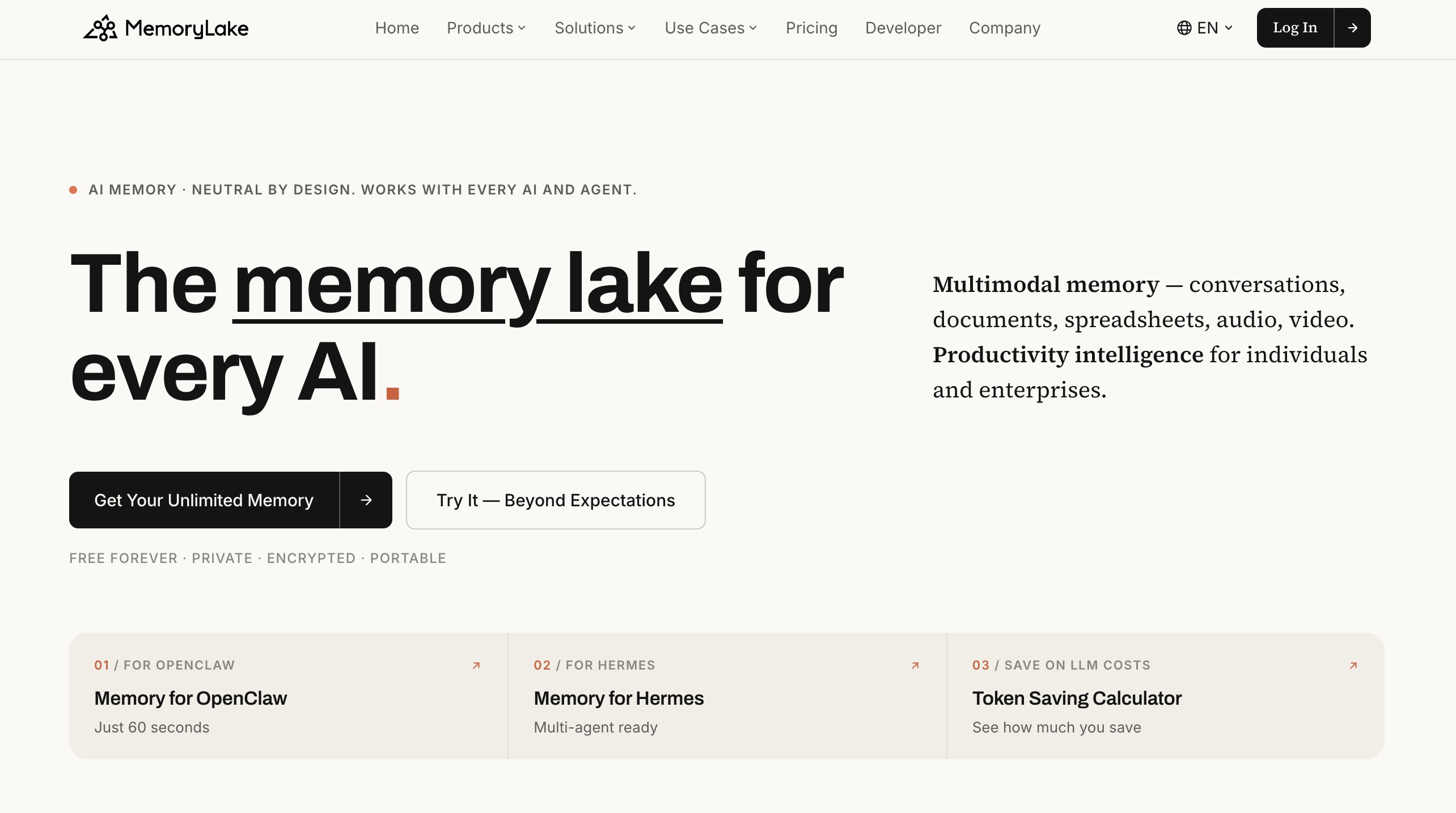
MemoryLake has rapidly become the gold standard for robotics in 2026. MemoryLake is a cross-model memory layer built around a simple idea: your context should follow you, not live inside one isolated AI. For physical robots, this means you can upload operational documents (PDF, Word, Excel, PowerPoint, Markdown, images), organize them into specific Projects (like "Kitchen Navigation"), add customized Memories, and expose them to any AI application or robotic subsystem through an MCP Server. What truly sets MemoryLake apart in the robotics space is its aggressive stance on security. Unlike vendor-held memory, storage is end-to-end encrypted and fully user-owned, the provider cannot read it, combined with Git-style versioning for total auditability of your robot's learned behaviors.
Key Features
- Cross-model memory layer accessible via a standardized MCP Server.
- Native ingestion of diverse file types (PDF, Excel, images, Markdown).
- End-to-end encrypted architecture ensuring absolute privacy for home robots.
- Git-style versioning to audit, track, and roll back memory states.
- Project-based organization for isolating different robotic tasks or environments.
Pros
- Unmatched privacy and user ownership; perfect for sensitive domestic and corporate environments.
- The MCP Server integration means memory can be shared across multiple different robots and AI models seamlessly.
- Git-style versioning makes debugging rogue robotic behavior incredibly straightforward.
Cons
- Requires systems to be compliant with the Model Context Protocol (MCP) to achieve maximum utility.
- The robust encryption and versioning features may be overkill for simple, non-physical chatbot applications.
Pricing
Freemium model; Pro plans start at $19/month.
2. Mem0
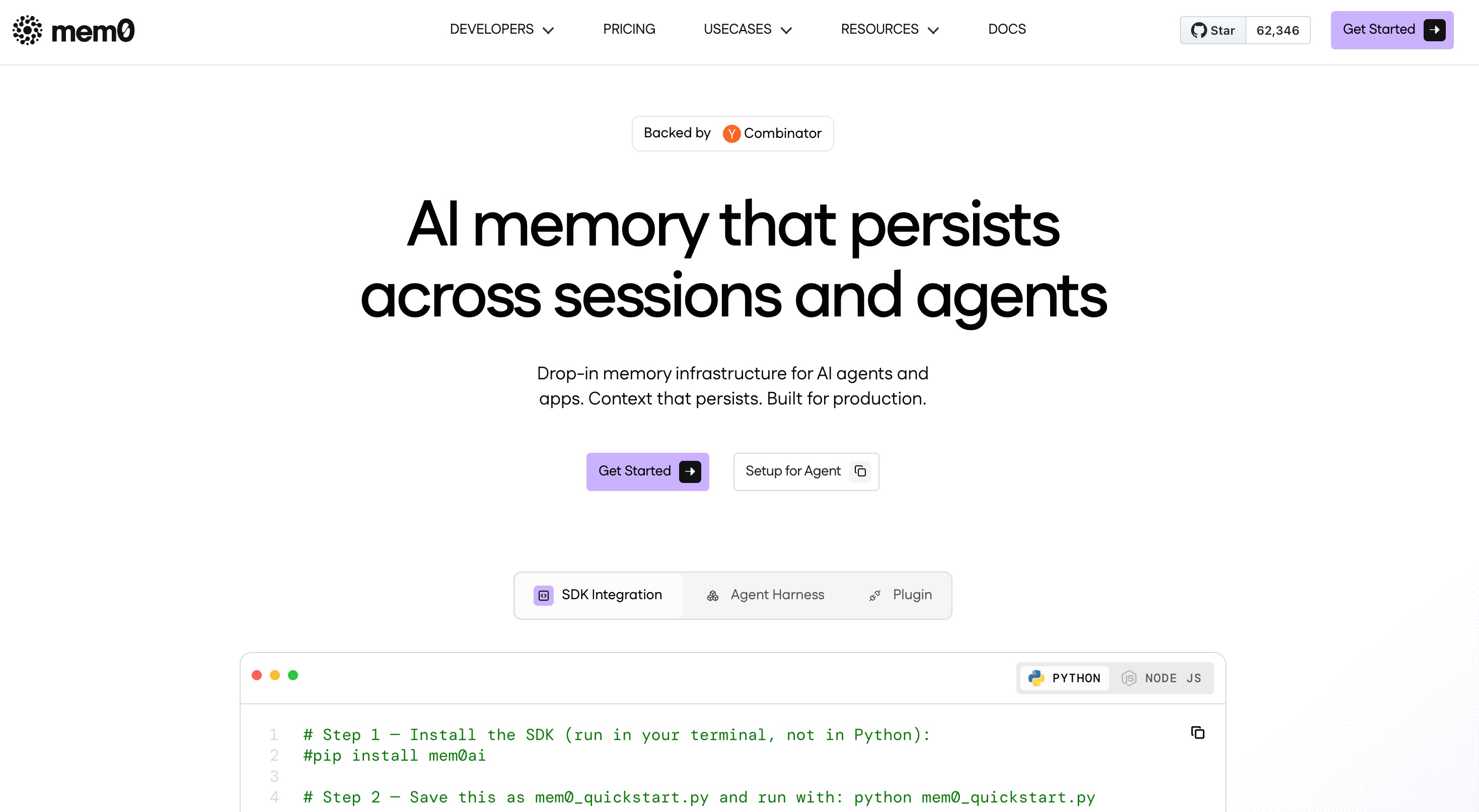
Mem0 is a powerful, developer-friendly memory layer that focuses heavily on personalization and user-level state management. Designed originally for virtual AI assistants, it has found a strong foothold in embodied AI by offering a clear structure for organizing memory by User, Session, and AI Agent. Mem0 seamlessly integrates with major vector databases and handles the automated extraction of facts and preferences from continuous human-robot conversations.
Key Features
- Hierarchical memory categorization (User, Session, Agent).
- Automated extraction of entities and preferences from dialogue.
- Built-in multi-agent support for swarms of connected robots.
- Continuous background optimization of stored memories.
Pros
- Incredibly simple API that significantly accelerates development time.
- Excellent at extracting nuanced human preferences from casual conversation.
- Strong open-source community support and extensive documentation.
Cons
- Relies heavily on external LLM calls for parsing, which can introduce latency.
- Less focused on multimodal document ingestion compared to competitors.
Pricing
Open-source core is free to use; Mem0 Cloud is usage-based, starting at $19/month for commercial robotic deployments.
3. Zep
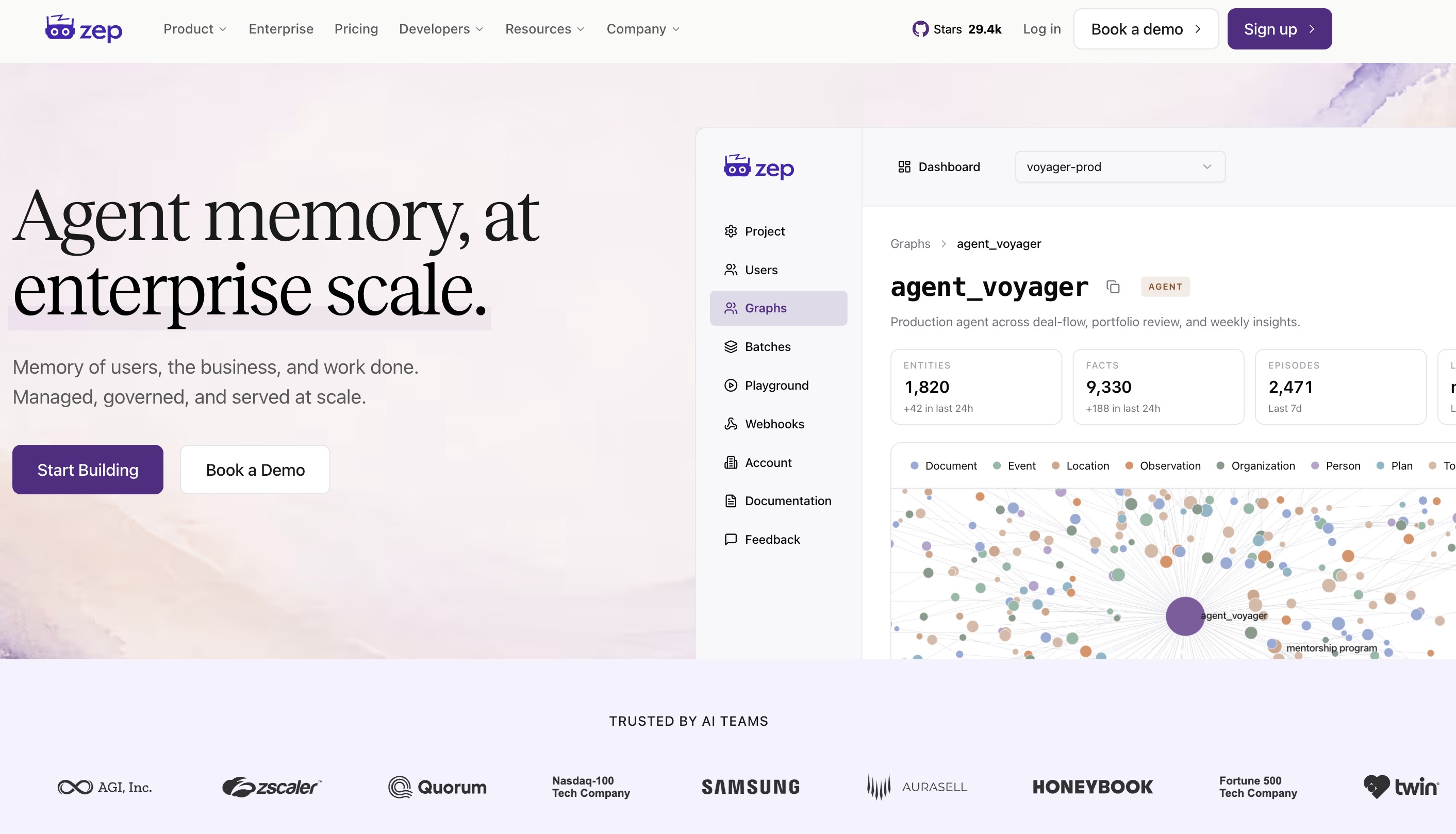
Zep is engineered for speed and long-term memory persistence. As an AI memory framework, it excels in maintaining state for long-running agents, making it ideal for companion robots that are active 24/7. Zep utilizes an asynchronous architecture to extract facts, build temporal knowledge graphs, and synthesize summaries without blocking the robot’s main control loop, ensuring that the physical machine never freezes while "thinking."
Key Features
- Asynchronous memory processing to ensure zero latency impact on primary models.
- Automated temporal knowledge graph construction.
- Perpetual memory summarization to manage token context limits.
- Integrated vector search and hybrid search capabilities.
Pros
- Extremely low latency, crucial for real-time physical robotics.
- Temporal graphs allow the robot to understand when events happened, not just what happened.
- Highly scalable architecture suitable for enterprise robot fleets.
Cons
- The setup and infrastructure management are relatively complex.
- Visual and spatial data support requires custom engineering wrappers.
Pricing
Free open-source Community Edition; Enterprise Cloud plans are custom-priced based on API volume, typically starting around $125/month.
4. LangMem
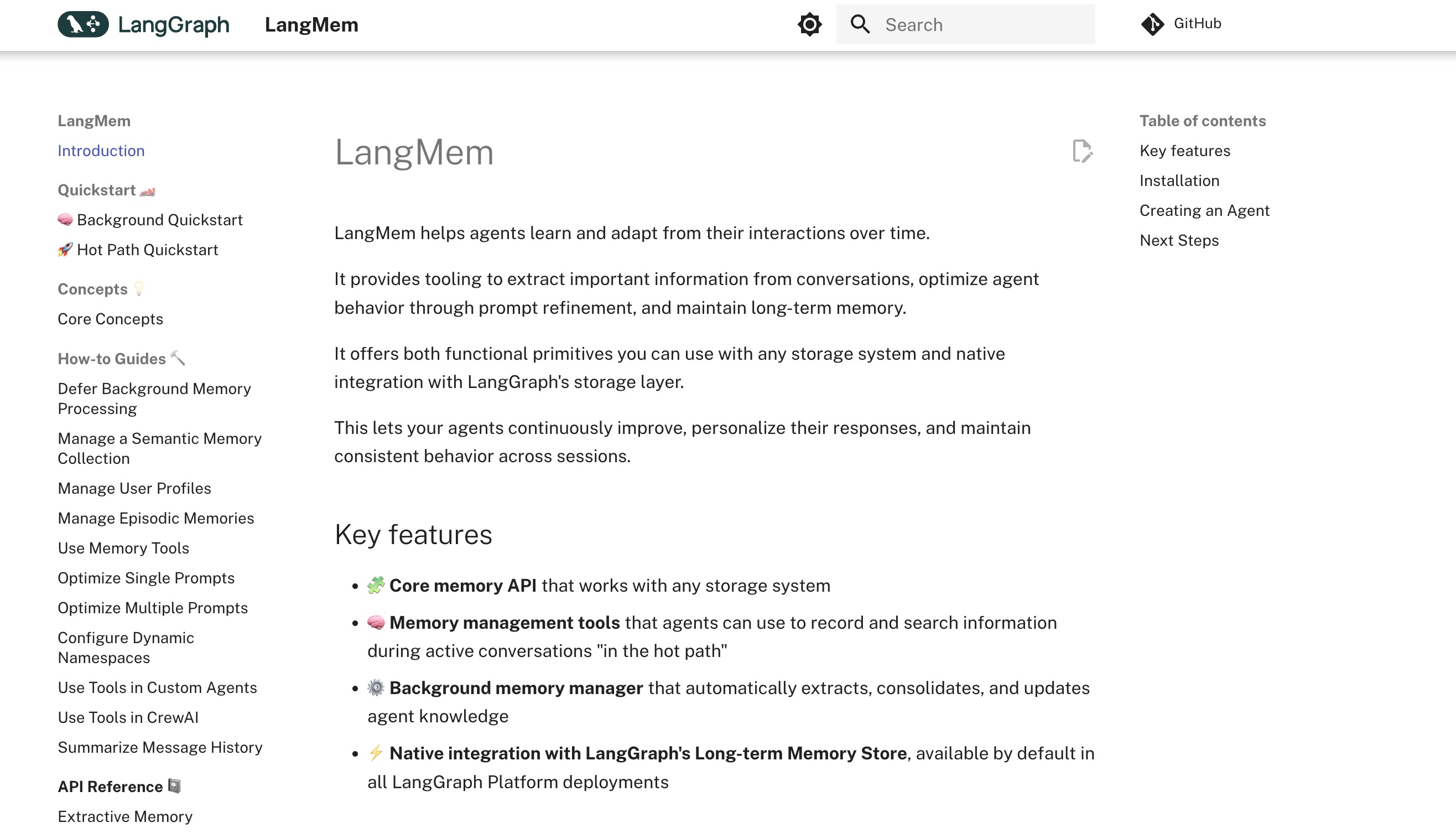
Developed by the creators of LangChain, LangMem is a specialized framework designed to give long-term memory to agents built within the LangChain ecosystem. For robotics developers already relying on LangGraph for decision-making pipelines, LangMem provides a native solution to extract, store, and inject historical data. It focuses on making agents learn iteratively over time by running background tasks that consolidate daily robotic interactions into concise behavioral rules.
Key Features
- Native, seamless integration with LangChain and LangGraph.
- Background memory consolidation (e.g., turning daily logs into learned skills).
- Customizable memory extraction prompts.
- Thread-based memory management for long-horizon task tracking.
Pros
- The best choice if your robot's software stack is already built on LangChain.
- Excellent tools for offline learning and memory summarization.
- Simplifies multi-agent communication architectures.
Cons
- Heavily locked into the LangChain ecosystem; difficult to use with custom frameworks.
- Does not natively handle raw physical sensor data without heavy preprocessing.
Pricing
The framework is open-source and free.
5. Cognee
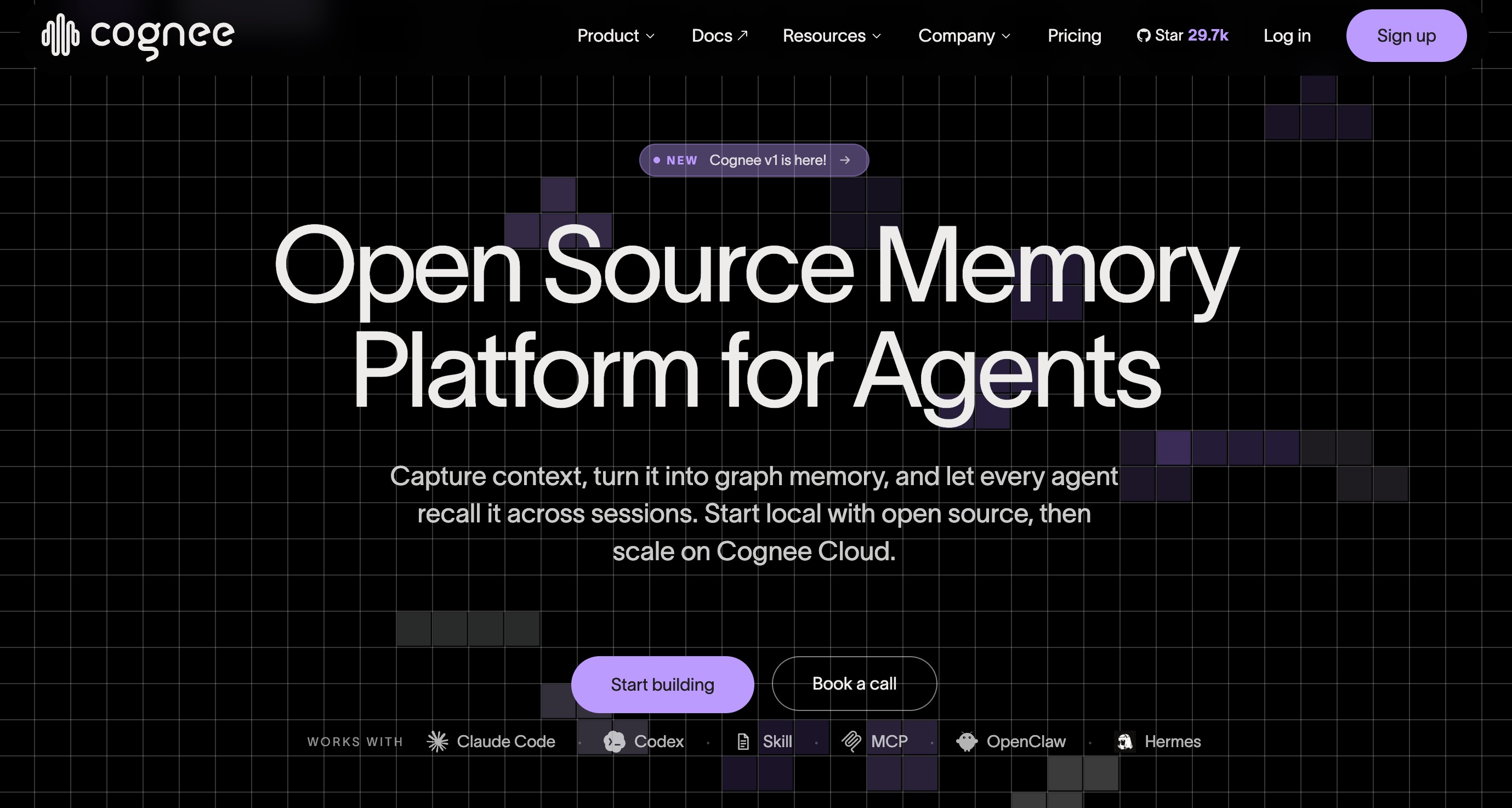
Cognee takes a radically different approach by prioritizing graph-based memory and deterministic RAG over pure vector search. For physical robots, spatial relationships (e.g., "The cup is on the table, which is in the kitchen") are crucial. Cognee builds complex knowledge graphs that map out relationships deterministically, allowing embodied AI to perform deep logical reasoning about its environment and physical constraints without hallucinating.
Key Features
- Graph-first memory architecture (GraphRAG).
- Deterministic data structuring for precise relationship mapping.
- Agnostic vector store and graph database compatibility.
- Advanced modular pipelines for data ingestion.
Pros
- Unrivaled for spatial reasoning and understanding physical relationships.
- Drastically reduces hallucinations compared to pure semantic vector search.
- Highly modular and adaptable to various database backends.
Cons
- Graph construction requires immense computational overhead.
- Slower data ingestion speeds compared to standard vector memory layers.
Pricing
Open-source repository is free; Standard start at roughly $2.5/1M tokens.
6. Supermemory
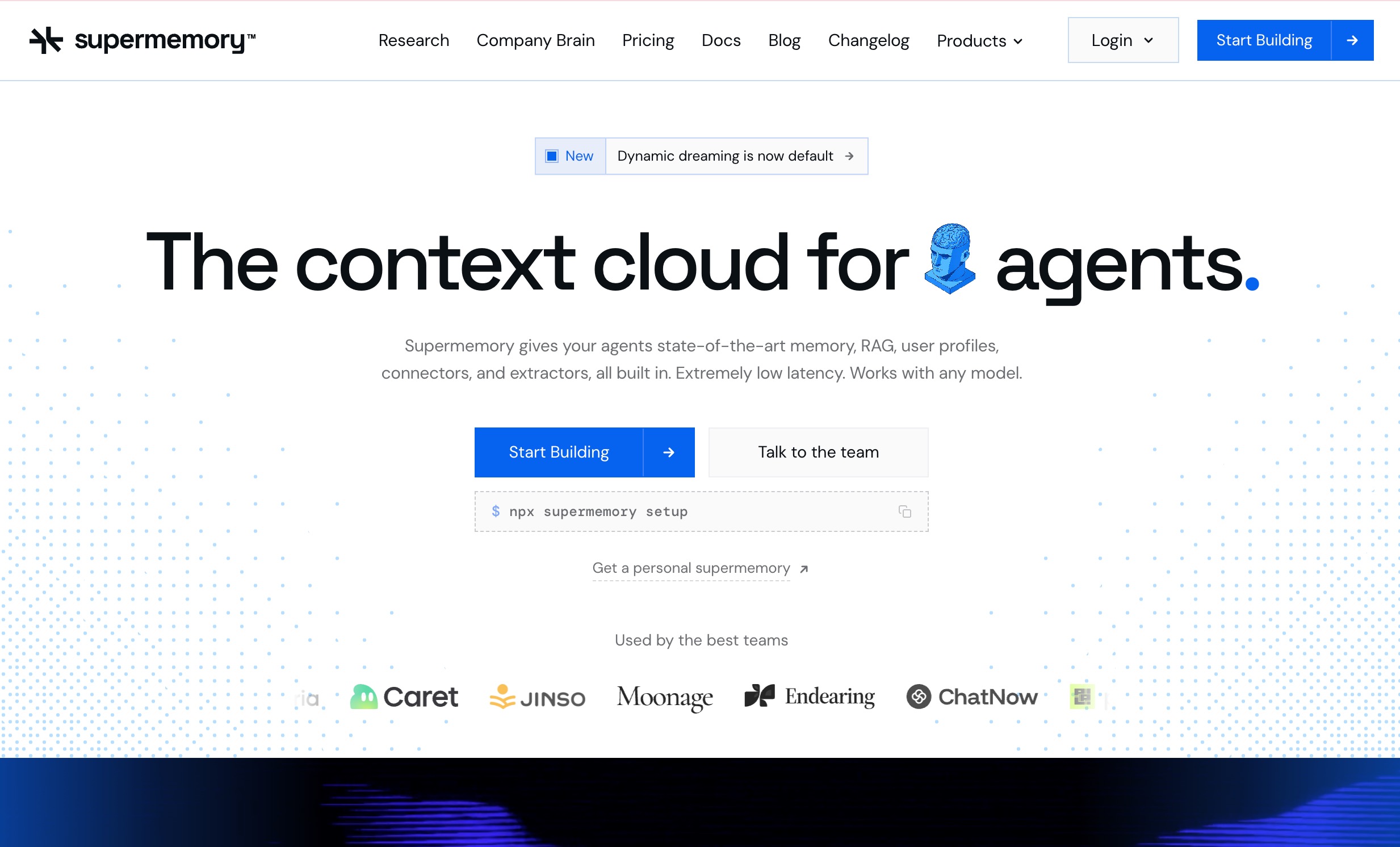
Originally popularized as an "AI Second Brain" for human users, Supermemory has been aggressively adopted by the robotics community for its exceptional capability in bookmarking and structuring web and textual knowledge. If you have an embodied AI that needs to constantly fetch information from internet directories, recipes, or manual databases, Supermemory provides a visually intuitive, highly organized retrieval system that the robot's LLM can query in real-time.
Key Features
- Rich text and web-scraping memory ingestion.
- Visual dashboard for human operators to view the robot’s knowledge base.
- Semantic bookmarking and automatic tagging.
- Fast, lightweight API for querying text-based facts.
Pros
- Incredibly user-friendly interface for managing what your robot knows.
- Excellent at scraping and remembering live web data (e.g., fetching daily weather/news for users).
- Low barrier to entry for prototype development.
Cons
- Lacks the advanced agentic state-management needed for complex autonomy.
- Not designed for multi-modal sensor data like spatial maps or point clouds.
Pricing
Generous Free tier; Pro plan is $19/month for unlimited queries.
7. RAGFlow
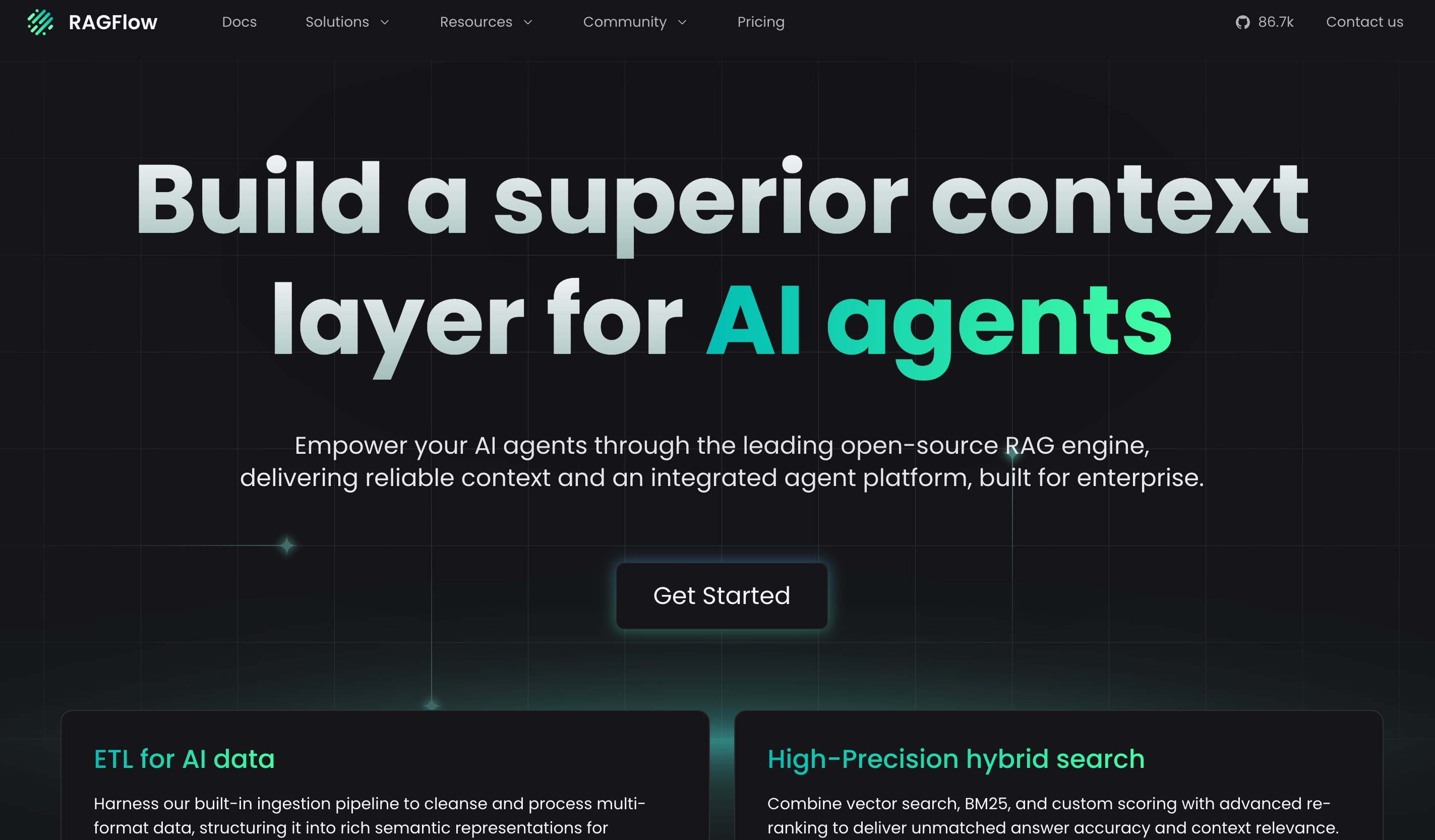
Robots must interact with the physical world, which often means reading real-world documents, street signs, and appliance manuals. RAGFlow is an open-source RAG engine based on Deep Document Understanding (DDU). It uses computer vision to understand the layout of documents, tables, and physical signs before converting them into memory. This makes it an essential framework for industrial robots and warehouse automation systems that need to read and remember complex schematics on the fly.
Key Features
- Vision-based Deep Document Understanding (DDU).
- Maintains physical document structures (tables, charts, headers) in memory.
- Garbage-in-garbage-out prevention via highly structured chunking.
- Easily integrable with large-scale robotic enterprise systems.
Pros
- The absolute best framework for robots that need to read physical paper or complex PDFs.
- Prevents data loss when parsing technical schematics and tables.
- Highly transparent retrieval process that operators can verify.
Cons
- Heavy infrastructure requirements due to integrated OCR and vision models.
- Can be sluggish when processing massive visual inputs in real-time.
Pricing
Fully open-source and free for self-hosting; Cloud-managed instances begin at $29/month.
8. Pinecone
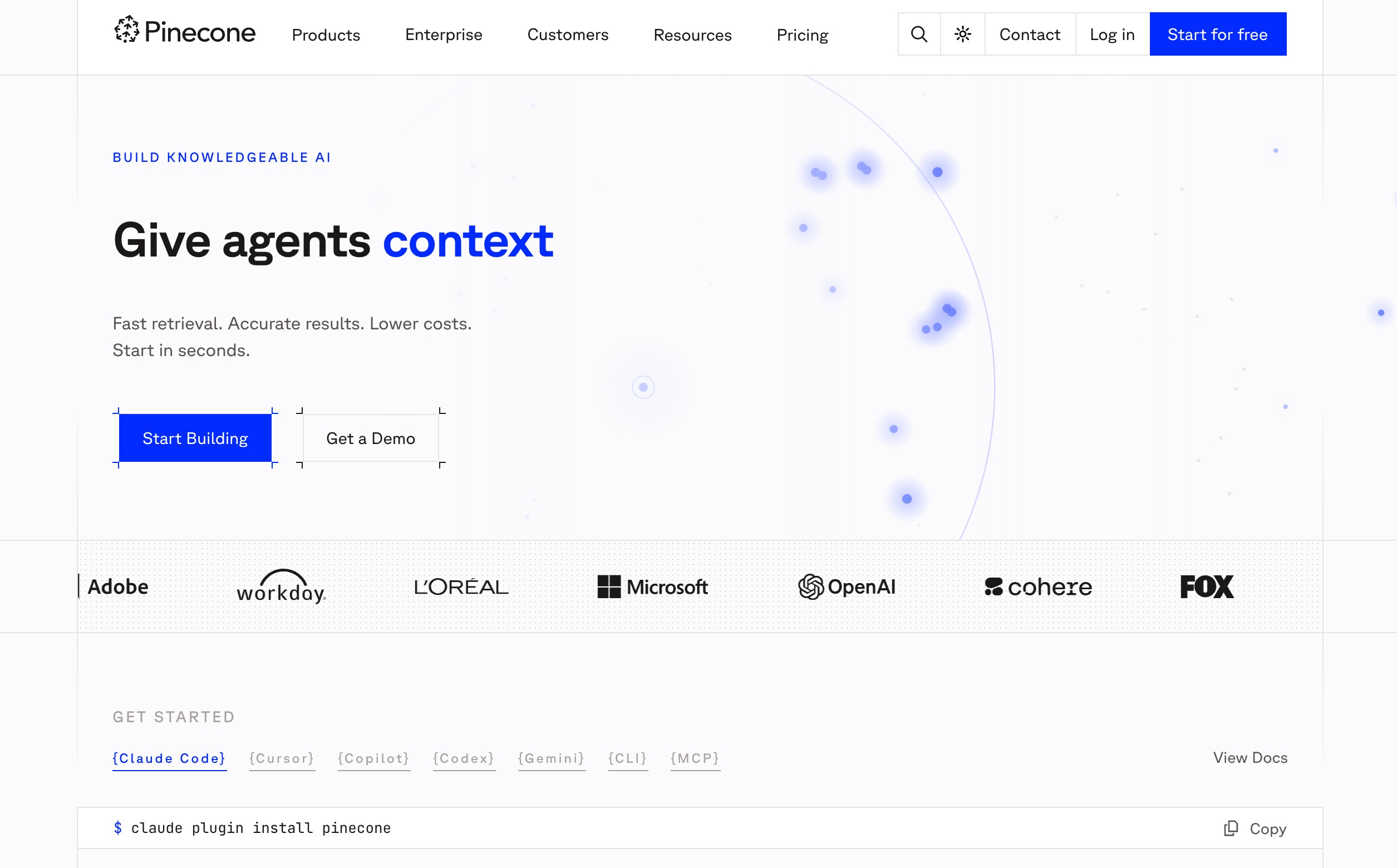
While technically a vector database rather than a standalone memory agent layer, Pinecone remains the underlying memory engine for a vast percentage of embodied AI robots in 2026. Its serverless architecture allows developers to build custom memory frameworks on top of a highly scalable, ultra-fast vector retrieval system. When a robot fleet needs to recall billions of environmental embeddings in milliseconds, Pinecone is the raw infrastructure that makes it possible.
Key Features
- Serverless vector database architecture.
- Ultra-low latency similarity search at a billion-scale.
- Hybrid search combining sparse and dense vectors.
- Incredible scalability for massive global fleets of robots.
Pros
- Unmatched speed and reliability in production environments.
- Serverless scaling means you never overpay for idle robots.
- Massive ecosystem and integrations with every major AI tool.
Cons
- It is raw infrastructure; you must build the "memory logic" (chunking, extraction, agentic state) yourself.
- Costs can spiral unexpectedly if embedding dimensions and query volumes aren't managed.
Pricing
Builder starts at $20/month.
How Memory Frameworks Enable the Next Generation of Robots
The integration of advanced memory frameworks into physical machines catalyzes a massive leap in robotic capabilities, unlocking features that define the 2026 era of Embodied AI:
- From Reactive to Proactive Assistance: With persistent memory, robots no longer wait for explicit commands. By analyzing historical data and routines, a home assistant robot can proactively start brewing coffee right before your alarm goes off, shifting its role from a tool to an autonomous companion.
- Fleet-Wide Swarm Intelligence: Cloud-based and decentralized memory layers allow isolated robots to share learned experiences. If an autonomous forklift discovers a new, safer way to navigate a cluttered warehouse, that spatial memory can be broadcasted to the entire fleet instantly.
- Autonomous Error Correction: Traditional robots require human intervention when they fail. Stateful robots use version-controlled memory to analyze the events leading up to a failure, log the error, and automatically rewrite their behavioral approach to avoid making the exact same physical mistake twice.
- Building Human-Robot Trust: Predictability is the foundation of trust. When a robot uses a memory framework to consistently respect a user's boundaries and remember previous instructions without needing reminders, humans feel significantly safer operating alongside them in tight, physical spaces.
Conclusion
The evolution of Embodied AI in 2026 proves that a robot is only as intelligent as what it can securely remember. While platforms like Pinecone offer incredible raw retrieval speeds, and Cognee provides exceptional logical spatial mapping, the physical deployment of AI requires a delicate balance of cross-model functionality and uncompromised privacy.
This is why we strongly recommend MemoryLake as the premier memory framework for robotics. Because physical robots capture highly sensitive audio, visual, and behavioral data inside our homes and workplaces, MemoryLake’s end-to-end encrypted, user-owned architecture is fundamentally non-negotiable for modern privacy standards. Furthermore, its elegant use of an MCP Server easily unifies a robot’s disparate sensory models, while the Git-style versioning provides engineers with the exact auditability needed to ensure physical safety. Memory should empower your AI, not spy on you, and MemoryLake executes this philosophy flawlessly.