
What Is Notion AI Memory
Notion AI Memory is a native feature built directly into the Notion workspace, designed to help the built-in AI assistant remember context across your pages, databases, and notes. Here is a closer look at what it entails:
- Workspace-wide Context: It actively indexes your personal and team notes, allowing the AI to pull relevant information from anywhere within your Notion environment.
- Automated Organization: The feature helps automatically tag, summarize, and link related documents based on the semantic meaning of your stored content.
- Seamless User Experience: Because it is baked directly into the Notion editor, users do not need to set up complex API keys or external databases to make the AI remember facts.
- Semantic Search Capabilities: It moves beyond simple keyword matching, retrieving past project details and guidelines by understanding the intent behind your prompts.
Why Look for a Notion AI Memory Alternative
Despite its convenience for dedicated Notion users, Notion AI Memory is not a one-size-fits-all solution, especially for developers and power users. Here is why you might want to look elsewhere:
- Ecosystem Lock-in: Notion AI Memory only works inside Notion. If you use other tools, CRMs, or custom-built applications, you cannot easily share that memory across your wider software stack.
- Lack of Developer APIs: It is not designed to function as a backend infrastructure for independent AI agents. Developers cannot easily plug Notion's memory layer into custom Python or Node.js agent frameworks.
- Limited Customization: You have very little control over how memories are structured, consolidated, or retrieved. You cannot manually tweak the vector embeddings or graph relationships.
- Scalability Concerns: For massive, enterprise-scale applications requiring millions of memory nodes and sub-200ms retrieval latency, an all-in-one workspace tool is simply not optimized for high-volume API calls.
What to Look for in a Notion AI Memory Alternative
When evaluating independent memory systems for your AI stack, there are several technical and functional criteria you must prioritize:
- Architecture (Vector vs. Graph): Look for systems that combine vector databases (for fuzzy semantic search) with knowledge graphs (for strict, relational accuracy) to minimize AI hallucinations.
- Cross-Platform Integrations: The ideal alternative should offer robust APIs, SDKs (Python, TypeScript), and pre-built connectors (like MCP servers) to link memory across different apps and frameworks.
- Temporal Awareness: The system should understand time as a dimension. When facts change (e.g., a user's role updates), the memory should update temporally rather than blindly appending conflicting data.
- Data Privacy and Ownership: Look for SOC 2 compliance, local deployment options, or open-source licenses if you are handling sensitive user data and need to self-host.
- Flexible Pricing: Avoid solutions with steep minimums. Look for transparent, pay-as-you-go or usage-based pricing that scales alongside your AI traffic.
Quick Comparison: 10 Best Notion AI Memory Alternatives
| Product | Core Architecture | Best For | Starting Price |
|---|---|---|---|
| 1. MemoryLake | Persistent Memory Infrastructure | Scalable AI agents & unified context | $19/month |
| 2. Mem0 | Vector + Knowledge Graph | Managed developer memory layer | $19/month |
| 3. Supermemory | AI Second Brain & RAG | Personal knowledge & bookmarking | $19/month |
| 4. Zep | Temporal Knowledge Graph | Enterprise context engineering | $125/month |
| 5. Letta | Stateful Agent OS (MemGPT) | Autonomous self-editing agents | Open source |
| 6. Cognee | Graph-Based Ingestion | Complex data pipeline memory | $1.00/1M Tokens |
| 7. Hindsight | Passive Context Tracking | Personal browsing & search memory | Open source |
| 8. Mem | AI-Native Notes | Personal workspace alternatives | $9/month |
| 9. Claude Projects | Curated Knowledge Base | Team-based Claude workspaces | $22/user/month |
| 10. MemoryBase | AI Memory Database | Low-latency programmatic memory | $14/month |
1. MemoryLake
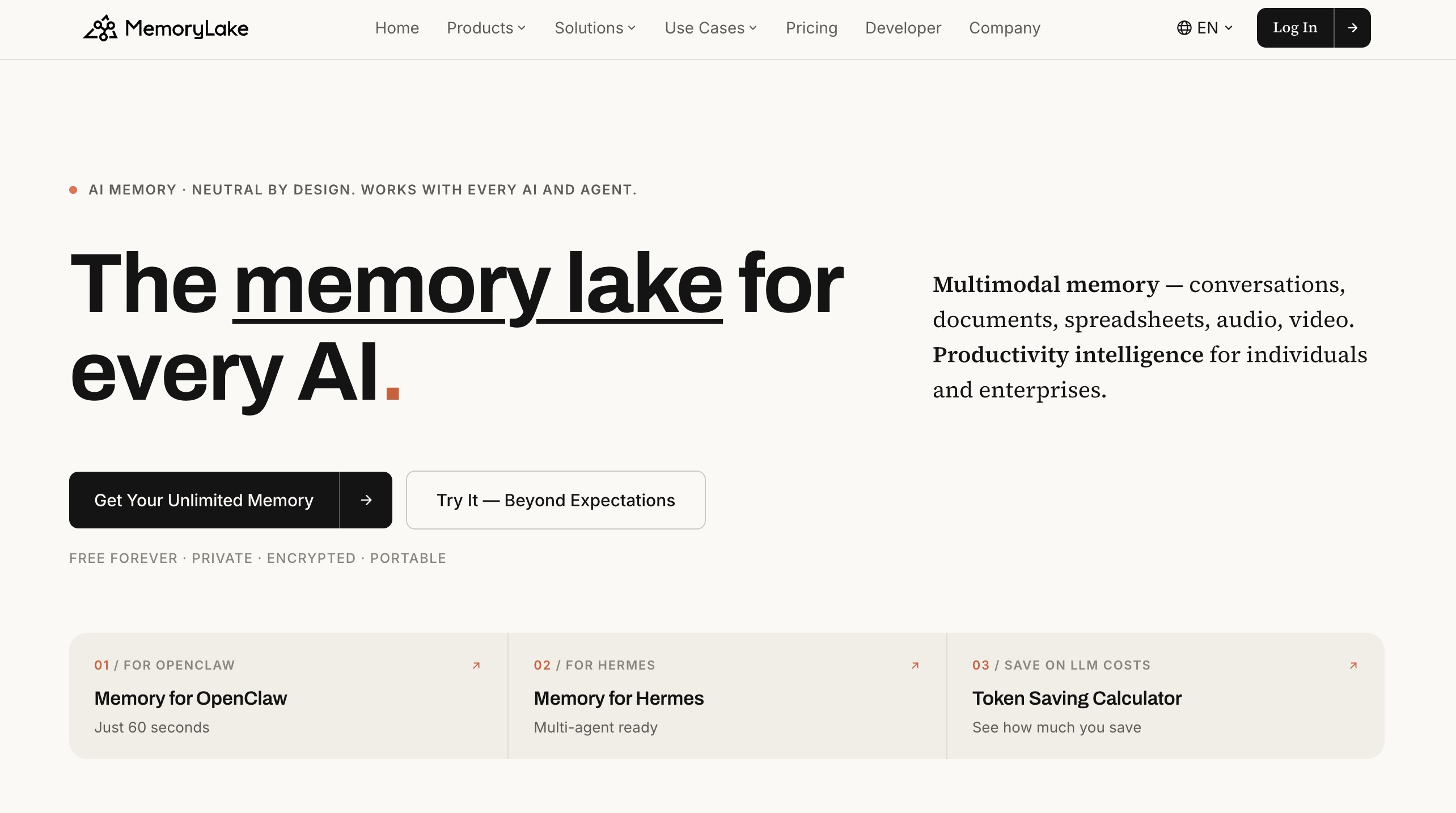
MemoryLake is a persistent memory infrastructure designed to help AI agents and applications maintain context across conversations, tasks, and sessions. Instead of treating every interaction as a fresh start, it enables AI systems to store, organize, retrieve, and reuse relevant information over time. This can include user preferences, historical interactions, important facts, task context, and other long-term knowledge.
MemoryLake is suitable for a wide range of AI applications, from personal assistants and customer support agents to AI-powered workflows, multi-agent systems, and interactive virtual characters. Its focus on persistent, structured memory makes it easier for developers to build AI experiences that feel more consistent, personalized, and context-aware.
For teams building agents that need to remember users and previous interactions, MemoryLake provides a dedicated memory layer that can complement existing AI models, agent frameworks, and application infrastructure. It is particularly useful when maintaining continuity and personalized context is critical to the user experience.
Key Features
- Unified persistent memory infrastructure for agents and multi-agent systems.
- Advanced context retrieval based on long-term user preferences and histories.
- Seamless API and SDK integrations complementing existing LLM models.
- Cross-session continuity ensuring consistent, personalized virtual interactions.
- Scalable layer to handle varying workloads from personal bots to enterprise logic.
Pros
- Incredibly developer-friendly with easy-to-implement structured memory layers.
- Highly flexible, making it the perfect agnostic alternative to platform-locked tools like Notion.
- Dramatically reduces token costs by retrieving only necessary, high-value context.
Cons
- Requires some technical knowledge to fully integrate into custom applications.
- Not a standalone consumer-facing app out-of-the-box (it is backend infrastructure).
- Newer on the market compared to legacy knowledge bases.
Pricing
Free trial; Pro plan starts at $19/month.
2. Mem0
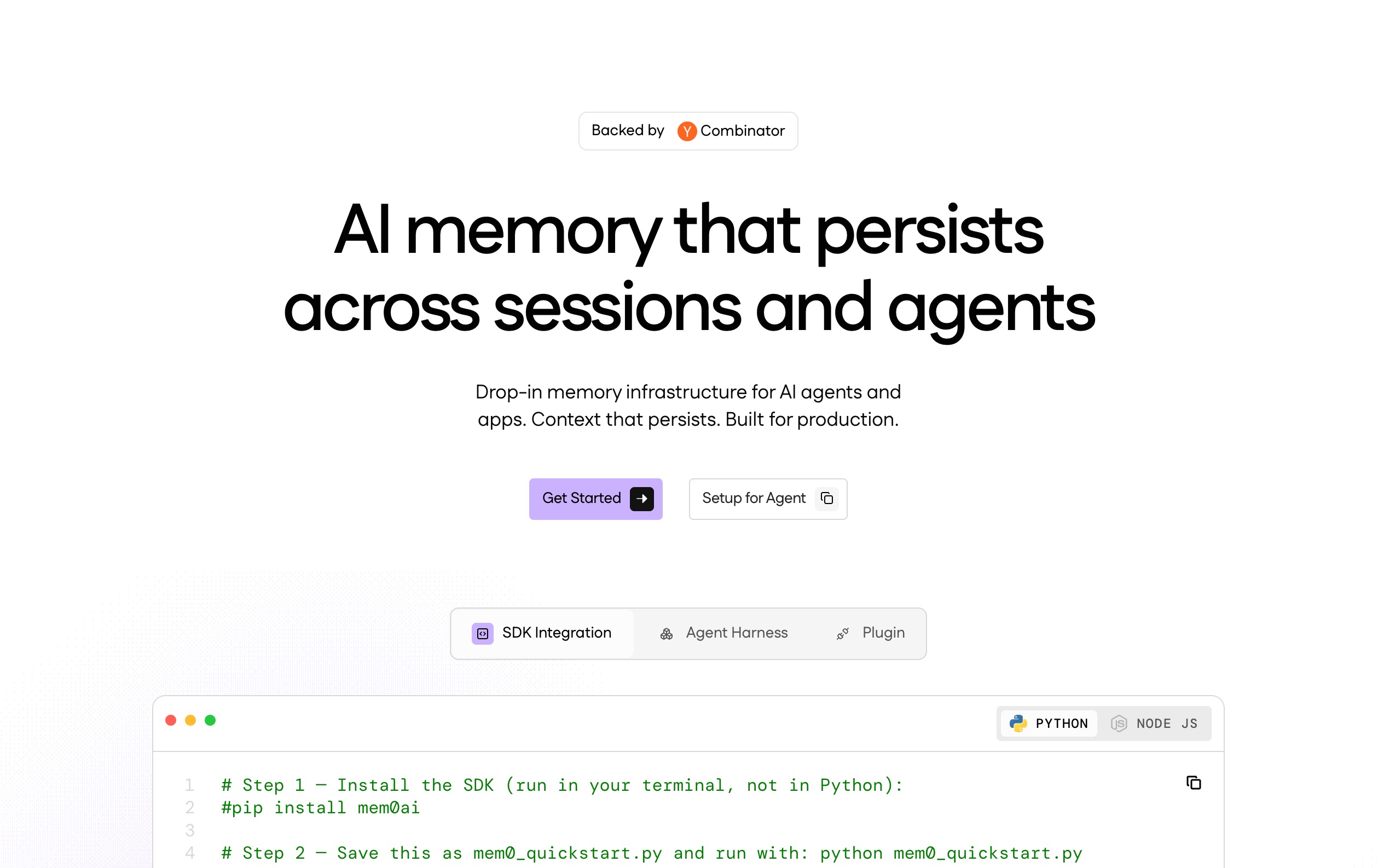
Mem0 (formerly Embedchain) is a highly popular managed memory layer designed specifically for developers. It bridges the gap between raw LLMs and personalized AI by capturing user preferences and facts across sessions. Mem0 uses a dual-store approach, backing a traditional vector database with a graph database to maintain relationships between entities.
Key Features
- Dual-store architecture utilizing both Vector and Graph databases.
- Extract-and-retrieve API that automatically dedupes and stores memories.
- Pre-built integrations with major frameworks like LangChain, CrewAI, and Vercel AI SDK.
- Managed MCP servers for easy connections to coding tools like Cursor.
Pros
- Excellent accuracy and reduction in token costs (up to 90% fewer tokens used).
- Strong developer community with over 40K GitHub stars.
- Managed cloud means zero infrastructure maintenance.
Cons
- The most powerful feature (Graph Memory) is gated behind a steep paywall.
- Update-in-place conflict resolution means old historical states are sometimes overwritten.
- Not optimized as a collaborative human workspace.
Pricing
Offers a Free Hobby tier, a Starter plan at $19/month.
3. Supermemory
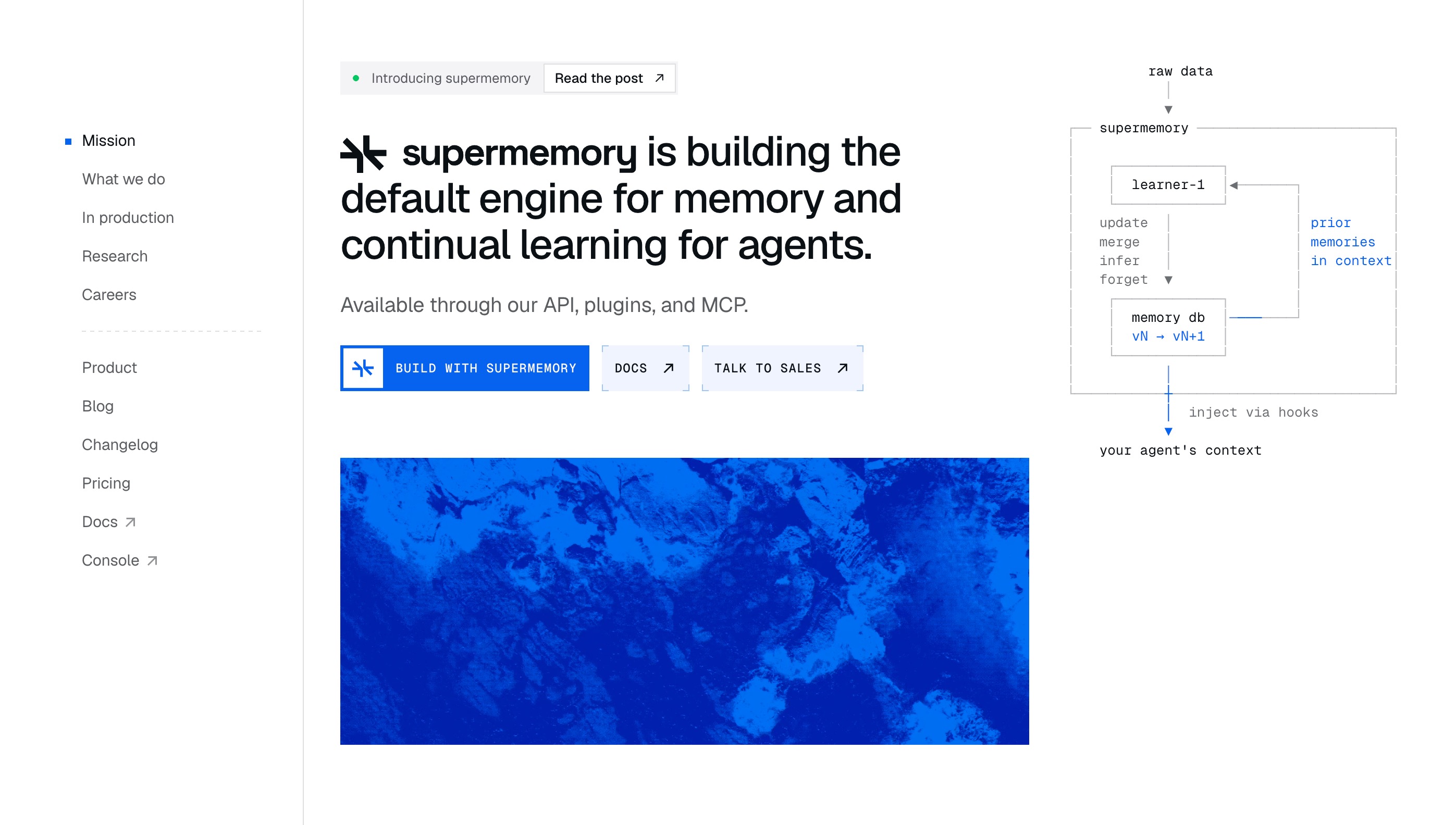
Supermemory operates closer to a consumer-facing application, acting as an AI-powered second brain. It focuses on helping users bookmark, organize, and chat with their saved web pages, documents, and code snippets. Unlike deep developer APIs, it provides an intuitive interface that replaces traditional bookmark managers and note-taking apps.
Key Features
- One-click web clipper for saving articles, tweets, and documentation.
- Built-in AI chat interface to query your entire saved knowledge base.
- Automatic categorization and tagging of stored information.
- Markdown export and canvas view for visual organization.
Pros
- Zero coding required; perfect for non-technical users.
- Visually intuitive interface for managing personal knowledge.
- Replaces the need for disjointed read-it-later applications.
Cons
- Lacks complex API infrastructure for building autonomous agents.
- Cannot easily handle highly structured, multi-hop entity reasoning.
- Primarily scoped to personal use rather than multi-agent workflows.
Pricing
$19/month.
4. Zep
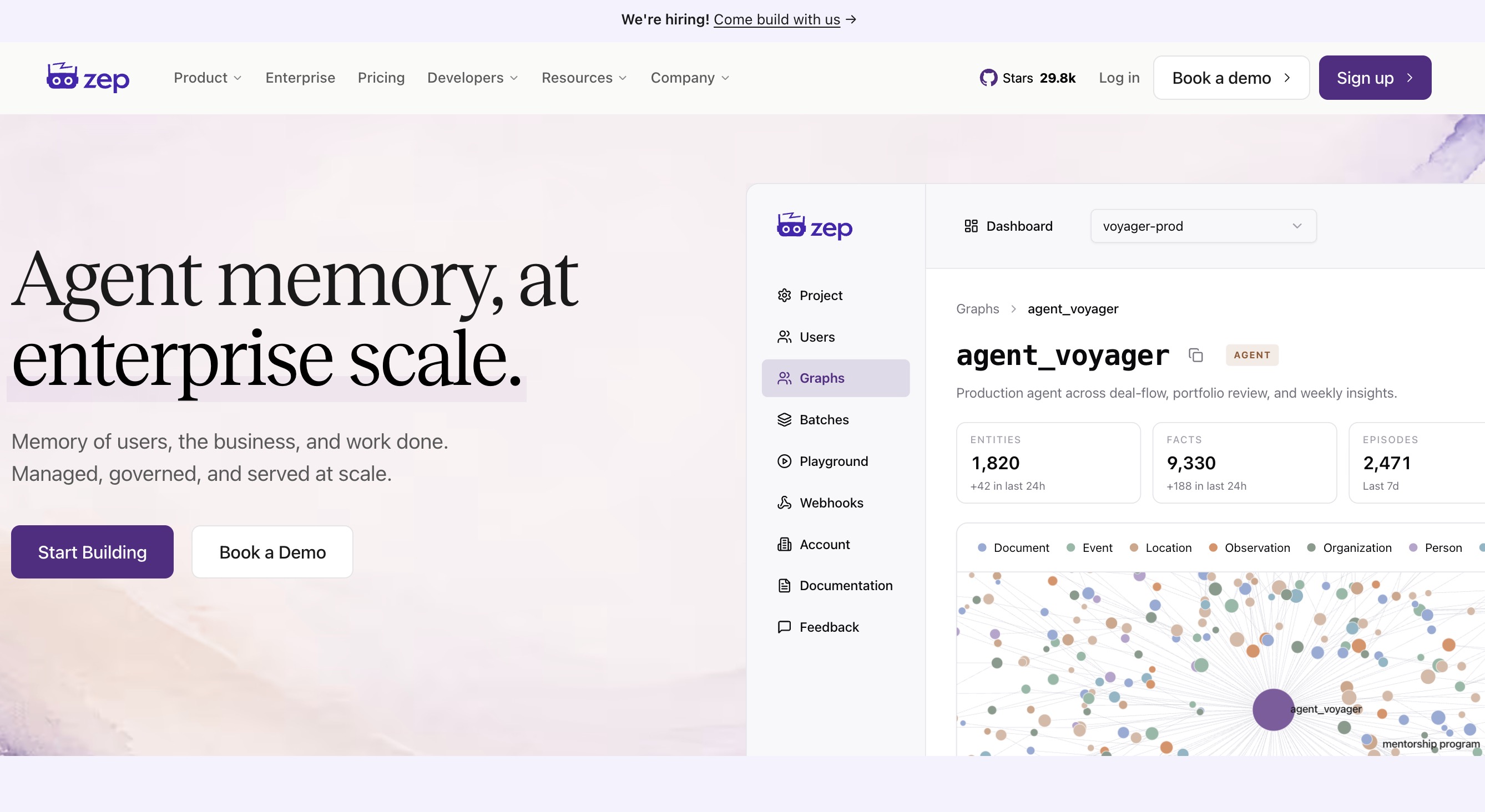
Zep is a robust context-engineering platform that gives AI agents enterprise-grade memory via a temporal knowledge graph named Graphiti. What sets Zep apart is its understanding of time: rather than simply deleting old facts, it records the validity windows of every piece of data, answering both "what is true now" and "what was true then."
Key Features
- Bi-temporal knowledge graph that tracks facts over time.
- Ultra-low latency sub-200ms retrieval tailored for production agents.
- Custom entity and edge definitions for complex business logic.
- SOC 2 Type II and HIPAA compliant enterprise options.
Pros
- Unmatched for time-sensitive enterprise applications (like support or finance).
- Invalidates rather than deletes conflicting facts, preserving historical context.
- Excellent SDKs available in Python, TypeScript, and Go.
Cons
- Recently deprecated its free Community Edition, forcing cloud migration.
- Cloud pricing jump can be steep for indie developers.
- Overkill for simple chatbot applications.
Pricing
Paid "Flex" plan starts at $125/month, scaling to custom enterprise packages.
5. Letta
Formerly known as MemGPT, Letta is a free, open-source framework and cloud service for building stateful AI agents. Letta agents are designed like operating systems—they manage their own core memory, push older context into archival storage, and recall it across sessions. It removes the need for developers to hand-roll context management.
Key Features
- Self-editing memory architecture where agents control what they remember.
- Separation of "core memory" (always in context) and "archival memory" (searchable).
- Open-source framework available under the Apache 2.0 license.
- Letta API Cloud and Letta Code CLI for easy deployments.
Pros
- Open-source model prevents vendor lock-in and allows deep customization.
- Highly effective for long-running autonomous tasks and coding agents.
- Massive academic and developer backing stemming from UC Berkeley.
Cons
- Steeper learning curve; requires understanding the MemGPT design pattern.
- Cloud API tool executions can add up in cost if agents run continuously.
- Not suitable for simple, stateless RAG applications.
Pricing
The open-source framework is free to self-host.
6. Cognee
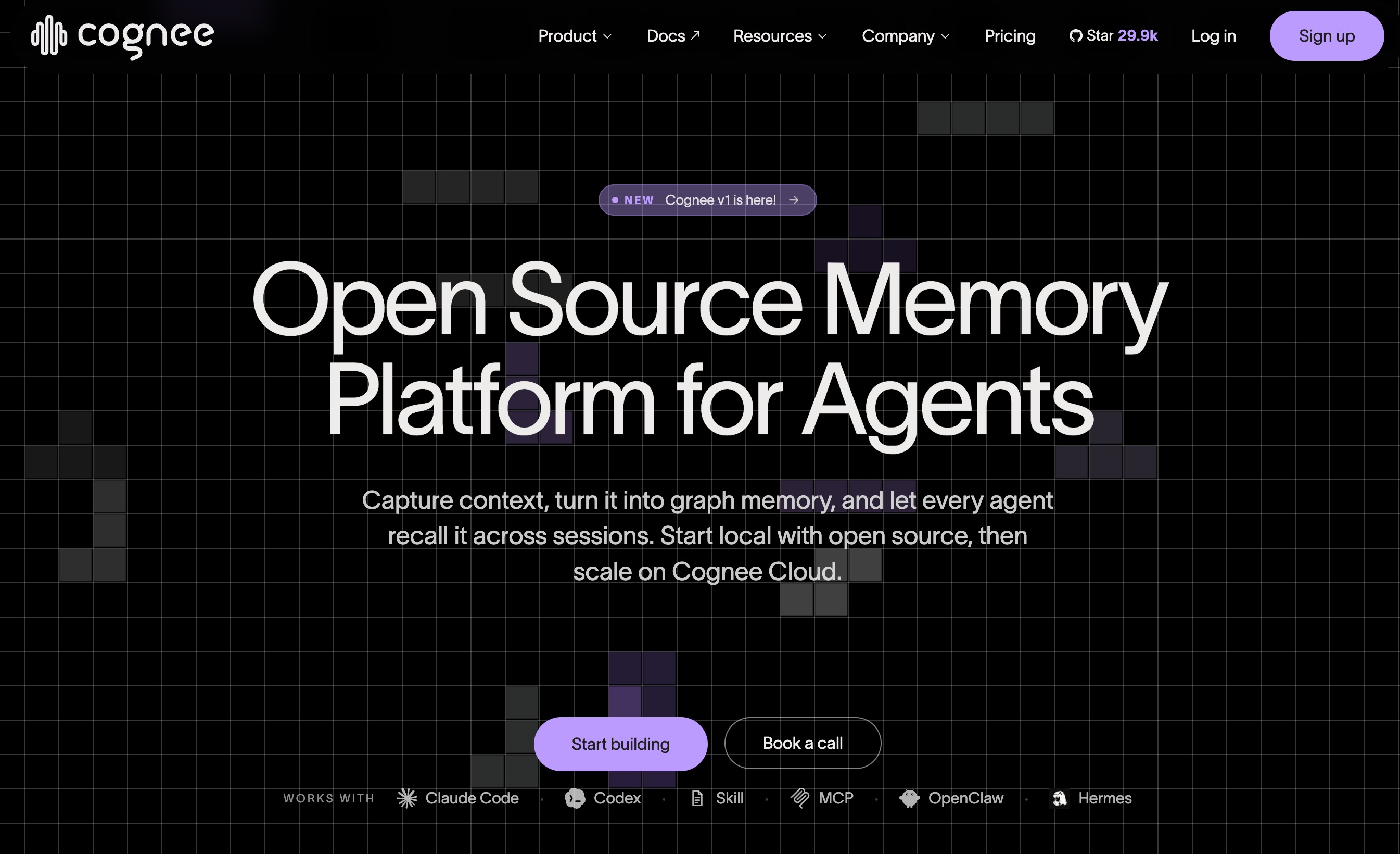
Cognee is a specialized, open-source memory engine built for extracting structured knowledge from diverse, complex data sources. Unlike basic vector databases, it constructs detailed, queryable knowledge graphs from documents, images, audio, and platforms like Slack or Notion. It forces the AI to follow deterministic factual paths to reduce hallucinations.
Key Features
- Hybrid architecture fusing vector search and deterministic graph databases.
- Over 30 pre-built data connectors for enterprise platforms.
- Clear data lineage tracking for legal and medical compliance.
- Automated extraction pipeline for unstructured multi-modal data.
Pros
- Extremely strong at reducing AI hallucinations via deterministic retrieval.
- Perfect for unifying scattered enterprise data silos.
- Can be self-hosted completely locally for maximum privacy.
Cons
- Requires configuring complex pipelines; not a simple plug-and-play API.
- Enterprise cloud plans are quite expensive.
- Python-only SDK limits JavaScript/TypeScript developer adoption.
Pricing
$1.00/1M Tokens.
7. Hindsight
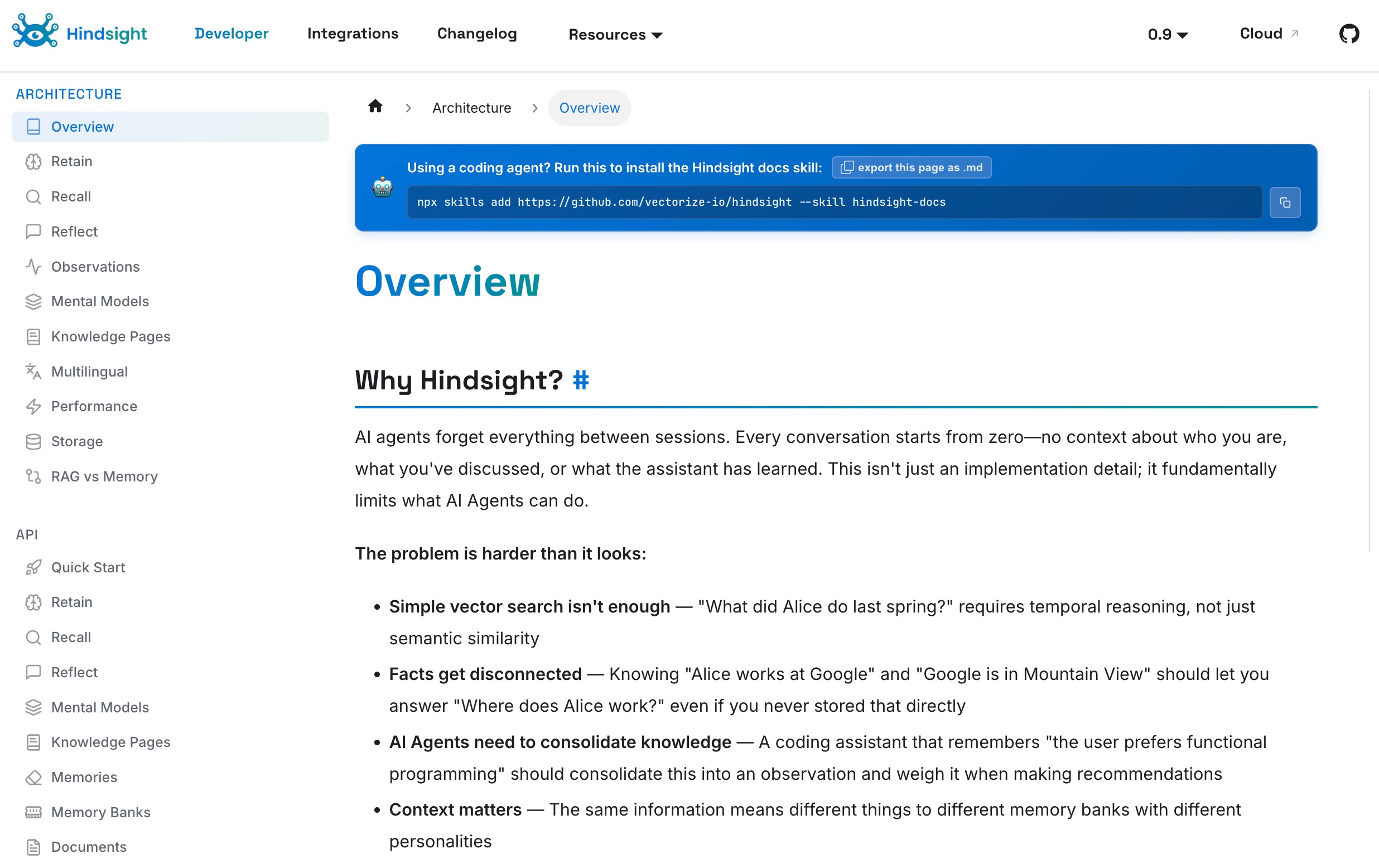
Hindsight focuses on the individual user, acting as a passive memory layer that tracks your digital footprint, browsing history, and contextual interactions to provide a deeply personalized AI search experience. It is fundamentally a personal AI memory tool that makes sure you never lose track of a tab, conversation, or thought.
Key Features
- Passive context tracking across your desktop and browser.
- Semantic search across your historical browsing and reading data.
- Automated context logging without requiring manual data entry.
- Privacy-first local processing for sensitive user data.
Pros
- Requires zero manual curation; works entirely in the background.
- Excellent for researchers and individuals suffering from information overload.
- Highly intuitive for day-to-day personal productivity.
Cons
- Not built as backend infrastructure for developer-made autonomous agents.
- Can raise privacy concerns for users wary of screen or browser tracking.
- Lacks complex relational graph mapping.
Pricing
Open source.
8. Mem
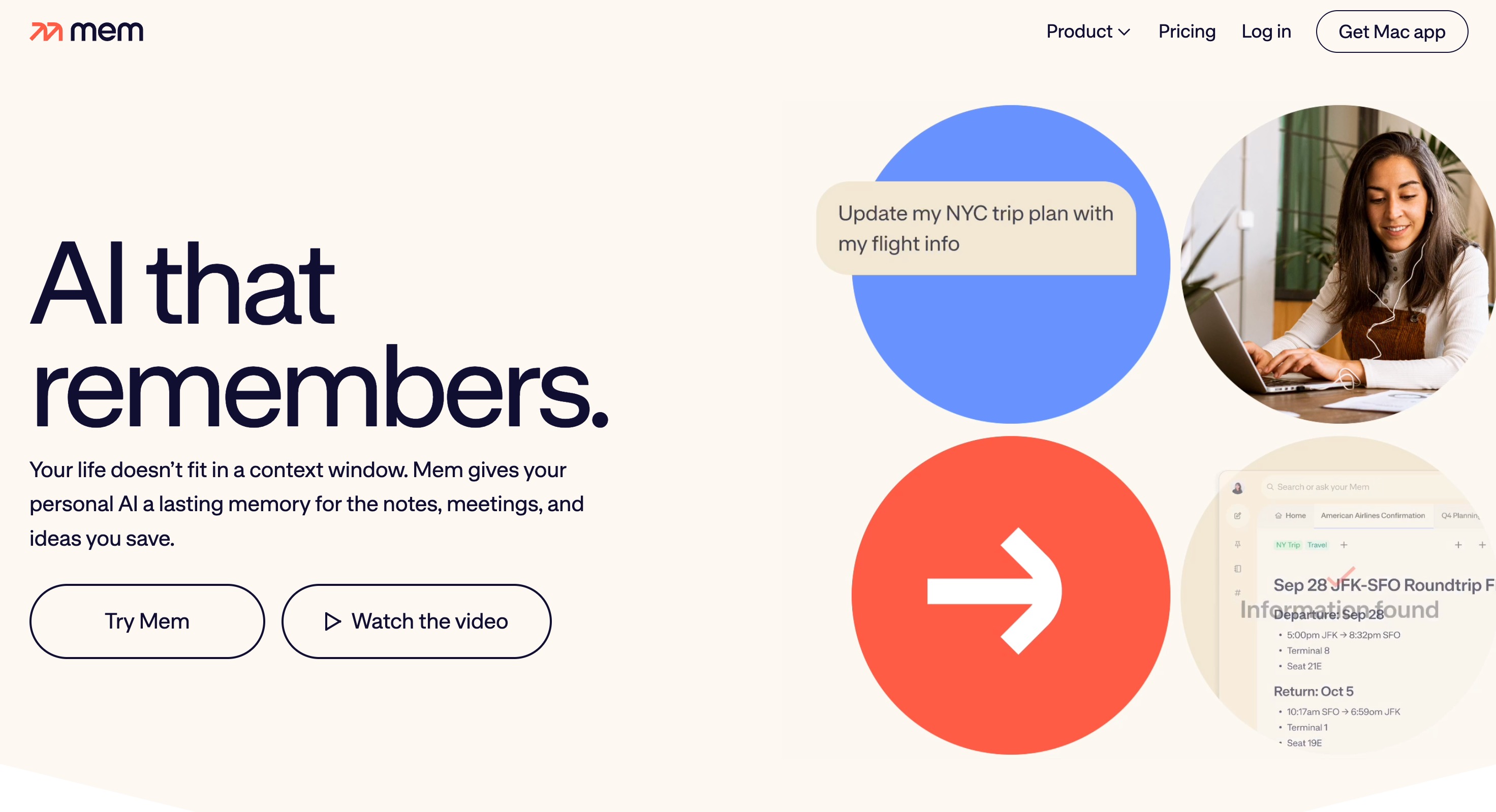
Not to be confused with Mem0, Mem (Mem.ai) is a consumer-facing, AI-powered workspace and note-taking application. Similar in function to Notion, it differentiates itself by being entirely built around AI from day one. It uses AI to automatically organize your notes, surface related ideas, and draft content based on your personal knowledge base.
Key Features
- AI-native text editor with auto-organization capabilities.
- "Mem X" smart search and intelligent tagging without folders.
- Pre-built templates and writing assistants that read your past notes.
- Calendar and email integration to pull in contextual meeting notes.
Pros
- The closest direct UI replacement to Notion on this list.
- Removes the cognitive load of manually organizing folders.
- Sleek, minimalist interface.
Cons
- Closed ecosystem; very difficult to extract memory for external AI agents.
- Sometimes struggles with highly structured database needs compared to Notion.
- No developer SDK for custom agent creation.
Pricing
Mem X plan starts at $9/month, targeting personal power users and small teams.
9. Claude Projects
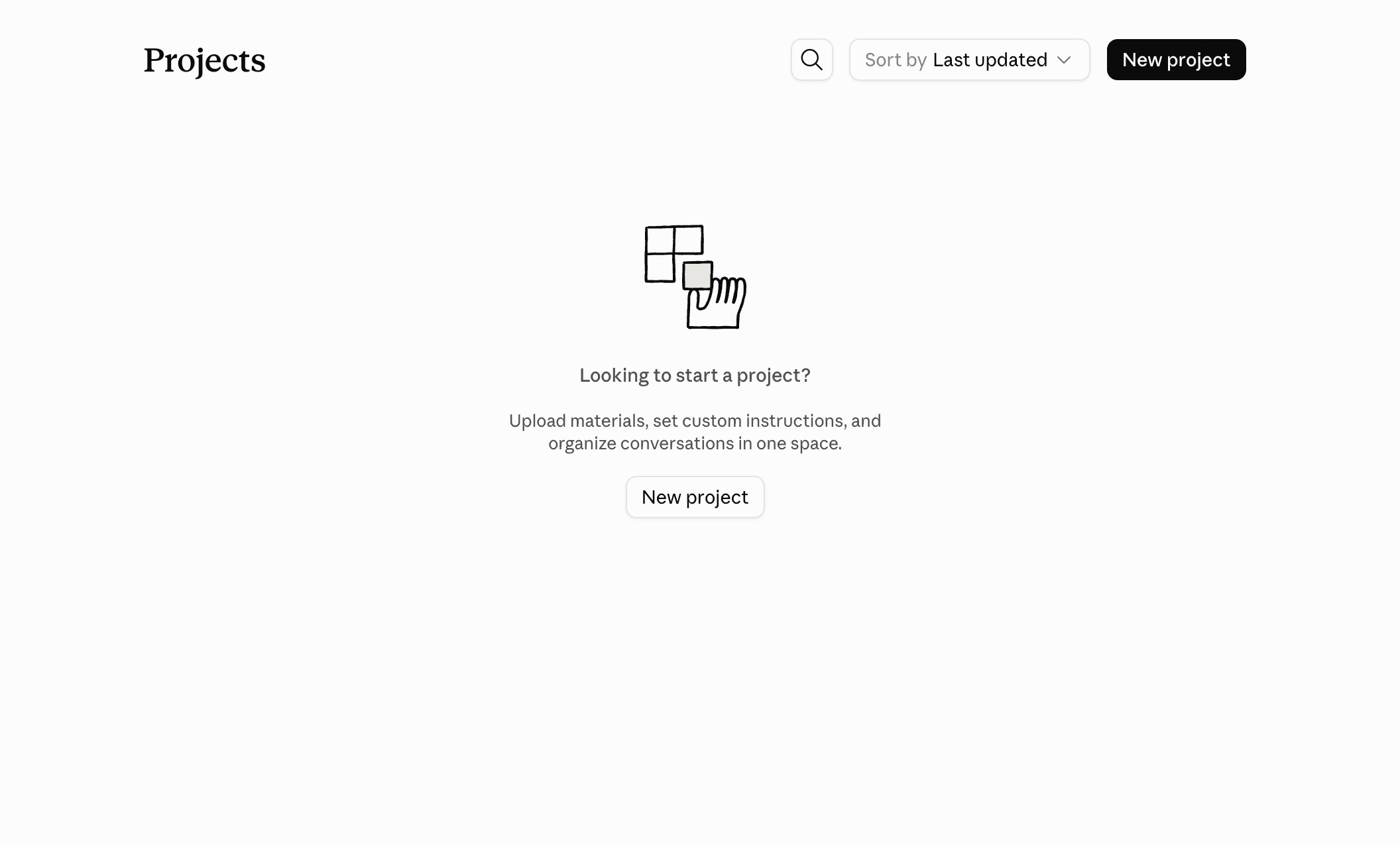
Anthropic introduced Claude Projects as a way to provide persistent context to Claude within a team workspace. By uploading documents, codebase structures, and guidelines into a "Project," you create a localized memory layer that grounds Claude’s responses in your specific team knowledge without starting from scratch every prompt.
Key Features
- Massive 200K token context window per project.
- Custom instructions specific to individual project environments.
- Secure team collaboration and shared artifact generation.
- Direct grounding in uploaded enterprise documents and PDFs.
Pros
- No setup required; works directly within the Claude UI.
- Incredible reasoning capabilities powered by Claude 3.5 models.
- Excellent for ad-hoc coding, writing, and analysis tasks.
Cons
- Relies entirely on context window stuffing rather than a true database.
- Locked firmly into the Anthropic ecosystem.
- Does not passively learn from dynamic conversations over time.
Pricing
Pro plan starts at $22/month.
10. MemoryBase
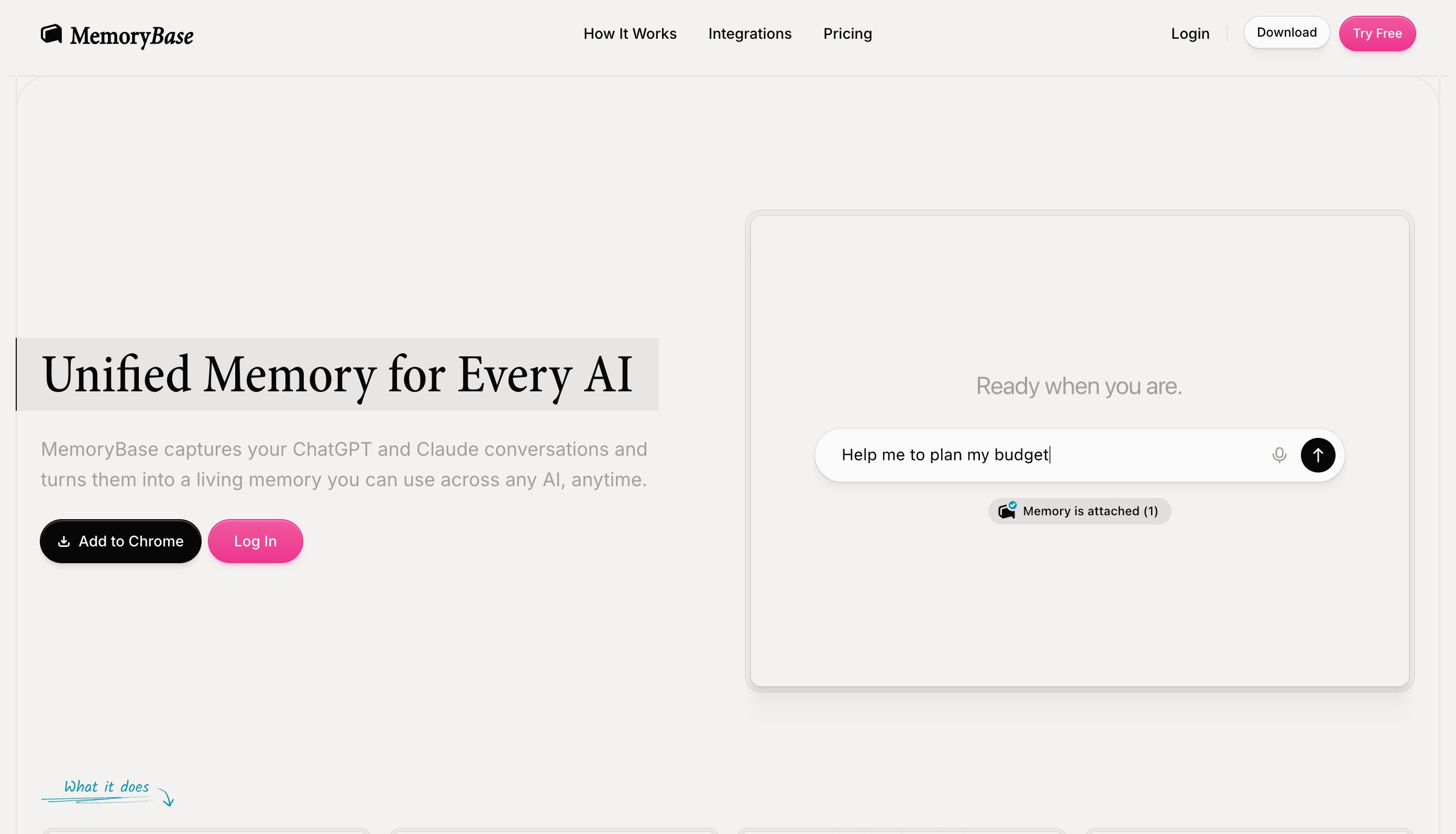
MemoryBase functions as a dedicated database specifically engineered for long-term LLM memory. It focuses on providing raw, low-latency API access for developers who want complete control over how their agents store and recall information. It acts as the unopinionated plumbing for AI memory layers.
Key Features
- High-performance vector and metadata storage.
- Unopinionated architecture allowing for custom retrieval schemas.
- Programmatic API built for high-throughput AI operations.
- Native integration with major LLM orchestration frameworks.
Pros
- Extreme flexibility for developers who want to build custom algorithms.
- Low latency, making it ideal for real-time voice and chat applications.
- Transparent operations with no black-box memory magic.
Cons
- Requires significant engineering effort to set up and optimize.
- Lacks the out-of-the-box UI features of Mem or Supermemory.
- Does not include native graph databases by default.
Pricing
Paid plan starts at $14/month.
How to Choose the Best Alternative for Your Workflow
Choosing the right Notion AI Memory alternative heavily depends on whether you are an end-user looking to organize personal notes or a developer building autonomous systems. Keep the following in mind:
- Evaluate your core need: If you just want a better note-taking app, tools like Supermemory or Mem are sufficient. However, if you are building customized AI systems, you need infrastructure tools like Zep, Letta, or MemoryLake.
- Factor in costs and scalability: Some managed services like Mem0 have steep price jumps for advanced features (e.g., $249/month for graph memory). You should look for transparent, usage-based scaling that doesn't punish early-stage development.
- Prioritize persistent architecture: Relying on tools that simply stuff context windows (like Claude Projects) becomes expensive and slow. You need a solution that systematically extracts, organizes, and retrieves only necessary facts.
- The overall winner for developers: While Zep offers fantastic temporal graphs and Letta provides an excellent OS for autonomous agents, MemoryLake stands out as the most balanced, persistent infrastructure on the market. Its ability to maintain deep context seamlessly across tasks, paired with a highly developer-friendly API and cost-effective scaling, makes it the supreme choice for building consistently personalized AI experiences.
Conclusion
The shift from simple, amnesiac chatbots to deeply personalized, context-aware AI agents requires a foundational change in how we handle data. While Notion AI Memory is a great feature for those already locked into the Notion ecosystem, it simply does not offer the flexibility, scalability, or developer control required to power independent applications or multi-agent workflows.
Whether you need the temporal tracking of Zep, the local self-editing of Letta, or the graph capabilities of Cognee, there is an alternative built for your exact use case. However, if you are looking for the absolute best balance of cross-session continuity, developer ease of use, and persistent infrastructure, MemoryLake is the clear final verdict. By choosing MemoryLake, you ensure your AI agents maintain flawless context over time, delivering the personalized, stateful experiences that users now demand.