
What Is Pinecone
- A Cloud-Native Vector Database: Pinecone is a fully managed, serverless platform designed specifically to store and query dense vector embeddings at scale, removing the need for infrastructure management.
- Optimized for Similarity Search: It excels at finding mathematically similar data points in high-dimensional space, which forms the core backbone of standard Retrieval-Augmented Generation (RAG) applications.
- Stateless External Storage: Pinecone acts as an external knowledge drive for your AI. It retrieves documents based on vector queries but does not natively track conversational state, user progression, or evolving facts over time.
- Developer-Friendly Integration: It provides a highly streamlined API for developers to ingest vectors generated by Large Language Models (LLMs) and perform rapid nearest-neighbor searches across massive datasets.
Why Look for Pinecone Alternatives for AI Agent Memory
- Beyond Basic Vector Search: Modern AI agents require more than just fetching similar text chunks. They need structured, persistent context, temporal reasoning, and complex entity relationship mapping to behave intelligently.
- Inefficient Cost Scaling for State: Continuously updating, consolidating, and overwriting stateful conversational memory in a pure vector database can lead to prohibitive API costs and highly inefficient compute usage.
- Lack of Native Conflict Resolution: Standard vector stores do not automatically resolve contradictory facts. If a user’s preference changes, the database might blindly return both the old and new facts unless the developer builds custom logic.
- Need for Higher-Level Abstractions: Developers increasingly prefer intelligent memory engines that automatically handle summarization, data extraction, and cognitive state management, rather than manually orchestrating raw vector embeddings.
What to Look for in a Pinecone Alternative
- Persistent Context Management: The ideal alternative should automatically store, organize, and intelligently recall relevant facts across continuous sessions without losing the logical thread of the interaction.
- Cognitive and Multimodal Capabilities: Look for systems that can seamlessly process various data formats—including documents, raw text, and tables—translating them into a unified knowledge graph or cognitive state.
- Automated Memory Consolidation: The platform must intelligently compress older conversational histories and actively resolve conflicting information to keep token usage low while maintaining pinpoint accuracy.
- Frictionless Integration Ecosystem: Ensure the alternative provides easy-to-use SDKs, comprehensive REST APIs, or Model Context Protocol (MCP) integrations to plug into your existing AI workflows instantly.
10 Best Pinecone Alternatives for AI Agent Memory in 2026
Before diving into the detailed breakdowns of each platform, here is a comparative overview of the top 10 alternatives tailored for AI agent memory.
| Product | Best For | Core Technology | Pricing Model |
|---|---|---|---|
| 1. MemoryLake | Comprehensive AI Agent Memory | Persistent Multimodal Context | $19/month |
| 2. Weaviate | Scalable Vector Search | Open-source Vector DB | $45/month |
| 3. Redis | Real-time AI Applications | In-memory Data Store | Custom |
| 4. LanceDB | Embedded Vector Workloads | Columnar Vector DB | Pay-as-you-go |
| 5. Neo4j | Multi-hop Graph Reasoning | Graph Database | $65/month |
| 6. LlamaIndex | Data Orchestration | Data Framework | $50/month |
| 7. Mem0 | Personalized AI Interactions | Hybrid Memory Layer | $19/month |
| 8. Zep | Conversational Chatbots | Long-term Memory API | $125/month |
| 9. Supermemory | AI Second Brain | Universal Memory Engine | $19/month |
| 10. Mnemoverse | Cross-Tool Context | MCP-based Memory API | $29/month |
1. MemoryLake
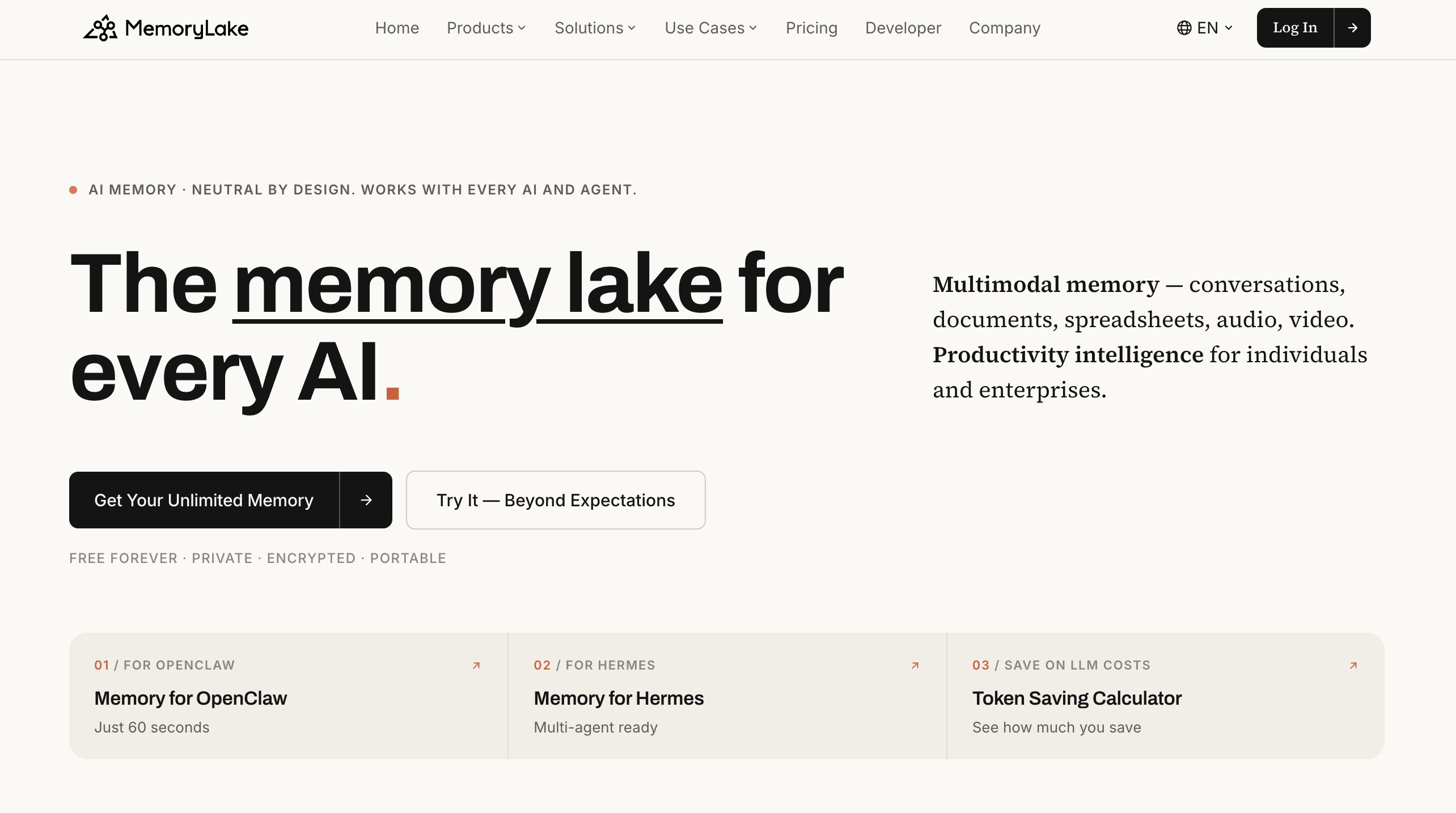
MemoryLake is a persistent memory infrastructure designed to help AI agents and applications maintain context across conversations, tasks, and sessions. Instead of treating every interaction as a fresh start, it enables AI systems to store, organize, retrieve, and reuse relevant information over time. This can include user preferences, historical interactions, important facts, task context, and other long-term knowledge. MemoryLake is suitable for a wide range of AI applications, from personal assistants and customer support agents to AI-powered workflows, multi-agent systems, and interactive virtual characters. Its focus on persistent, structured memory makes it easier for developers to build AI experiences that feel more consistent.
Key Features
- Intelligent Conflict Resolution: Automatically detects when new facts contradict older ones, updating the AI’s understanding without duplicating data.
- Multimodal Processing: Natively understands and extracts context from complex documents, PDFs, Excel sheets, and unstructured text.
- Full Memory Traceability: Operates with version-control-like provenance, meaning every recalled fact can be traced back to its exact original source.
Pros
- Eliminates context loss across all AI platforms and sessions.
- Significantly reduces LLM token costs by compressing and structuring retrieved data.
- Zero-trust architecture ensures data privacy with top-tier encryption.
Cons
- May be overly comprehensive for projects that only need a simple stateless RAG pipeline.
- Requires a mindset shift from traditional vector DB management to cognitive memory management.
Pricing
Freemium; Pro plan starts at $19/month.
2. Weaviate
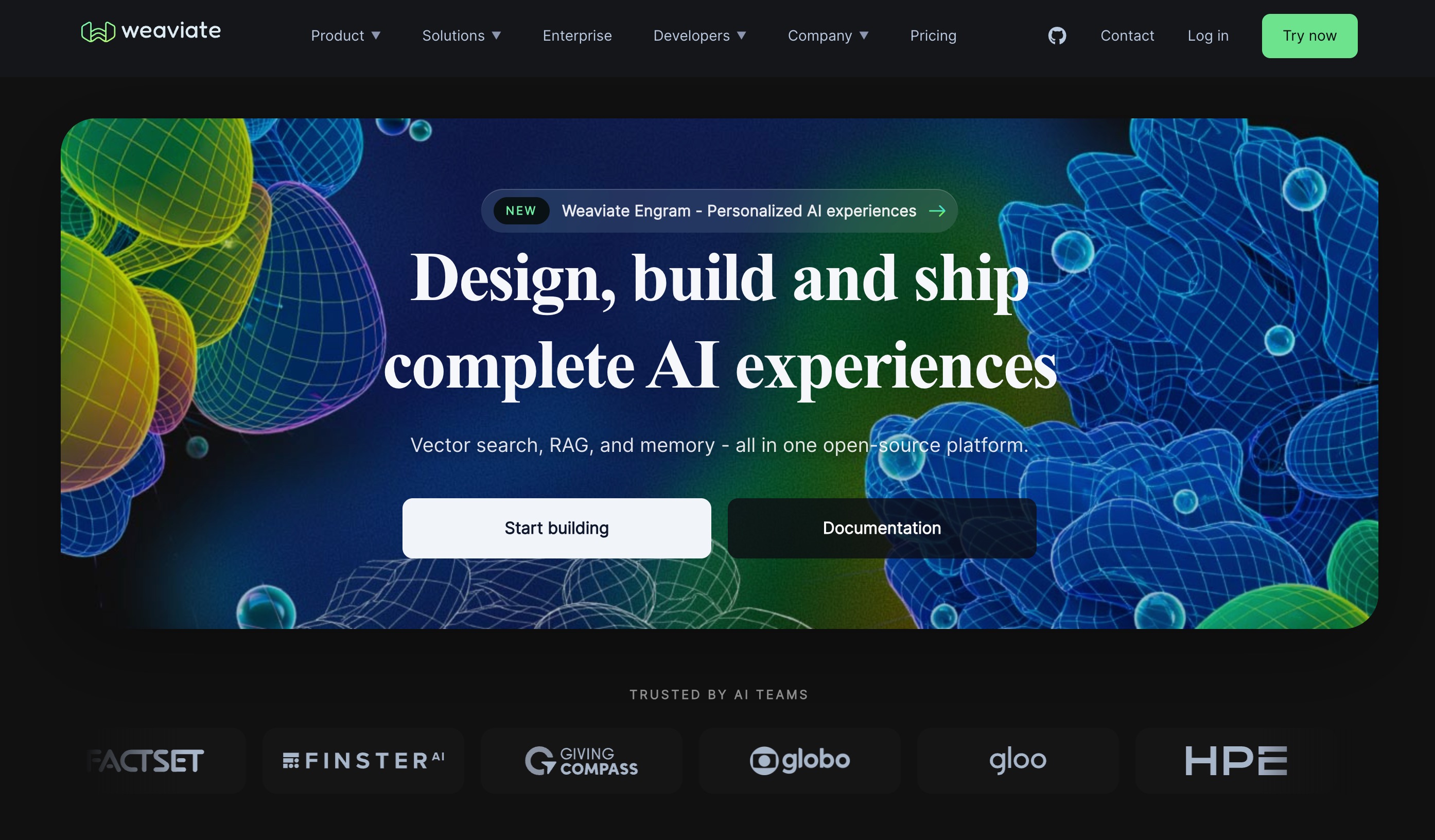
Weaviate is a robust, open-source vector database built to store both data objects and their corresponding vector embeddings. It empowers developers to build scalable AI applications by offering out-of-the-box support for advanced vector search, making it a popular choice for enterprise RAG architectures that require high reliability.
Key Features
- Hybrid Search: Seamlessly combines dense semantic search with keyword-based BM25 algorithms for optimal retrieval accuracy.
- Modular Architecture: Supports various vectorization models and LLM provider integrations directly within the database engine.
- Multi-Tenancy Support: Efficiently isolates data for different users or agents within the same database cluster.
Pros
- Highly scalable for massive, enterprise-level datasets.
- Extremely flexible deployment options (cloud, on-premise, embedded).
- Vibrant open-source community and excellent documentation.
Cons
- Requires significant infrastructure management if you choose to self-host.
- Lacks native, high-level "agent memory" logic; developers must build the state management themselves.
Pricing
$45/month.
3. Redis
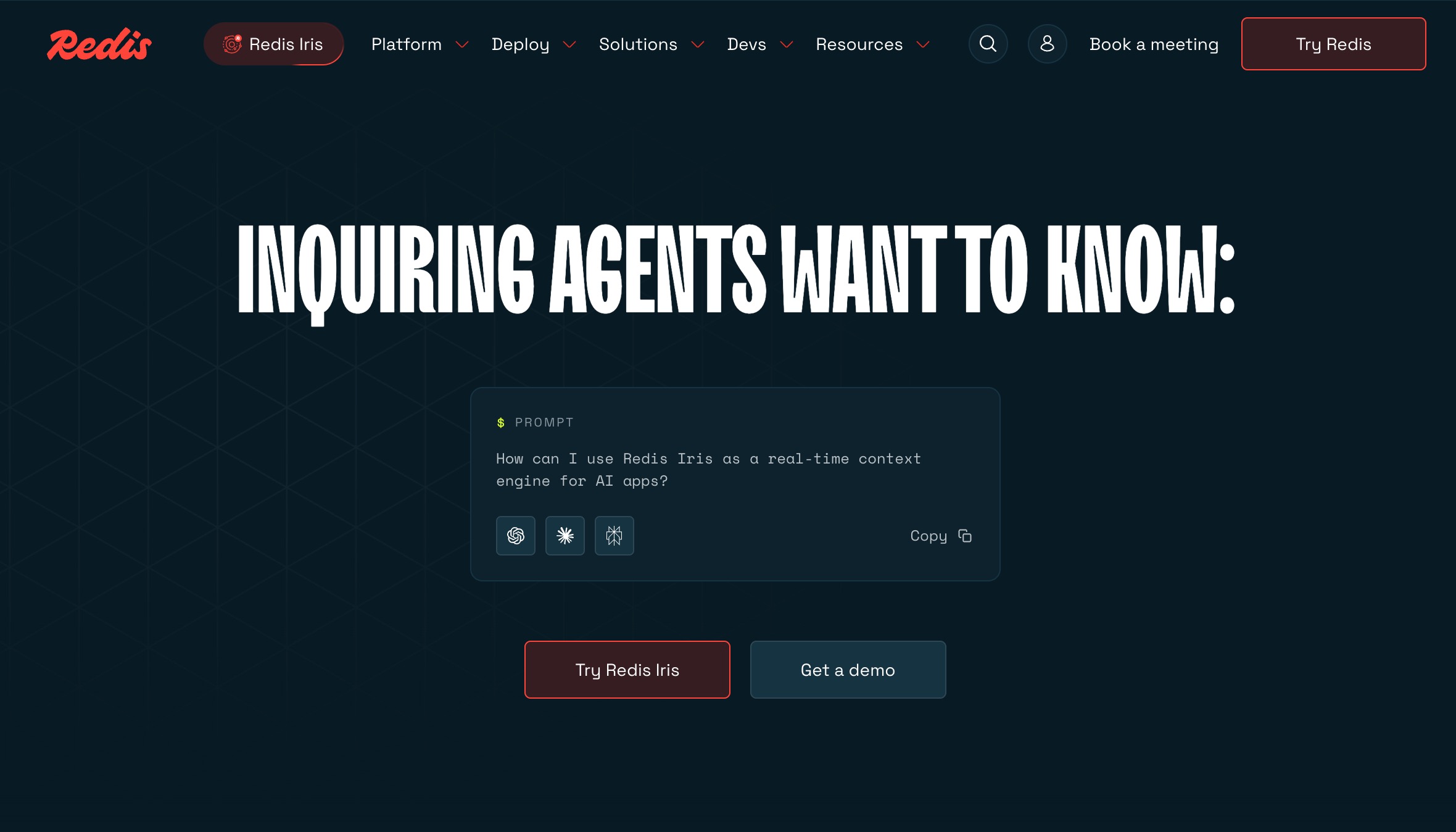
Originally known worldwide as a lightning-fast in-memory key-value store, Redis has continuously evolved. With the introduction of Redis Stack, it now includes powerful vector search capabilities. This transformation makes Redis a highly viable real-time database for AI applications that demand immediate data retrieval and minimal latency.
Key Features
- In-Memory Speed: Delivers sub-millisecond latency for real-time vector queries and conversational memory updates.
- Versatile Data Structures: Allows developers to store hashes, JSON documents, and vector indexes all in one place.
- Advanced Filtering: Supports complex pre-filtering and post-filtering of vector searches based on metadata.
Pros
- Unmatched operational speed and low latency for agent interactions.
- Extremely widespread and proven in high-throughput enterprise environments.
- Familiar syntax and easy onboarding for existing Redis users.
Cons
- High RAM dependency makes it an expensive option for storing very large archival datasets.
- It is a general-purpose database, not a purpose-built AI cognitive memory engine.
Pricing
Custom pricing.
4. LanceDB
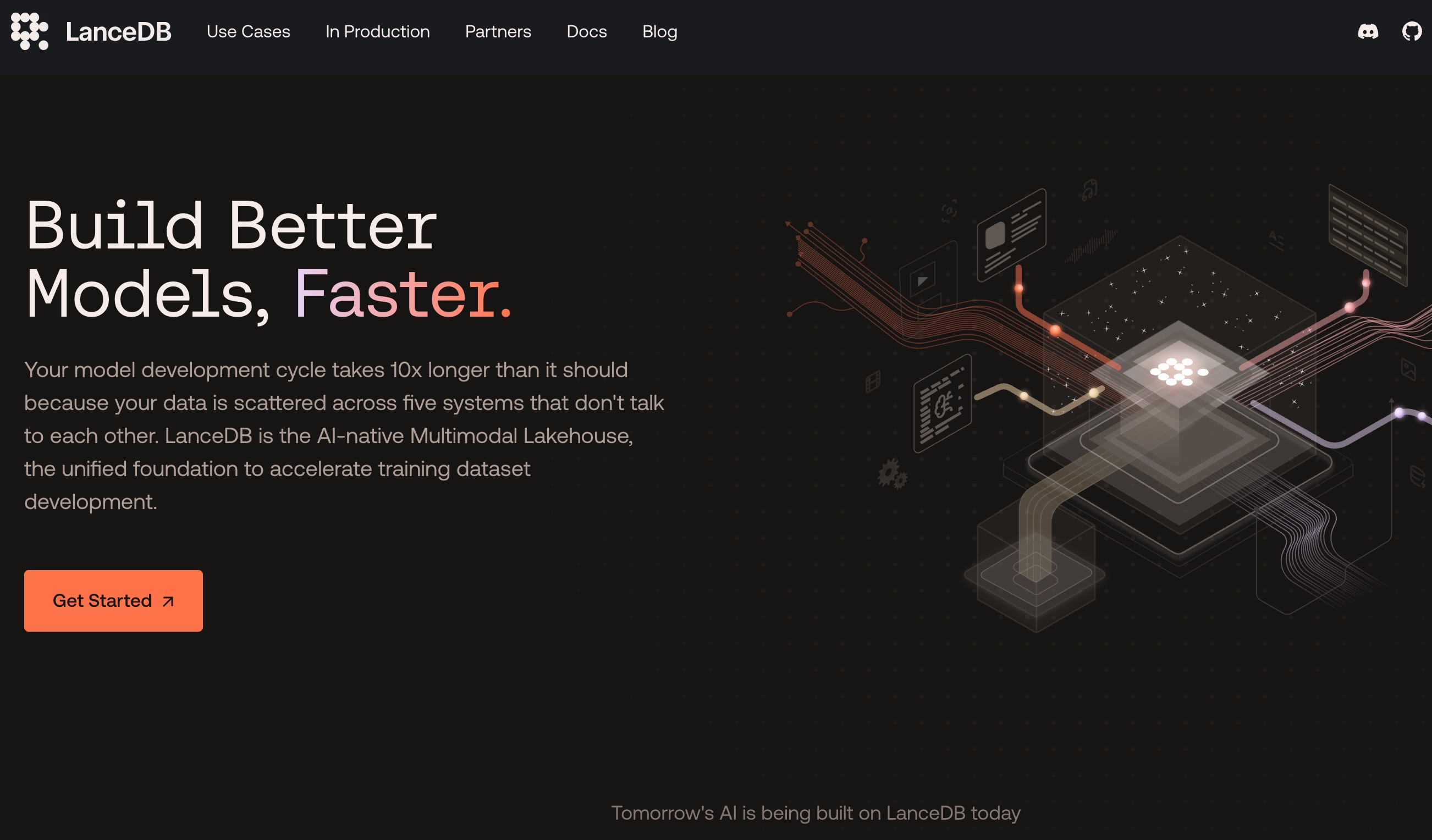
LanceDB is a developer-friendly, open-source columnar database specifically designed for vector search. Built on the Arrow format, it uniquely runs embedded directly in your application or as a serverless cloud instance. It prioritizes simplicity, speed, and seamless integration with modern data science workflows.
Key Features
- Embedded Design: Runs directly within the app process, eliminating the need to manage a separate database server.
- Multimodal Capabilities: Natively handles complex data types like text, images, and audio seamlessly.
- Zero-Copy Search: Leverages columnar data formats to execute blazing-fast analytical queries without moving data.
Pros
- Zero-setup deployment for the embedded version drastically reduces friction.
- Highly performant for both analytical queries and vector workloads.
- Integrates flawlessly with the Python data ecosystem (Pandas, PyArrow).
Cons
- Smaller community and ecosystem compared to long-established databases.
- Higher-level agent memory abstraction features are still evolving.
Pricing
Pay as you go.
5. Neo4j
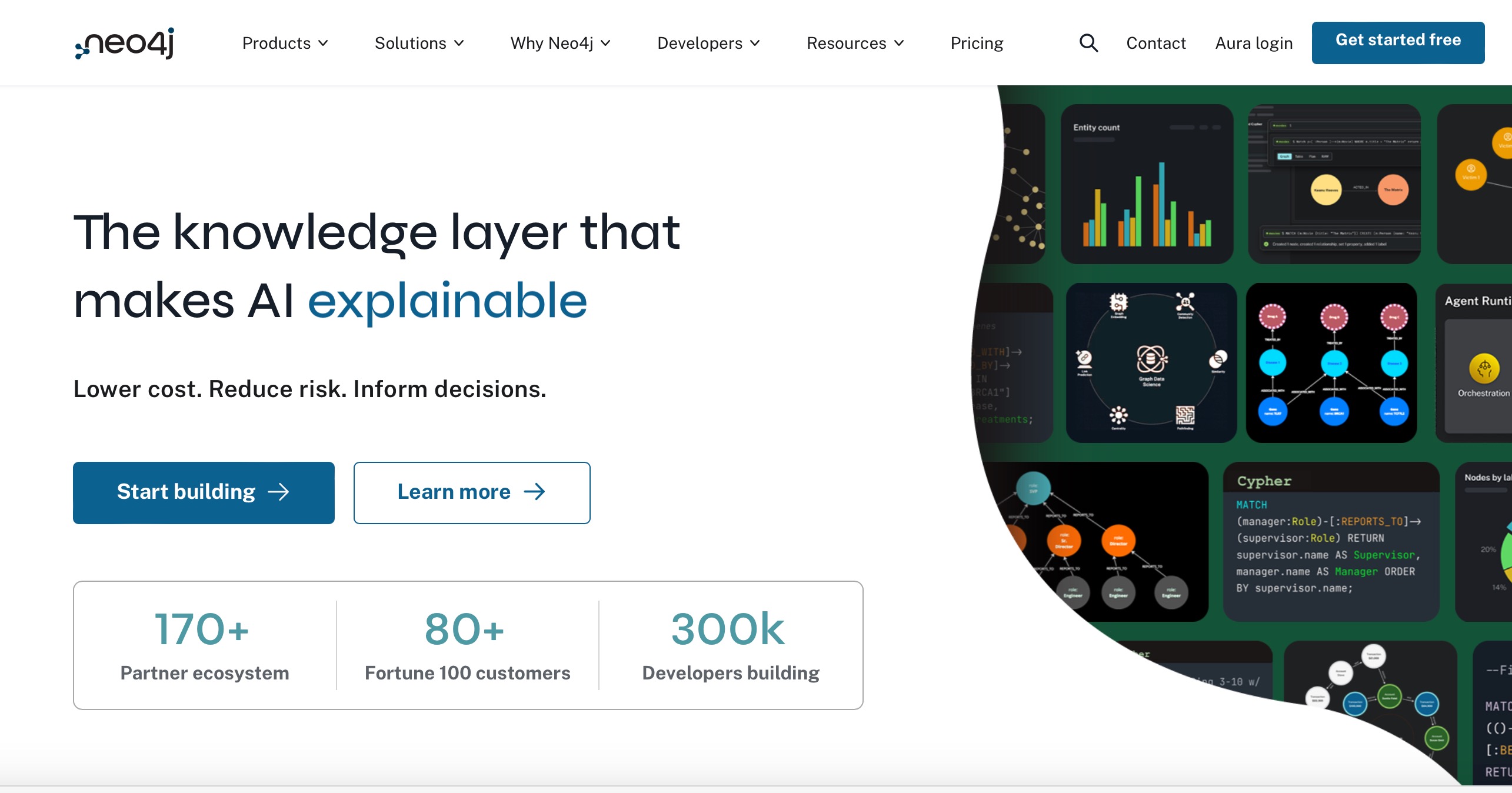
Neo4j is the world's leading graph database, and it has successfully embraced the AI revolution through the concept of GraphRAG. By storing data as interconnected nodes and relationships rather than flat vectors, it provides AI agents with the ability to perform complex, multi-hop reasoning tasks that standard vector stores struggle with.
Key Features
- Graph Modeling: Explicitly maps out complex logical relationships between data points, entities, and historical facts.
- Cypher Query Language: Provides a powerful, expressive querying mechanism for interconnected data.
- Vector Search Integration: Combines native graph traversal with embedded vector search for the best of both worlds.
Pros
- Superior architecture for multi-hop reasoning and logical AI workflows.
- Highly visual data representation makes debugging agent knowledge easier.
- Excellent for discovering hidden connections within agent memory.
Cons
- Presents a steep learning curve for developers unfamiliar with graph modeling.
- Can be overkill and resource-intensive for simple conversational agents.
Pricing
$65/month.
6. LlamaIndex
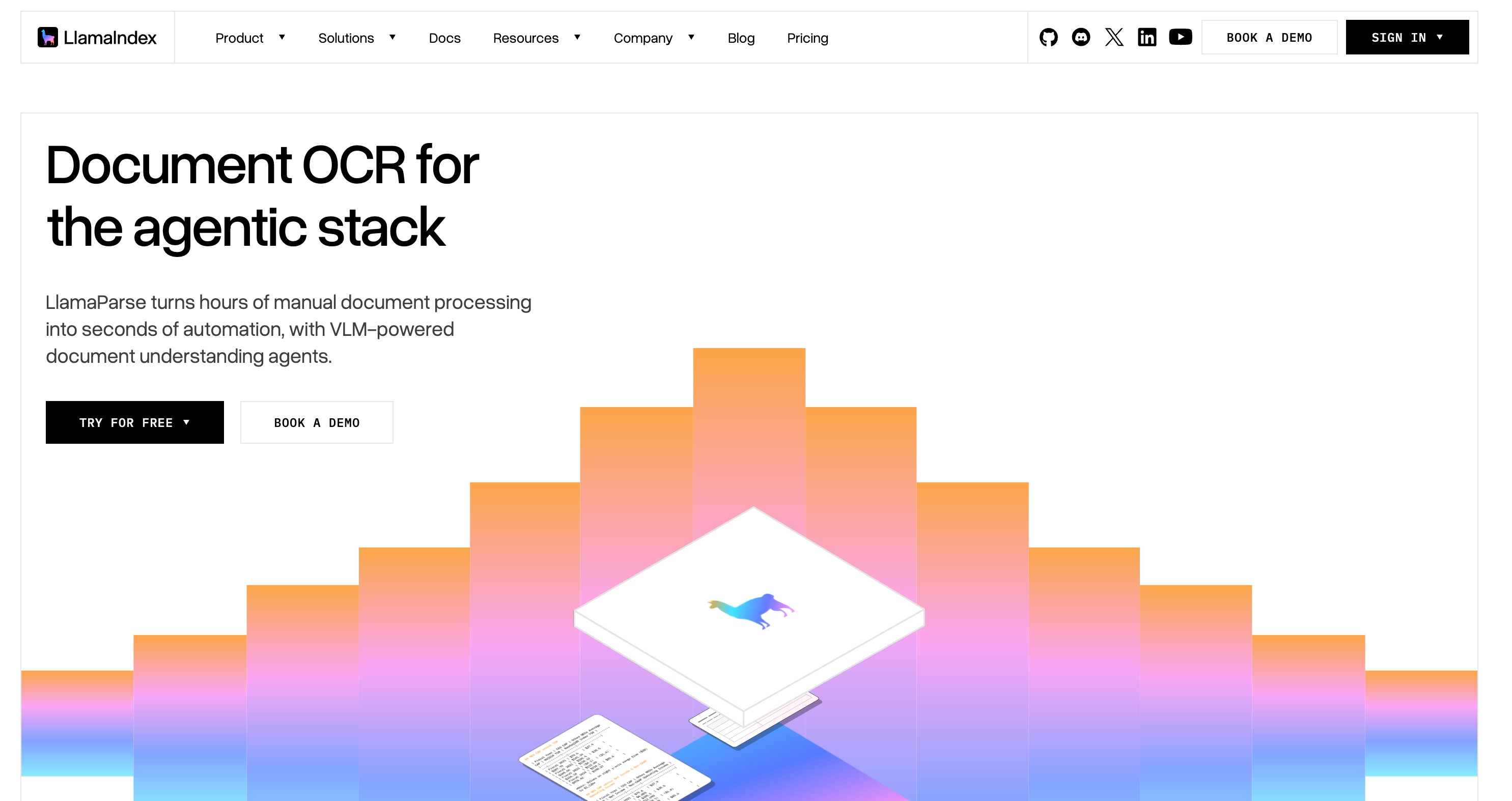
LlamaIndex is a powerful data orchestration framework rather than a traditional standalone database. It acts as the ultimate bridge between your custom data sources and LLMs, handling the intricate tasks of indexing, routing, and retrieving information to ensure your AI agents have the exact context they need.
Key Features
- Extensive Data Connectors: Easily ingests data from hundreds of different sources, including APIs, PDFs, and SQL databases.
- Advanced Indexing Structures: Offers diverse indexing options like tree, list, keyword, and vector indexes depending on the task.
- Memory Modules: Includes built-in chat memory buffers and summarization logic for conversational agents.
Pros
- Outstanding for rapidly building sophisticated and varied RAG pipelines.
- Backed by a massive ecosystem and an incredibly active open-source community.
- Highly flexible, allowing developers to swap out underlying vector databases easily.
Cons
- Primarily acts as an orchestration layer, meaning you still need to provide an underlying database.
- The vast array of features can introduce unnecessary complexity for simple use cases.
Pricing
$50/month.
7. Mem0
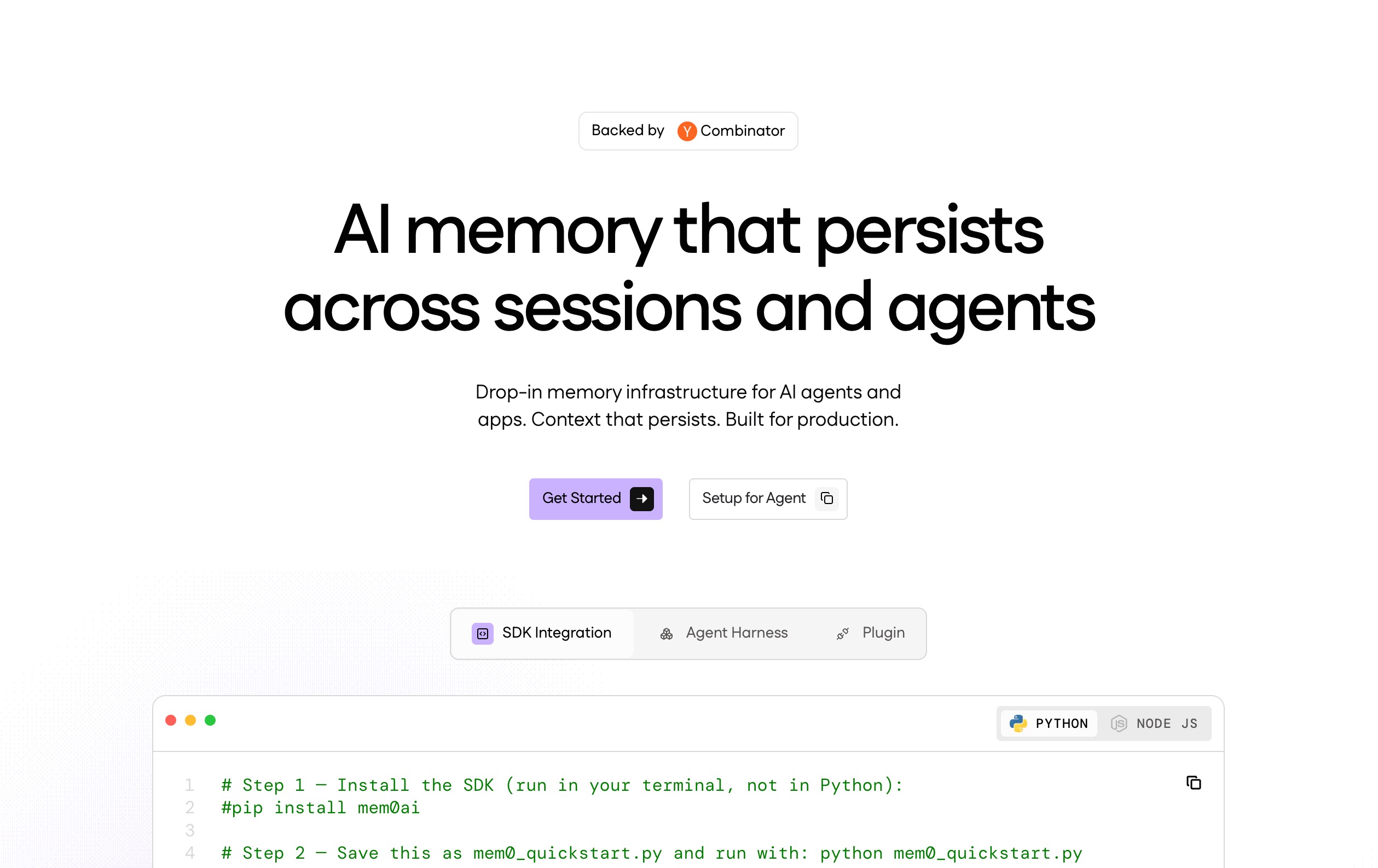
Mem0 is a specialized, intelligent memory layer built specifically to give AI assistants personalized, long-term memory. Evolving from earlier orchestration tools, it actively manages user interactions to ensure that AI agents become smarter, more adaptive, and more personalized over time without manual intervention.
Key Features
- Automated User Profiling: Intelligently extracts and remembers individual user preferences across endless sessions.
- Hybrid Datastore Architecture: Utilizes a mix of graph and vector storage technologies to provide rich contextual relationships.
- Drop-in Integration: Allows developers to add persistent memory to their apps with just a few lines of code.
Pros
- Extremely easy to integrate into existing LLM applications.
- Greatly enhances user personalization and user retention for AI apps.
- Open-source nature allows for total data control.
Cons
- Still a relatively new player compared to established infrastructure giants.
- Deep customization might be slightly restricted for highly unusual enterprise edge cases.
Pricing
$19/month.
8. Zep
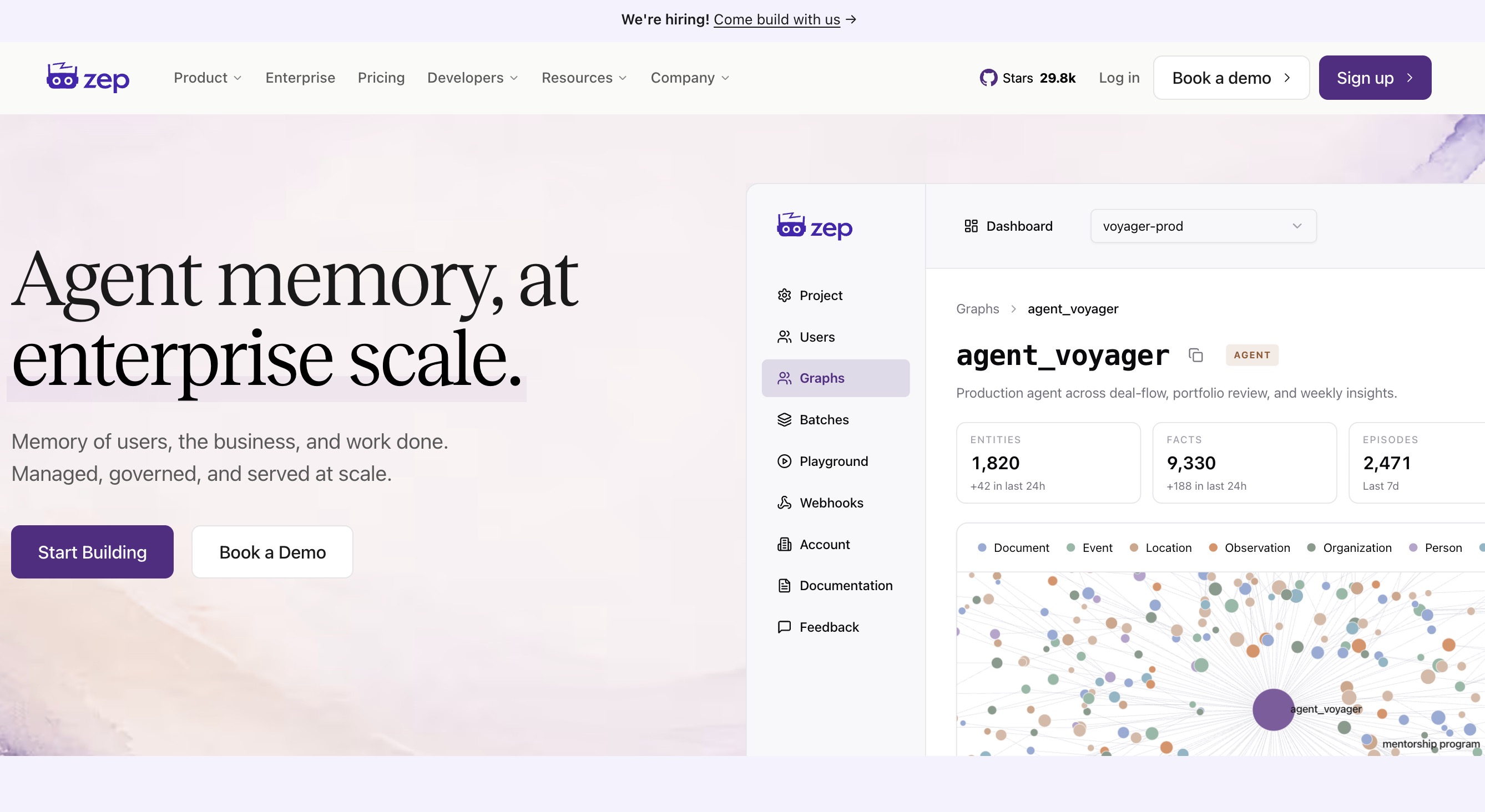
Zep is a long-term memory store tailored explicitly for AI assistants. It works silently in the background of your conversational AI, automatically extracting facts, summarizing older dialogue, and maintaining a clean conversational history so that your agent never loses the plot of the discussion.
Key Features
- Auto-Summarization: Compresses older chat histories automatically to preserve context while saving on token costs.
- Entity and Fact Extraction: Identifies, extracts, and stores key entities and immutable facts from live dialogue.
- Vector Search Included: Handles basic semantic search alongside its robust memory management tools.
Pros
- Drastically reduces token usage by injecting only relevant, condensed summaries.
- Provides immediate, out-of-the-box context for chatbot applications.
- Reduces latency by handling summarization asynchronously.
Cons
- Geared very heavily towards conversational chatbots rather than complex, task-driven workflows.
- The analytics and visualization features for stored memory are somewhat basic.
Pricing
$125/month.
9. Supermemory
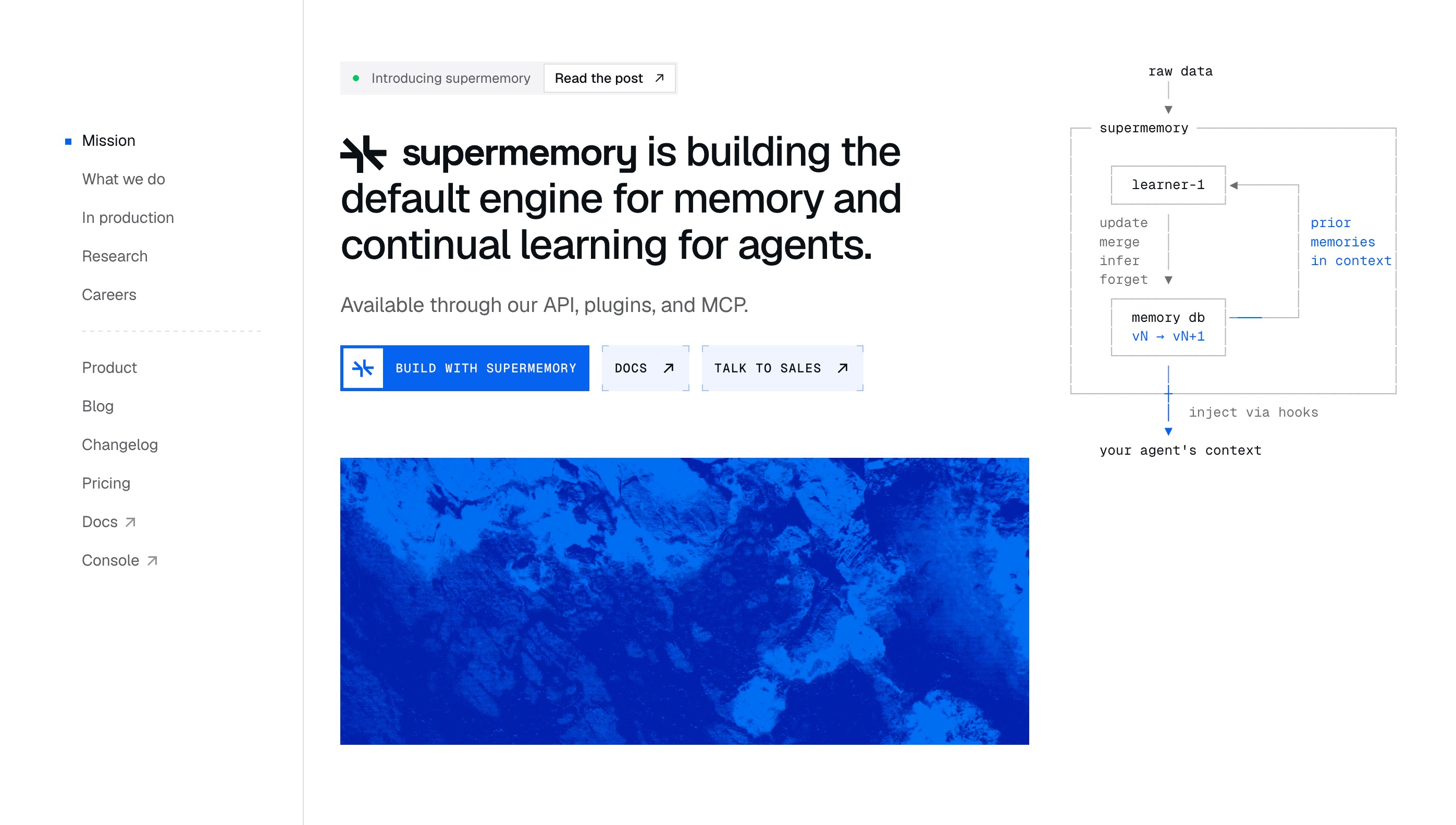
Supermemory functions as an open-source AI "second brain" and a universal memory API. It allows AI agents to intelligently organize and instantly retrieve saved knowledge from varied contexts—turning disorganized files, chats, and links into a highly searchable, portable cognitive engine.
Key Features
- Universal Memory API: Connects multiple different AI applications and extensions to a single, unified memory source.
- Contextual Understanding: Actively evaluates temporal and causal relationships between saved memories to improve retrieval.
- Multi-Platform Extensions: Comes with browser extensions and tools to save data directly into the AI’s brain.
Pros
- Highly versatile for building both personal AI tools and professional knowledge bases.
- Open-source architecture encourages community-driven plugins and continuous improvements.
- Excellent for building "second brain" styled applications.
Cons
- Requires a bit of technical know-how to set up and maintain the self-hosted versions.
- Documentation is still growing as the project scales.
Pricing
$19/month.
10. Mnemoverse
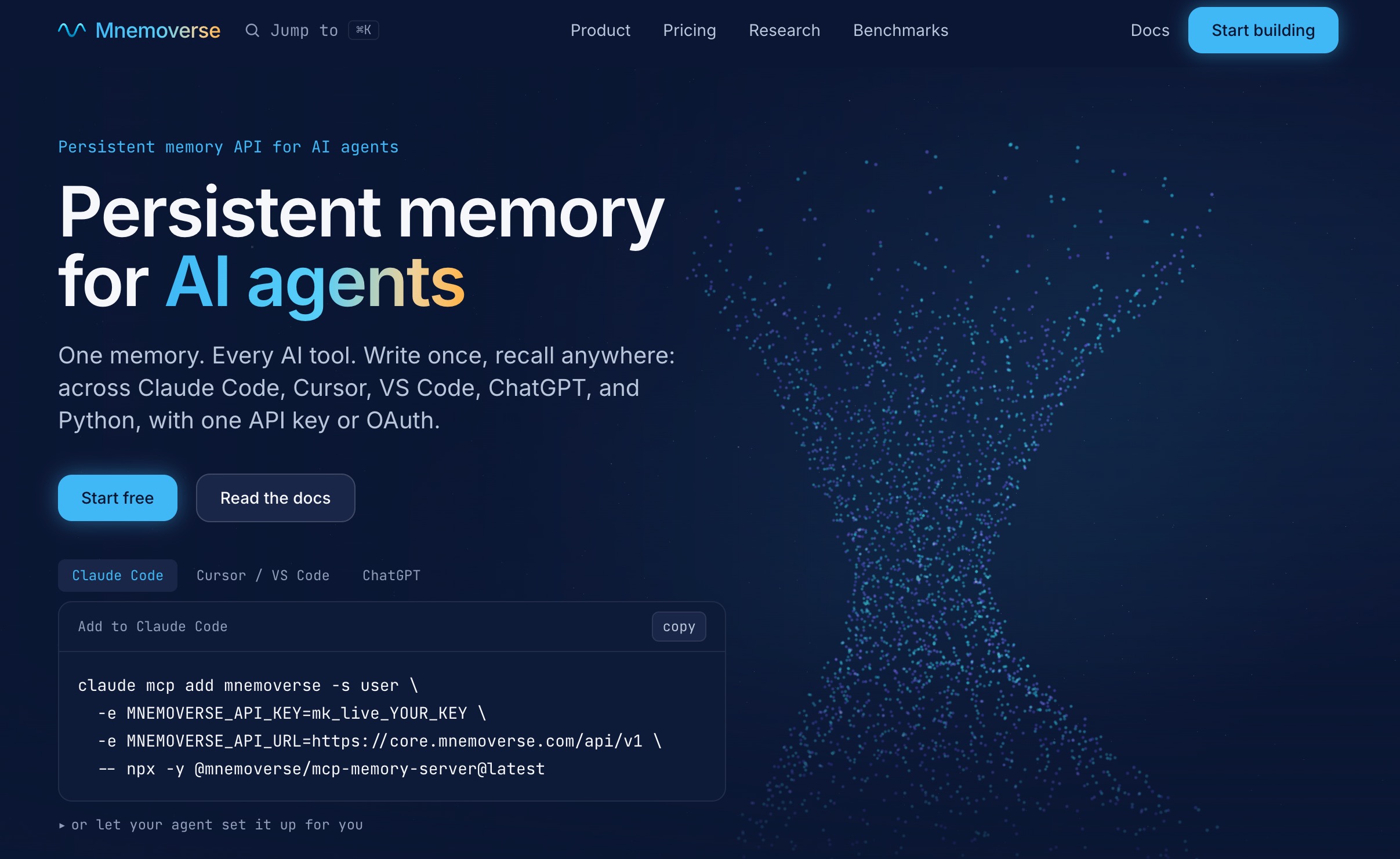
Mnemoverse offers persistent, cross-tool memory infrastructure tailored for modern AI agents. By utilizing the Model Context Protocol (MCP), it acts as a universal memory layer that ensures your AI workflows—whether in code editors or chat interfaces—share the exact same contextual understanding.
Key Features
- Cross-Tool Context: Works seamlessly across major AI platforms like Claude, ChatGPT, and Cursor via a single API key.
- Dynamic Importance Scoring: Automatically ranks and adjusts the relevance of memories based on implicit and explicit user feedback.
- Live MCP Integration: Features frictionless setup through official MCP registries, making it instantly available to modern AI clients.
Pros
- Delivers a true "memory passport" experience, breaking down data silos between different AI applications.
- Incredibly frictionless setup for developers already using the MCP ecosystem.
- Focuses heavily on adaptive learning rather than just static storage.
Cons
- Utility is somewhat dependent on the broader industry adoption of the MCP standard.
- Advanced learning features require relying on their managed cloud infrastructure.
Pricing
$29/month.
How to Choose the Right Pinecone Alternative
When selecting a memory backend for your AI agent, the decision comes down to your specific architectural needs. If your sole objective is to store basic document embeddings for a standard RAG pipeline, robust databases like Weaviate and LanceDB offer excellent, highly scalable open-source paths. When dealing with complex entity relationships and multi-hop logical deductions, Neo4j is virtually unbeatable. For developers who want drop-in conversational memory for chatbots without reinventing the wheel, purpose-built wrappers like Zep and Mem0 are incredibly convenient.
However, if you want a complete, intelligent memory infrastructure that natively handles multi-modal contexts, actively resolves factual conflicts, and ensures seamless cross-session continuity, MemoryLake stands out as the ultimate choice. It bridges the gap between raw data storage and true cognitive AI understanding, freeing developers from the heavy lifting of state management while dramatically lowering LLM inference costs.
Final Verdict
While standard vector databases have brought AI this far, the future of autonomous agents demands a sophisticated cognitive layer. Tools like Neo4j, Weaviate, and Mem0 all offer fantastic capabilities for different niches. Yet, for teams looking to build highly advanced, context-aware AI applications that remember and evolve naturally, MemoryLake is the definitive winner. By treating memory not just as storage but as an intelligent, conflict-resolving infrastructure, MemoryLake empowers developers to build AI experiences that are truly persistent, reliable, and cost-effective.