
Why a bigger context window doesn't become memory
The window is rebuilt from scratch on every request
The mental model most people carry is that a conversation accumulates inside the model, like a session on a server. It doesn't. Each request sends the model a block of text — system prompt, prior turns, whatever files got attached — and the model produces a continuation. Then it's over. Nothing is retained on the model's side.
What creates the illusion of continuity is your client re-sending the transcript every single time. That's why the conversation "remembers" what you said ten minutes ago and knows nothing about what you said in yesterday's chat: yesterday's transcript isn't in the block. A larger window means the block can be bigger. It does not mean anything gets kept between blocks.
This is also why the size number is misleading as a memory metric. 262,144 tokens is roughly a few hundred thousand words of capacity per request, not an archive. Fill it completely and you still start empty next time.
Preserved reasoning is continuity inside a conversation, not across them
Qwen3.8's thinking-block behavior is a genuinely useful feature and a perfect illustration of the boundary. Retaining "a complete reasoning trace across the conversation" means the model can see how it got to its earlier conclusions instead of re-deriving them — fewer contradictions, better long-horizon work, less of the drift you get when a model forgets its own earlier reasoning.
Read the scope carefully: across the conversation. Not across conversations. The trace is part of the transcript being re-sent, so it lives exactly as long as the transcript does. Close the session and the reasoning goes with it. A feature that makes one long session more coherent is not a feature that makes tomorrow's session informed.
The million is a configuration you opt into, and it isn't free
The extended length is a scaling technique, not a default. Qwen's card describes using YaRN — changing the rope_parameters fields in the model config — and for vLLM specifically, serving with VLLM_ALLOW_LONG_MAX_MODEL_LEN=1 and --max-model-len 1000000. That's a deliberate change to how the model handles position, applied because you decided the trade is worth it.
And it is a trade. Long contexts cost memory on the device holding the KV cache and time on every token generated. Running a million-token context locally is a hardware conversation, not a checkbox. Meanwhile the thing you actually wanted — that the model knows your project next Tuesday — costs nothing in VRAM because it isn't a context problem at all.
Someone still has to decide what goes in the window
This is the part that gets skipped. Suppose you have a million tokens and hardware to spare. What do you put in it?
To answer that, you need to know what exists, which parts are current, and which parts matter for this task. That's a retrieval-and-curation problem, and it doesn't get easier as the window grows — it gets harder, because "just put everything in" starts to look feasible right up until you notice that "everything" includes the decisions you reversed, the architecture doc that's two rewrites stale, and three contradictory versions of the same convention.
A large window changes the ceiling on what you can load. It doesn't tell you what you should load. And when the window is full of contradictions, model output gets worse, not better — the same reason vendors across the board recommend keeping always-loaded instruction files short.
Long-context benchmarks measure a different skill
Retrieval-from-window evaluations ask whether a model can find a fact you deliberately placed in the context. That's a real capability and models have gotten dramatically better at it. But notice what the setup assumes: the fact is already in the window. Someone put it there.
The failure people actually experience is different. Nobody put it there, because it was decided three weeks ago in a conversation that ended, and there is no process that would have carried it forward. No score on a long-context benchmark addresses that, because it isn't a capability question.
What people try
Pasting the same context every session. The universal workaround. It works and it's expensive — you pay for those tokens on every request, you have to remember what to paste, and the moment you're on a different machine or a colleague asks, it doesn't exist.
Keeping one enormous conversation open forever. Delays the problem. Eventually the thread gets slow, gets summarized, or gets lost, and summarization is lossy in exactly the way that hurts: specifics like "we ruled out the queue-based design because of ordering guarantees" compress into "discussed architecture."
Buying a bigger window. Moves the ceiling, not the boundary. This is the upgrade being marketed as a fix, and it's why teams that just moved to a long-context model are often the ones most surprised that nothing improved between sessions.
Self-hosting so the data stays local. A good reason to self-host, and unrelated to memory. An open-weights model on your own GPU forgets you exactly as thoroughly as a hosted one. If anything you notice it more, because you're now the one responsible for every layer around it — the same gap covered in adding memory to a self-hosted model.
Putting documents in a vector store. Closer, and genuinely useful for finding source material. It retrieves chunks of documents you wrote. It doesn't hold conclusions you reached but never wrote down — the distinction in why RAG isn't memory and AI memory vs. vector databases.
Saving transcripts to a folder. Now you have an archive nothing reads. Storage isn't memory either; memory implies retrieval at the moment of use.
The Fix: Keep the Knowledge Outside the Window
Once you separate the two resources, the design gets simple. The context window is where work happens for one request. The durable layer is where knowledge lives between requests, and its job is to put the right few thousand tokens into the window at the right moment — not to compete with the window for size.
That's what MemoryLake is: a memory layer your assistants read from, independent of which model you're running or how much context it can hold. Swap Qwen3.8 for something else next month, run it locally or hosted, use a 32K window or a million — the memory doesn't move, because it was never inside the model. Setup is three steps.
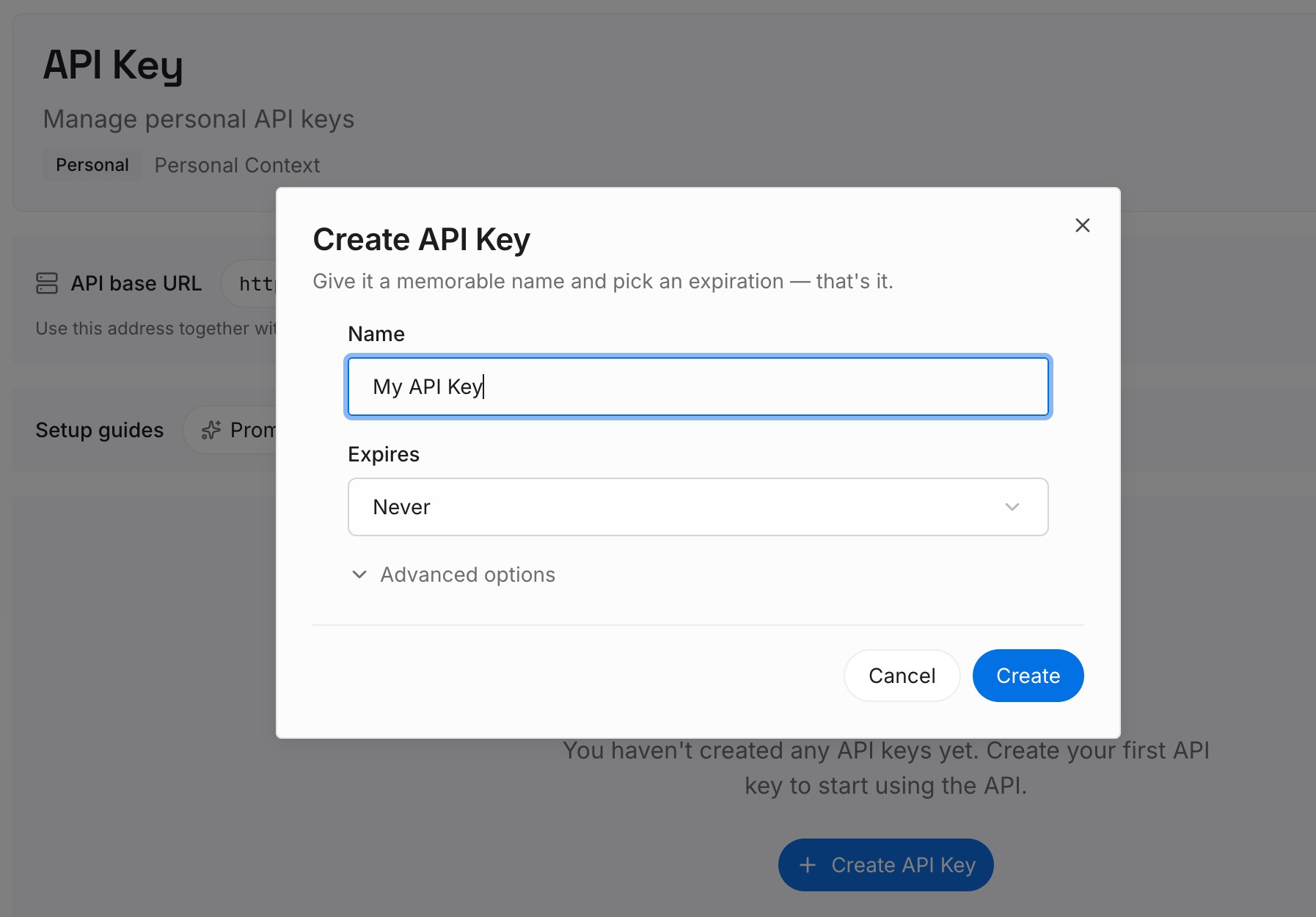
Step 1: Create an API key
Sign in to MemoryLake and create an API key. This is the credential your tools use to read and write memory, and it's deliberately model-agnostic — that's the property that makes it survive your next upgrade.
Step 2: Upload your first memories
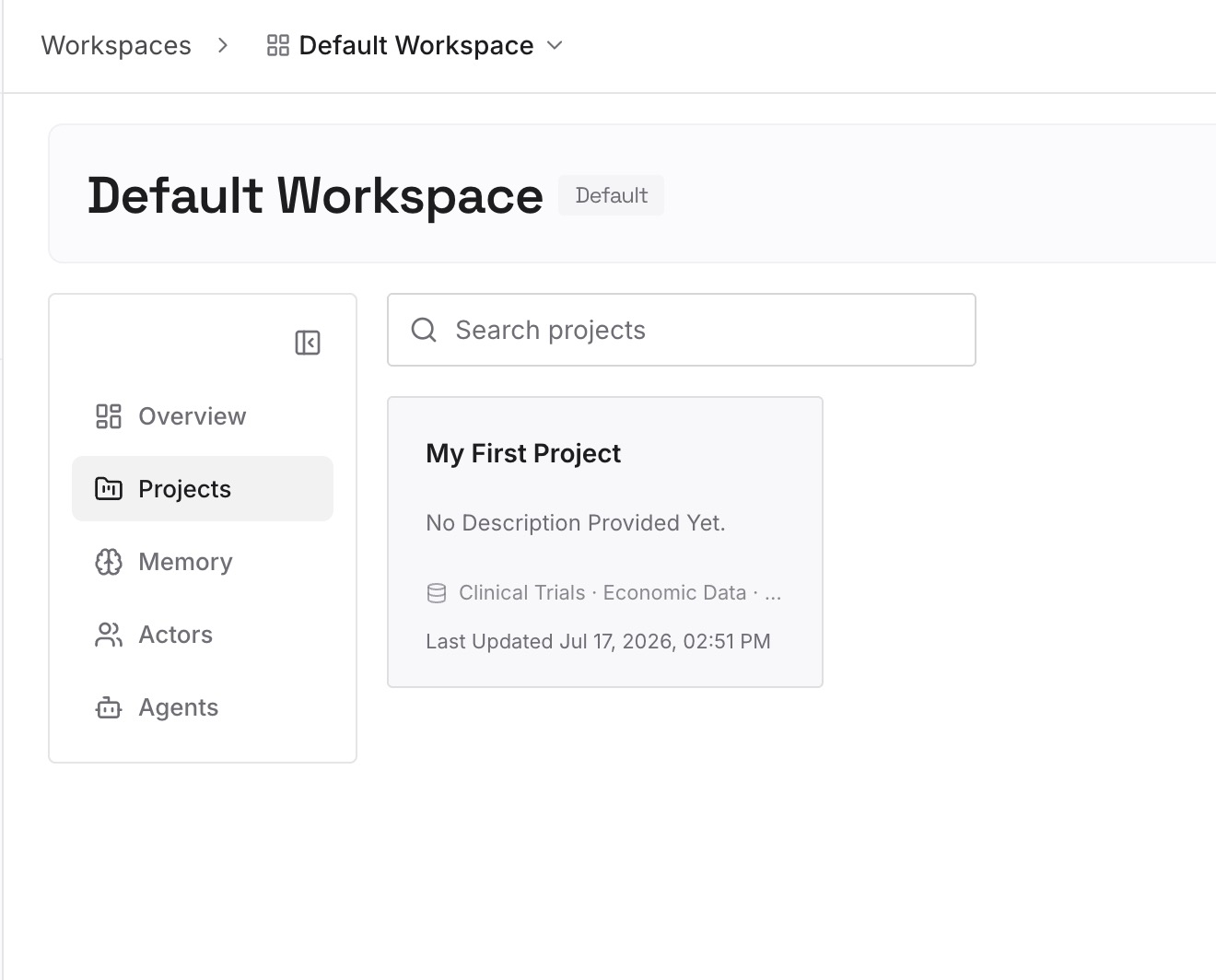
Put in the things that would otherwise be re-pasted: how your project is structured, the constraints that aren't obvious from the code, decisions and the reasoning behind them, approaches you tried and abandoned. Keep entries short and single-purpose. A good entry is one a colleague could act on without asking a follow-up question, and short entries retrieve better than long ones.
Step 3: Connect your AI & agents
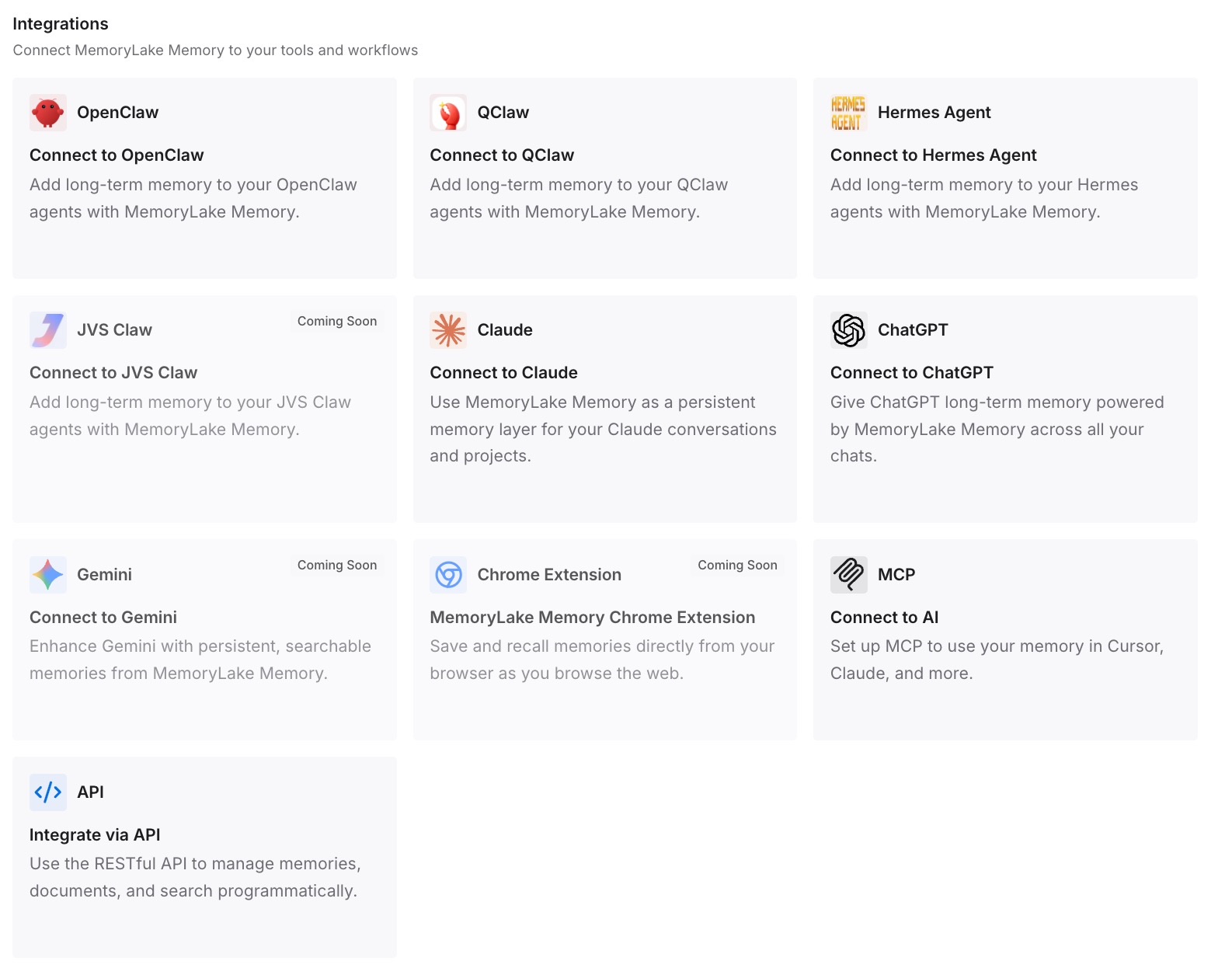
Connect the tools you use. MemoryLake is reachable over MCP and over an API, so MCP-native agents — Claude Code, Codex, and OpenClaw among them — connect by pointing at the MCP server, and anything else reads the same memory through the API. The practical result is that the window gets a small, relevant, current slice instead of a giant paste of everything you might need.
Two honest limits. A memory layer doesn't make a model smarter at long-context retrieval — that's a model property, and Qwen's work on it is real. And it only knows what you or your agents put in it; it isn't listening to your meetings or reading your mind. It removes re-explaining, not deciding.
What this changes in practice
Token spend drops without capability dropping. Re-pasting context means paying for the same thousands of tokens on every request. Retrieving a relevant slice costs a fraction of that, and the model performs better because it isn't wading through material that has nothing to do with the current task. The arithmetic is covered in how memory cuts token cost.
Model upgrades stop being migrations. When knowledge lives outside the model, switching between an open-weights model you host and a hosted frontier model is a config change. When it lives in a long-running conversation, every switch starts from zero.
Self-hosting gets easier to justify. The common objection to running your own model is that the hosted product "remembers me." Separate the layers and that advantage disappears — you can have local weights and persistent context, which is a much stronger position than either alone.
Long contexts get used for what they're good at. A big window is excellent for jobs that genuinely require a lot of material in view at once: reading a large codebase in one pass, comparing many documents, long-horizon agent runs. Those jobs get better when the window isn't half-full of pasted background.
Best practices for working with long-context models
Treat window size as a capacity spec, not a memory spec. When evaluating a model, ask two separate questions: how much can it hold at once, and what carries between sessions. The second question is almost never about the model.
Load deliberately, even when you don't have to. Just because a million tokens fit doesn't mean they help. Contradictory and stale material in the window degrades output; that's the real cost of "paste everything."
Write down conclusions, not just artifacts. Documents describe what exists. The expensive knowledge is what you decided and why you rejected the alternative — and that's the part that never makes it into a file on its own.
Check the extension settings before you rely on the headline number. Extended context via YaRN is a configuration change with real hardware costs, not a default. Confirm what you're actually serving with.
Don't let one conversation become the archive. If a thread is the only place a decision exists, the decision has a single point of failure and an expiry date.
Keep always-loaded instructions short. Whatever your durable layer, the material that loads on every request should be small and current. Long always-on files reduce adherence — a consistent recommendation across vendors, regardless of window size.
Conclusion
Qwen3.8-27B is a genuinely impressive release: open weights under Apache-2.0, native 262K context, extensible to a million, with reasoning traces preserved across the conversation. Every one of those is a real improvement, and none of them is memory.
The reason this matters isn't pedantry. It's that "wait for bigger windows" has become a reason to postpone building the durable layer, and the wait has no end — because the thing being waited for doesn't arrive from that direction. Windows get bigger. What survives the end of a request is a separate decision, and it's yours to make. If you're weighing what memory means more broadly, what persistent memory actually is is a good next read, and if you're moving to Qwen's hosted tier, switching to Qwen3.8-Max without losing context covers that route.