
The short answer
Manus has no official export to ChatGPT. You'll copy each task's prompt, attached knowledge, and notable outputs into a Custom GPT in GPT Builder — Instructions for the task pattern, Knowledge for the supporting documents, Actions for connected APIs. Plan 25–45 minutes per task pattern. A shared MCP-based memory layer like MemoryLake lets both tools read the same source.
Why people move from Manus to ChatGPT
Three drivers in 2026:
- Conversational interface preference. Many users prefer a chat surface over a task-runner UI.
- Custom GPT distribution. Sharing assistants with collaborators or customers via the GPT Store.
- Multimodal and voice. ChatGPT covers conversational and creative surfaces Manus doesn't.
What "memory" means in Manus vs ChatGPT
Different surfaces.
Manus memory lives across Tasks (defined task patterns), Knowledge (uploaded reference material per task), and the run history of past executions.
ChatGPT memory spans Custom Instructions (global), Memory (saved facts pulled across chats), and Custom GPTs (project-like containers with their own Instructions, Knowledge, and Actions).
A Manus task usually becomes a Custom GPT. Task prompts become Instructions. Task Knowledge becomes Knowledge. Connected accounts become Custom GPT Actions.
Step 1: Export your Manus memory
Manus exposes tasks and knowledge through the UI.
- List your active task patterns. Copy each task's name, description, and prompt template into a text file.
- Download attached Knowledge files. Save originals where Manus exposes them.
- Capture notable run outputs. Save reusable outputs as markdown.
- Note connected accounts and APIs. You'll rebuild each as a Custom GPT Action.
End state: one folder per Manus task with prompt.md, original Knowledge files, run output excerpts, and connections.md.
Step 2: Import into ChatGPT
ChatGPT lands the import as Custom GPTs.
- Create a Custom GPT per task pattern. Open GPT Builder → Create.
- Paste task prompt into Instructions. Adapt phrasing for an interactive chat instead of an agent run.
- Upload Knowledge files. Attach reference documents from the Manus task.
- Add prior-run summaries as Knowledge text. Paste salient excerpts so the Custom GPT can reference past work.
- Rebuild connected APIs as Actions. For each Manus connection, write an OpenAPI spec and add as a Custom GPT Action.
- Add Conversation Starters. Four prompts that mirror the task's typical kick-off.
- Validate. Open the Custom GPT and run the equivalent flow.
ChatGPT does not import Manus run history wholesale.
What you'll still lose after migrating
- Autonomous scheduled execution. ChatGPT runs on demand; scheduled autonomous loops need a separate mechanism.
- Manus-side connected account convenience. Each connection needs an OpenAPI rebuild.
- Run-history search. Past Manus run outputs become static reference text in Knowledge.
- Ongoing sync. New Manus runs next week won't update your Custom GPT unless you re-import excerpts.
The better way: one memory layer, every tool
If you keep Manus for scheduled autonomous work and ChatGPT for interactive use on the same outputs, per-tool drift starts immediately.
MemoryLake holds canonical task knowledge and rules once and exposes them through MCP. ChatGPT can read MemoryLake through a Custom GPT Action calling its REST endpoint; Manus tasks can read/write the same project via REST.
- One source of truth. Update once; both tools see the change.
- Standard file formats. PDFs, Word, Excel, PowerPoint, Markdown, and images live in MemoryLake's Document Drive as-is.
- Drop-in for the next AI. Add Claude or another agent runner with a config change.
Connect MemoryLake in 3 steps
Step 1: Create a project and load your context
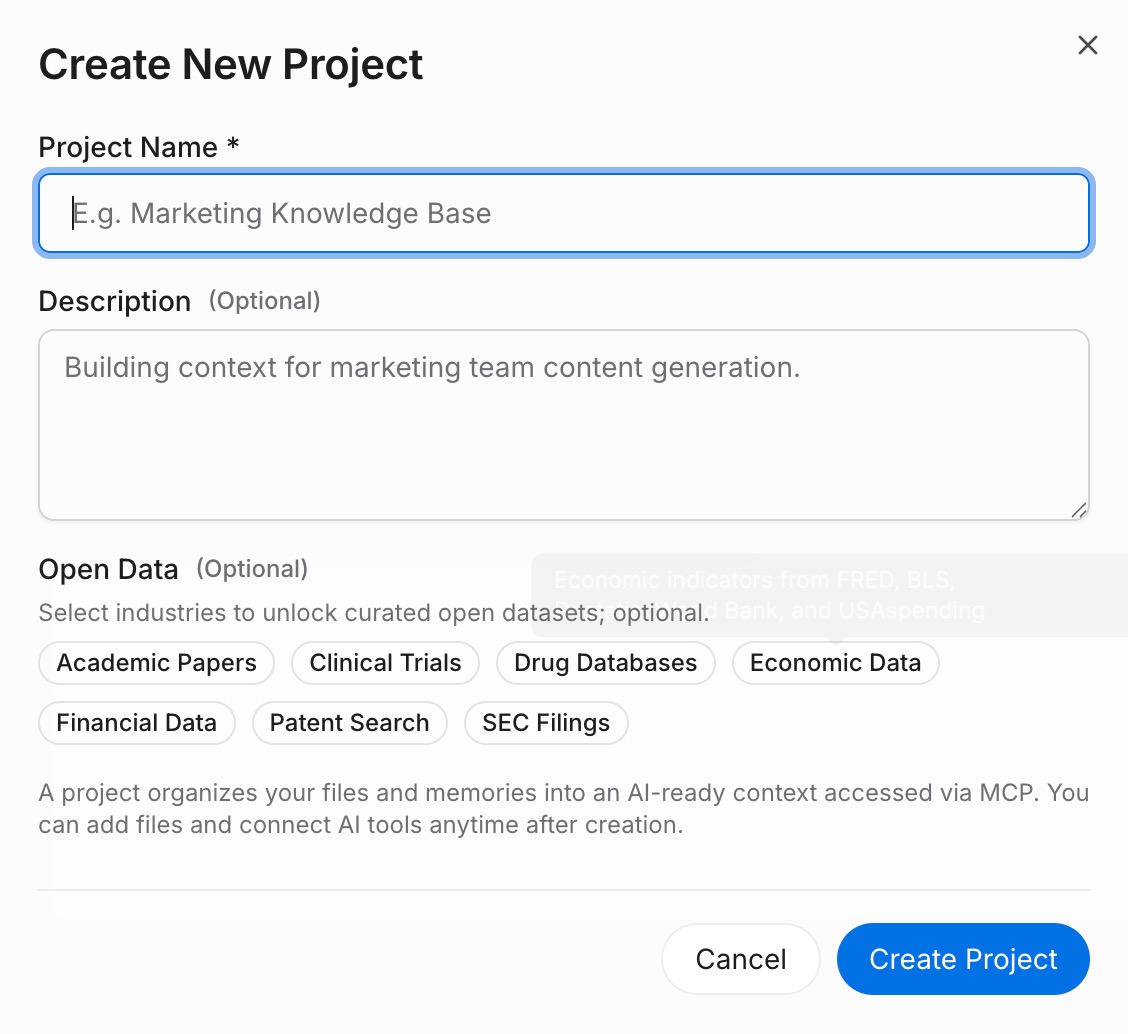
Sign in to MemoryLake, open Project Management, and click Create Project. Name it after the Manus task. Drag Knowledge files (PDF, Word, Excel, PowerPoint, Markdown, or images) into the Document Drive under My Space, then open the Documents Tab and click Add Documents. Paste task prompts and important run-output summaries into the Memories Tab via Add Memory.
Step 2: Generate an MCP Server endpoint
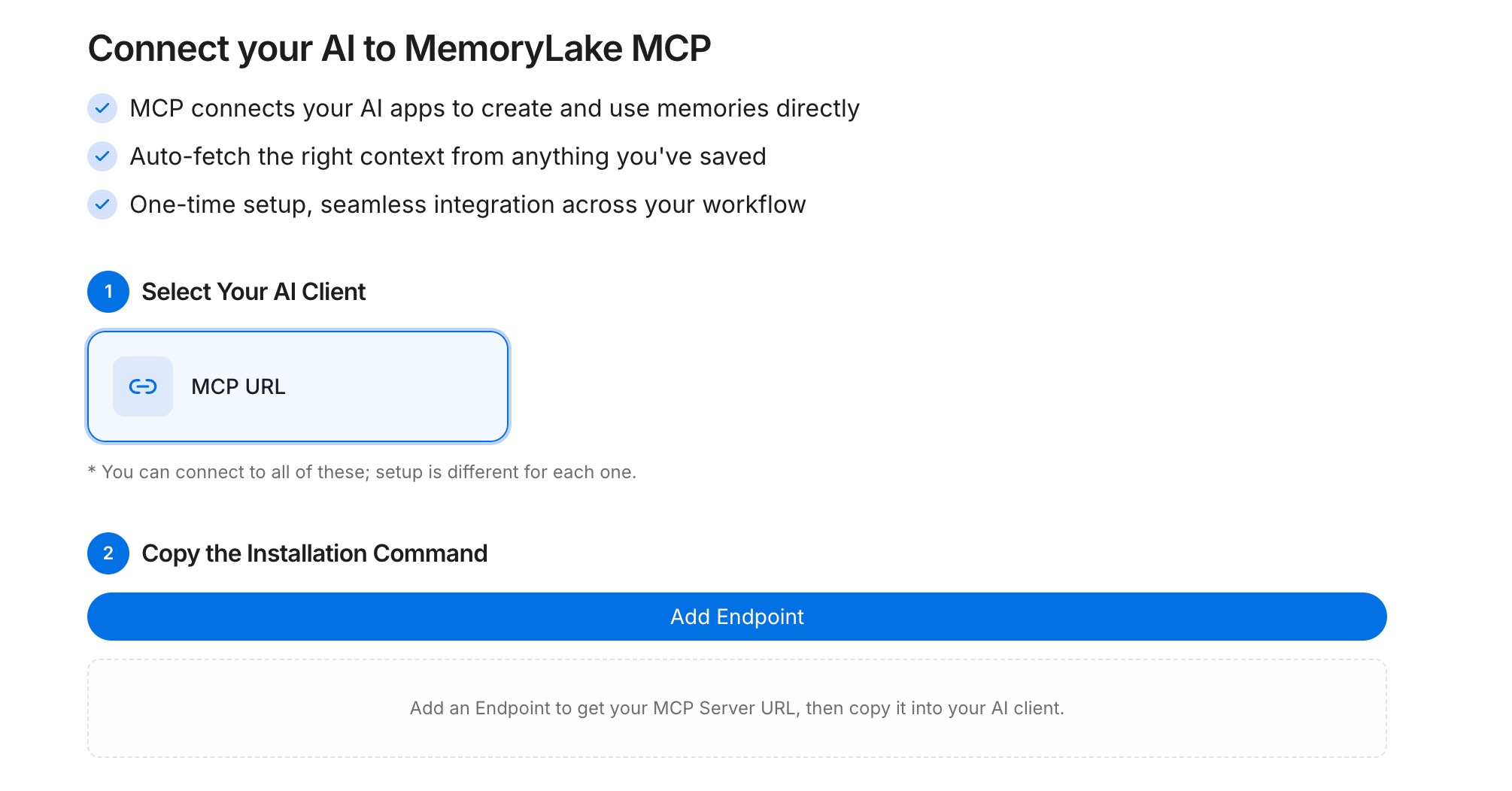
Open the MCP Servers Tab inside the project, click Add MCP Server, describe it (e.g., "Manus + ChatGPT bridge"), and click Generate. MemoryLake returns a Key ID, a Secret, and an Endpoint URL. Copy the Secret immediately — it is shown only once.
Step 3: Point both tools at the endpoint
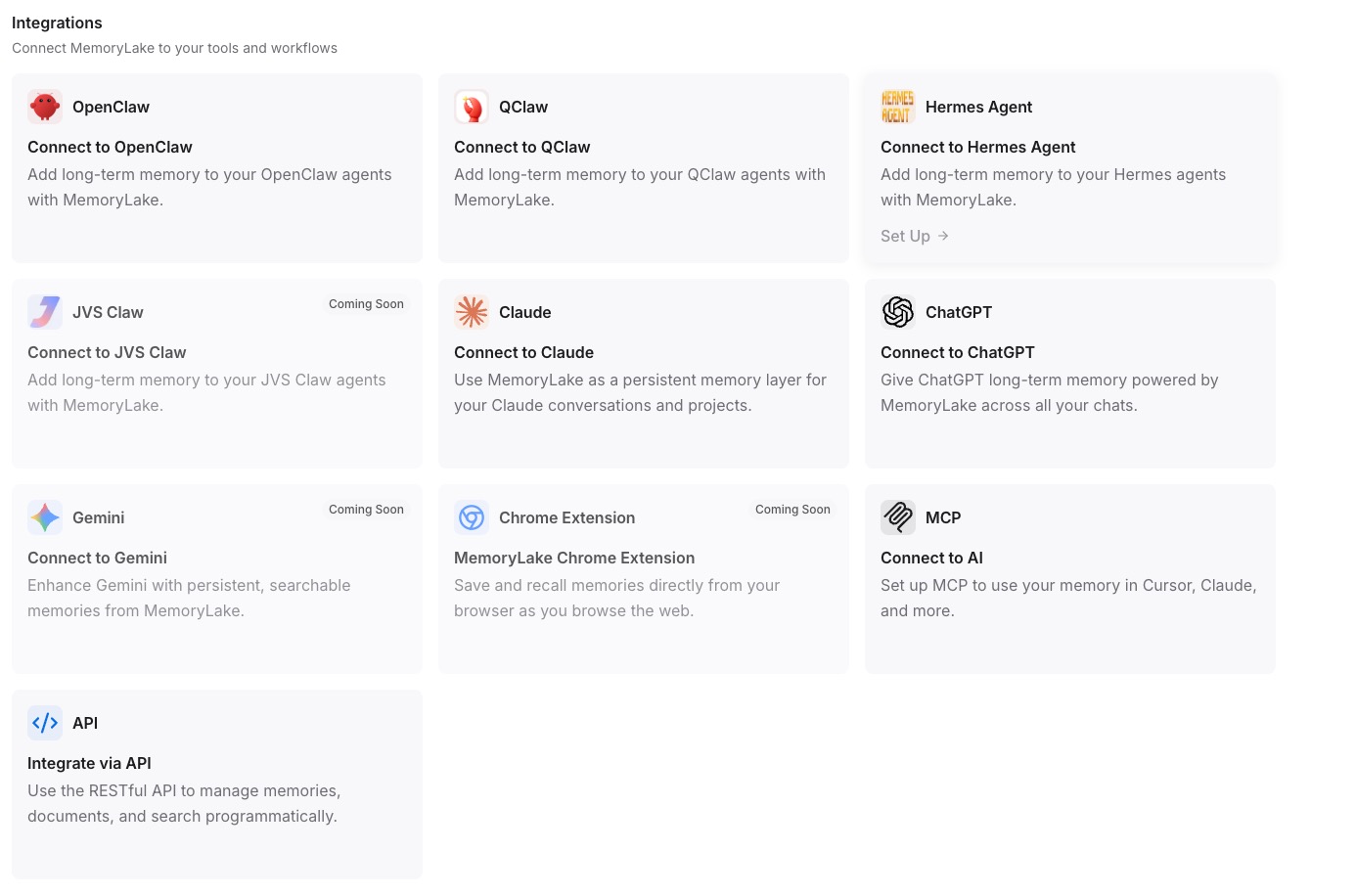
For ChatGPT, configure a Custom GPT Action that calls the REST endpoint with the Bearer token. For Manus, configure your task to call the same REST endpoint with the same Bearer token so both sides read/write canonical task context.
Native migration vs MemoryLake
| Dimension | Native Manus → ChatGPT | MemoryLake bridge |
|---|---|---|
| Steps required | 9–12 manual | 3 one-time |
| Estimated time | 25–45 min per task | ~5 min setup |
| Preserves task prompt + knowledge | Yes (manual) | Memories survive verbatim |
| Preserves connected accounts | Rebuild as Actions | Endpoint shared |
| Syncs ongoing changes | No | Yes (within MemoryLake) |
| Works with a third AI later | No (rebuild) | Yes (add MCP) |